
Font size
 Worksheets
rectilinear motion
Total questions: 51
Worksheet time: 31mins
Which of the following is a scalar quantity?
acceleration
velocity
distance
displacement
Rate of change of velocity is called-
average speed
average velocity
acceleration
none of these
When an object travels equal distance in equal intervals of time, it is said to be in-
uniform acceleration
non uniform accelration
uniform motion
non uniform motion
Speed of an object is equal to the magnitude of velocity if-
the object is travelling in uniform circular motion
the object is travelling along a straight path
the initial and final positions are same
none of these
An object moving in a circular path with uniform speed experiences a continuous change in its
direction
velocity
speed
both a and b
The numerical ratio of distance to displacement is always
more than 1
equal to one
less than or equal to 1
more than or equal to 1
The nature of s-t graph for rest -
straight line passing through origin
straight line parallel to time axis
straight line perpendicular to time axis
straight line overlapping time axis
Position time graph for zero acceleration -
straight line parallel to time axis
straight line passing through origin
curved line
zig zag line
It is concerned with the geometrically possible motion of a body or system of bodies without consideration of the forces involved.
Statics
Dynamics
Kinetics
Kinematics
It is the study of the motion in space of one or several bodies in which deformation is neglected.
Kinematics
Kinetics
Statics
Dynamics
It deals with the effects of forces upon the motions of material bodies.
Kinematics
Kinetics
Statics
Dynamics
It has a mass but negligible size and shape.
Which of the following is the magnitude of velocity?
Position
Speed
Displacement
Acceleration
An idealization of a body that does not deform or change shape.
Rigid Body
Solid Body
Deformable Body
Flexible Body
Positive acceleration of a particle means that its velocity is
Increasing
Decreasing
Constant
Zero
Negative acceleration of a particle means that its velocity is
Increasing
Decreasing
Constant
Zero
The acceleration of a free falling body is denoted by
Deceleration
Gravity
Speed
Velocity
The rectilinear motion of two mobiles are described by the laws of motion: x1 = 2t (m) and x2 =9-t (m). To determine the time after which they meet
9 s
3 s
4,5 s
2 s
The rectilinear and uniform motion of a mobile is described by the equation: x= 6- 3t. Determine the position and speed of the mobile
6 m, 3m/s
3 m, 6 m/s
6m, -3m/s
-3m, 6 m/s

The graphical representation of the law of motion of a mobile is shown in the next figure. Determine the speed of the mobile in the interval (11h-13 h)
10 km/h
20 km/h
60 km/h
50 km/h
A train covers 60 miles between 2 p.m. and 4 p.m. How fast was it going at 3 p.m.?
60 mph
30 mph
40 mph
50 mph
When speed and direction of motion of a body do not change then the body will have:
uniform velocity
uniform acceleration
variable acceleration
variable velocity
When we say a body remains in one position for a long time
motion
rest
stationary
none of the above
The unit of linear acceleration is
sm
s2 m
s2 rad
The rate of change of velocity is called ___________
distance
displacement
speed
acceleration
When speed and direction of motion of a body do not change then the body will have:
uniform velocity
uniform acceleration
variable acceleration
variable velocity
A ball thrown straight up takes 8 total seconds to complete its journey all the way up and down. 1 second into its journey and 7 seconds into its journey the magnitude of its velocity will be ______________ and its direction _______________.
opposite, the same
the same, opposite
the same, the same
opposite, opposite
If a ball thrown straight up into the air takes 4 seconds to reach the top (peak), how long will it take to travel from the peak back to the original position?
0s
1s
3s
4s
The fact that an apple and a watermelon, dropped simultaneously from the same height, would hit the ground at the same time indicates that
you don't like apples or watermelons.
greater masses have greater acceleration.
lesser masses have greater acceleration.
acceleration is independent of mass.
The initial horizontal velocity of a projectile is ____ its final horizontal velocity.
less than
equal to
greater than
Which hits the ground first if they start at the same height: a dropped ball or a ball launched with a
horizontal velocity?
the launched ball
the dropped ball
they both hit at the same time


A car accelerating constantly at 5 m s-2. If its velocity changes from 10 m s-1 to 25 m s-1, calculate the time taken to reach final velocity.
1 s
4 s
2 s
3 s
A lorry accelerating constantly at 5 m s-2. If its velocity changes from 10 m s-1 to 25 m s-1, calculate the displacement of the lorry.
125 m
33.2 m
52.5 m
41.5 m
Which equation is not related to uniform accelerated motion, with an acceleration different from zero
v=v0+at
v2 =v02 +2aΔx
Δx =21at2+ v0 t
v=tΔx
An object start from rest and then the velocity become 10 ms-1. The word rest, refer to......
v = 10 ms-1
v = 0 ms-1
a = 10 ms-1
x = 0 m

Which of the following velocity vs. time graphs corresponds to the distance vs. time graph shown?


A boy throws a ball at an angle of 30º at a speed of 20 m/s. What is vertical component of velocity and what is the horizontal component of velocity?
15 m/s , 12.5 m/s
20 m/s, 15 m/s
10 m/s , 17.32 m/s
12.5 m/s, 12.5 m/s


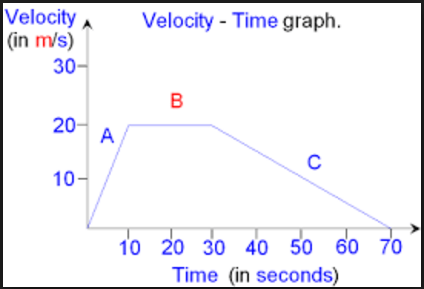
The path followed by a projectile is also known as its
trajectory
range
height
vertical displacement
Once a projectile is launched, what is the only force that affects its motion?
mass
friction
inertia
gravity
Which of the following statements about the horizontal and vertical components of projectile motion is true?
Changes in the horizontal component occur only when the vertical component changes.
Both the horizontal and vertical components are always constant.
The vertical component changes while the horizontal component stays the same.
The horizontal and vertical components are dependent of each other.

Victor Velocity is standing on top of the roof of his house, firing stones with his slingshot over a level field. He is aiming straight outward, horizontally. If Victor pulls back harder on the sling to shoot a stone, which of the following quantities will be changed?
The vertical displacement of the stone.
The distance the stone travels, and the horizontal velocity.
The time it takes the stone to strike the ground, and the horizontal velocity.

