wayground logo

Free Printable Worksheets

Font size

S
M
L
XL
Worksheets

Unit 1 Review - Systems and Spheres

Total questions: 46

Worksheet time: 12hrs 30mins

Name
Class
Date
1.
When volcanoes erupt, dust and ash particles spread through much of the air blocking the sun.  Which two spheres are interacting? 
a)
Hydrosphere and atmosphere 
b)
Geosphere and atmosphere 
c)
Biosphere and atmosphere 
d)
Atmosphere and atmosphere 
2.
When plants draw nutrients from the soil, the interaction is between which two spheres? 
a)
The atmosphere and the geosphere 
b)
The geosphere and the hydrosphere 
c)
The hydrosphere and atmosphere 
d)
The biosphere and the geosphere 
3.

What is the geosphere?

a)

all the air and gases on the planet

b)

all the frozen water on the Earth

c)

the non-living soil, rocks, and minerals of the Earth

d)

the rivers, lakes, and oceans of the Earth

4.

How do Earth systems interact with each other?

a)

Through matter and energy

b)

Through specific components

c)

Through scientific models

d)

Through nonspecific components

5.

What is the atmosphere?

a)

all the air and gases on the planet

b)

made up of living things

c)

the non-living soil, rocks, and minerals of the Earth

d)

the rivers, lakes, and oceans of the Earth

6.

which statement explains the type of system Earth is?

a)

It is a closed system because energy but not matter flows into and out of it.

b)

It is an open system because both matter and energy flow into and out of it.

c)

It is an isolated system because it is separated in space from other objects

d)

It is a shielded system because its atmospheric reflects materials and strike it .

7.

Decomposers make ammonium in the soil during the process of -

a)

nitridication.

b)

nitrogen fixation.

c)

denitrification.

d)

ammonification.

8.

Select all answers below that are stages of the nitrogen cycle.

a)

Nitrogen fixation

b)

Diffusion

c)

Ammonification

d)

Nitrification

9.

Converts nitrogen in the air to ammonium, making it biologically available to some plants (legumes)

a)

Fixation

b)

Nitrification

c)

Assimilation

d)

Ammonification

10.

Nitrogen in the soil gets back into the air

a)

Ammonification

b)

Assimilation

c)

Nitrification

d)

Dentrification

11.

Plants absorb nitrates by roots

a)

Nitrification

b)

Assimilation

c)

Ammonification

d)

Dentrification

12.

Decomposers change nitrogen into ammonium to re-enter the cycle

a)

Denitrification

b)

Ammonification

c)

Nitrification

d)

Assimilation

13.
The efficiency of energy transfer from a lower trophic level to the next highest level is roughly
a)
1%
b)
10%
c)
100%
d)
1000%
14.
In the energy pyramid here, how much of the energy in each level gets lost as heat or used by the organism for survival?
a)
80%
b)
90%
c)
10%
d)
20%
15.
An organism that uses an outside source of energy like the sun to create energy-rich food molecules.
a)
Consumer
b)
Producer
c)
Decomposer
d)
Parasite 
16.
Eat primary consumers (can be carnivores and omnivores)
a)
Tertiary Consumers
b)
Secondary Consumers
c)
Quaternary Consumers 
d)
Top Predators 
17.
If there is 1000 Kcal available in the producers in trophic level 1, how much energy is available in the herbivores in trophic level 2?
a)
10 Kcal
b)
1 Kcal
c)
100 Kcal
d)
1000 Kcal
18.

An owl eats a rat that lived in an ecosystem where there was 2,800 kcals of energy in the insect population that the rat consumed. How many kcals would transfer to the trophic level the owl is in?

a)

28

b)

280

c)

2,800

d)

28,000

19.

Name the correct trophic level for level 1.

a)

Tertiary

b)

Consumer

c)

Producer

d)

Quatemary

20.
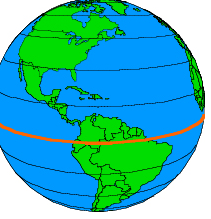
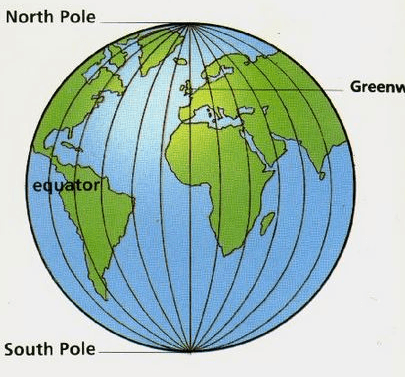
The 0 degree line of latitude is the ___________.
a)
Equator
b)
Prime Meridian
c)
International Date Line
d)
Contour line
21.
a)
The map shows lines of longitude.
b)
The map shows lines of latitude.
22.
a)
The map show the lines of longitude.
b)
The map shows the lines of latitude.
23.

The value of prime meridian is

a)

90° latitude

b)

0° longitude

c)

14° longitude

d)

80° latitude

24.

Which of the following is the correct location of a province A?

a)

A. 18 ° N and 121° E

b)

B. 16 ° N and 122° E

c)

C. 16 ° S and 121° W

d)

D. 18 ° N and 122° W

25.

Province B would be located at _____________

a)

16° N and 122° W

b)

16° S and 122° E

c)

16° N and 122° S

d)

16° N and 122° E

26.

4) What is the approximate latitude and longitude of the sunken ship?

a)

20.5° S , 70° W

b)

20.5° S. 70° E

c)

20.5° N, 70° W

d)

20.5° N, 70° E

27.

10) Which point on the diagram correctly locates 15° S and 30° W?

a)

Z

b)

Y

c)

X

d)

W

28.

Another name for a line of longitude

a)

Parallel

b)

Rhombus

c)

Meridian

d)

Tropic

29.

Lines of Latitude.

a)

Meridians

b)

Parallels

c)

Latitude

d)

Longitude

30.

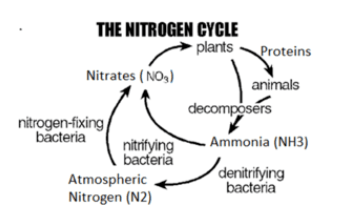
According to this diagram, plants absorb

a)

nitrates

b)

nitrogen fixing bacteria

c)

animals

d)

decomposers

31.

A correct path that nitrogen could take would be

a)

air -> animals -> plants -> bacteria

b)

animals -> air -> bacteria -> plants

c)

bacteria -> air -> plants -> animals

d)

air -> bacteria -> plants -> animals

32.

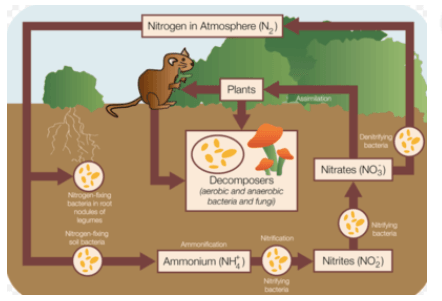
In Figure 6.3, which process converts nitrogen gas in the air into

a)

Nitrogen fixation

b)

Decomposition

c)

Respiration

d)

Denitrification

33.

According to the diagram in Figure 6.3, what organism converts atmospheric nitrogen into nitrogen compounds that will later be used by plants? What is this process called?

a)

bacteria, denitrification

b)

bacteria, fixation

c)

plants, assimilation

d)

dead log, ammonification

34.

According to the diagram in Figure 6.3, what process allows animal/plant waste to re-enter the nitrogen cycle?

a)

denitrification

b)

fixation

c)

assimilation

d)

ammonification

35.

The step of the nitrogen cycle that is in red is called...

a)

Denitrification

b)

Nitrification

c)

Nitrogen Fixation

d)

Ammonification

36.

The step of the nitrogen cycle that is in red is called...

a)

Denitrification

b)

Nitrification

c)

Assimilation

d)

Ammonification

37.
If there are 100 Kcal of energy available in the producers, how much energy would be available in the herbivores?
a)
10 Kcal
b)
1 Kcal
c)
100 Kcal
d)
1000 Kcal
38.
The diagram represents a pyramid of energy in an ecosystem.  Which level would most likely contain organisms that do photosynthesis?
a)
A
b)
B
c)
C
d)
D
39.
True or False. In this energy pyramid, the consumers on each level only get about 10 percent of energy that the trophic level before it has stored.
a)
True
b)
False
40.
What makes an energy pyramid different than a food web or chain?
a)
It shows energy flowing from the top of the chain and downward. 
b)
The tropic levels are the opposite
c)
It shows the amount of energy in each trophic level
d)
It shows specific predator/prey relationships
41.
Why are producers found at the base of the pyramid?
a)
They create all of the energy and therefore have the most energy of all of the trophic levels
b)
There are more plants than animals. 
c)
They begin the flow of energy in an ecosystem.
d)
All of these answers are correct. 
42.
The diagram represents a model of a food pyramid.  Which statement best describes what happens in this food pyramid?
a)
More organisms die at higher levels than at lower levels, resulting in less mass at higher levels.
b)
Energy is lost to the environment at each level, so less mass can be supported at each higher level.
c)
When organisms die at higher levels, their remains sink to lower levels, increasing the mass of lower levels.
d)
Organisms decay at each level, and thus less mass can be supported at higher levels
43.

A hawk eats a mouse that lived in an ecosystem where there is 10,000 kcals of energy in the insect population the mouse consumes. How much energy, in kcals, moves up to the trophic level the hawk is in?

a)

1 kcals

b)

10 kcals

c)

100 kcals

d)

1000 kcals

44.
Eat primary consumers (can be carnivores and omnivores)
a)
Tertiary Consumers
b)
Secondary Consumers
c)
Quaternary Consumers 
d)
Top Predators 
45.

Fungi and bacteria would play which of these roles in a food web?

a)

producer

b)

heterotroph

c)

autotroph

d)

decomposer

46.
In the food web shown, the snail would be considered...
a)
primary consumer
b)
secondary consumer
c)
tertiary consumer
d)
producer