
 Worksheets
Thermochemistry
Total questions: 34
Worksheet time: 46mins
This measures the average kinetic energy of molecules
temperature
heat
Kevin
Carbon dioxice
Device used to measure temperature
thermometer
electronic balance
pH meter
graduated cylinder

Observe the diagram. Which statement is true about the kinetic energy of the molecules in the containers?
The molecules are moving faster in Diagram A
The molecules are moving slower in Diagram A
The molecules are moving at the same rate in both diagrams

Heat loss causes matter to ________. Heat gain causes matter to ________.
contract ; expand
expand ; contract
stay ; change
change ; stay
Radiation

Curling Iron
Conduction
Convection
Radiation

Sun Bathing
Conduction
Convection
Radiation
Which of the following is an example of an endothermic process or reaction?
condensing
freezing
combustion
melting
Which of the following is an example of an exothermic process or reaction?
melting
boiling
photosynthesis
freezing

What type of system is this/
open
closed
isolated

What type of system is this
open
closed
isolated

what type of system is this
open
closed
isolated
the exchange of mass and energy is what type of system?
open
closed
isolated
The exchange of energy but not mass is what type of system
open
closed
isolated
What is the phase change of a solid to a liquid?
freezing
melting
boiling
condensation
What is it called when a solid turns directly into a gas?
All phase changes (changing states) requires energy to be added or taken away.
Change from Liquid to Solid is called ...
fusion
Freezing
sublimation
evaporation
Change from liquid to gas is called....
expansion
evaporation
condensation
sublimation

What happens along the AC line?
Melting/Freezing
Boiling/Condensing
Boiling/melting
freezing/condensing
What is the normal boiling point?
0 οC
< 0 οC
100 οC
> 100 οC
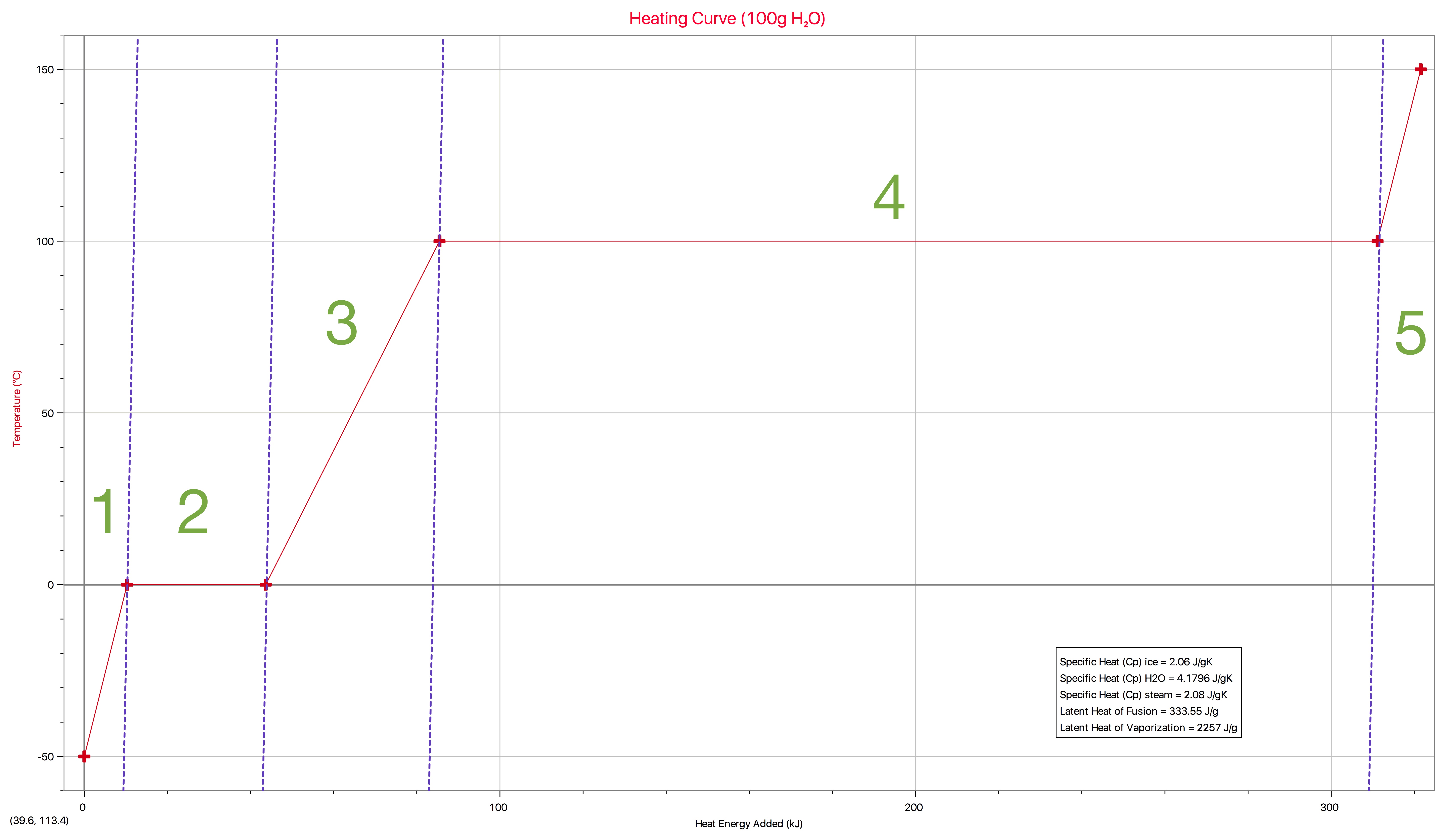

Describe the substance at letter A.
Solid
Liquid
Melting
Evaporating
- 105 J
- 10.5 J
- 1.05 J
- 50 J
How much energy is required to completely boil away 150g water?
If a 8.50g ice cube at -10.0o C sits out on the counter, completely melts, and then warms to room temperature (25.0 o C) how much energy did the ice cube absorb?
177 J
1070 J
888 J
3905 J
Which of the following best explains why the sand at the beach is hotter than the water?
Sand has a higher specific heat than water.
Sand has a lower specific heat than water.
There is more water than sand at the beach.
There is more sand than water at the beach.

