wayground logo

Free Printable Worksheets

Font size

S
M
L
XL
Worksheets

Atomic Structure Study Guide

Total questions: 100

Worksheet time: 1hrs 2mins

Name
Class
Date
1.
Sodium has an atomic number of 11, how many protons does this atom have?
a)
22
b)
11
c)
12
d)
2
2.
Where is the proton located?
a)
In the very dense nucleus
b)
Floating around in the negative electron cloud
c)
the loose nucleus
d)
the positive electron cloud
3.
Which description about the proton is accurate?
a)
Positively charged particle with a mass less than 0 amu
b)
A neutrally charged particle with a mass less than 0 amu
c)
Positively charged particle with a mass of 1 amu
d)
A neutrally charge particle with a mass of 1 amu
4.

How many protons are in Sodium?

a)

11

b)

22

c)

12

d)

33

5.

How many neutrons are in Magnesium?

a)

36

b)

12

c)

24

d)

6

6.

How many electrons are in Aluminium?

a)

40

b)

27

c)

13

d)

14

7.

How many protons are in Silicon?

a)

7

b)

42

c)

28

d)

14

8.

How many neutrons are in Phosphorus?

a)

16

b)

15

c)

31

d)

46

9.

How many electrons are in Sulfur?

a)

32

b)

16

c)

48

d)

8

10.

How many protons are in Chlorine?

a)

35

b)

18

c)

17

d)

52

11.

How many neutrons are in Argon?

a)

18

b)

40

c)

58

d)

22

12.

How many electrons are in Potassium?

a)

19

b)

20

c)

58

d)

39

13.

How many protons, neutrons, and electrons are in Oxygen?

a)

Protons = 8; Neutrons = 16; Electrons = 8

b)

Protons = 8; Neutrons = 8; Electrons = 8

c)

Protons = 16; Neutrons = 8; Electrons = 16

d)

Protons = 16; Neutrons = 24; Electrons = 16

14.

A neutron has what charge?

a)

Positive

b)

Negative

c)

It has no charge (it is neutral)

15.

An electron has what charge?

a)

Positive

b)

Negative

c)

It has no charge (it is neutral)

16.
Which subatomic particle has a positive (+) charge?
a)
Neutron
b)
Proton
c)
Electron
17.
True or False - Protons and Neutrons have about the same mass.
a)
True - They have about the same mass
b)
False - They do not have about the same mass
18.
Which subatomic particle has a negative (-) charge?
a)
Proton
b)
Electron
c)
Neutron
19.
Which subatomic particle has a neutral or no charge?
a)
Proton
b)
Electron
c)
Neutron
20.
Which two subatomic particles make up the nucleus of an atom?
a)
Protons and Electrons
b)
Neutrons and Electrons
c)
Electrons and Protons
d)
Protons and Neutrons
21.
Where are the Electrons found in the structure of an atom?
a)
In the nucleus
b)
In spaces around the nucleus
22.
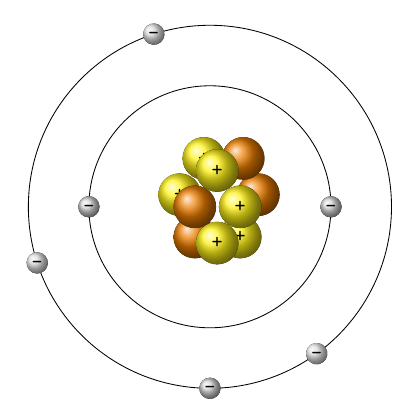
How many electron shells/levels does this atom have?
a)
1
b)
2
c)
3
d)
4
23.
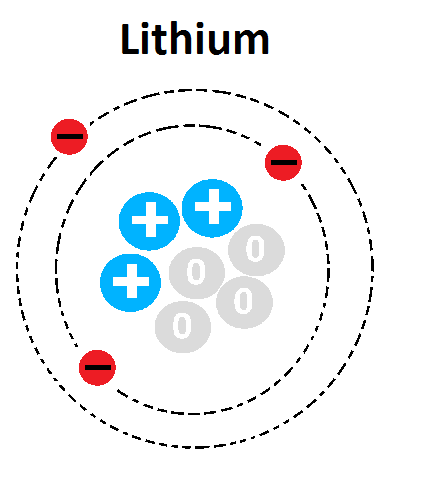
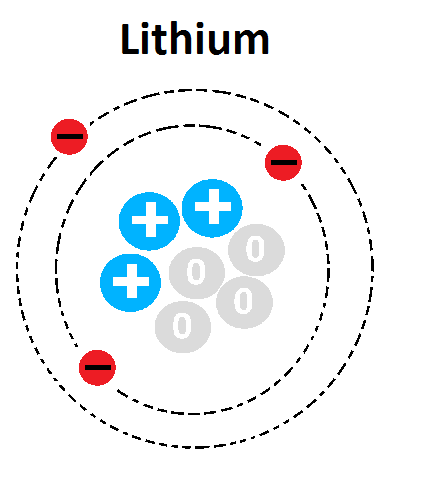
How many protons does this atom have?
a)
3
b)
6
c)
4
d)
2
24.

The name of this particle means indivisible and it is the building block of matter

a)

molecule

b)

compound

c)

atom

d)

isotope

25.

At what part of the atom is the arrow pointing?

a)

nucleus

b)

energy level

c)

electron

d)

proton

26.

The mass of an atom is

a)

equal to the number of protons

b)

the protons + electrons

c)

the protons + neutrons

d)

the protons + neutrons + electrons

27.

In a neutral atom,

a)

protons = electrons

b)

protons = neutrons

c)

neutrons = electrons

d)

protons = neutrons = electrons

28.
Value representing the number of protons in an element
a)
Atomic Mass
b)
Mass Number
c)
Valence Electrons
d)
Atomic Number
29.
All ____________ are made up of two or more atoms bonded together.
a)
atoms
b)
molecules
c)
electrons
d)
elements
30.
What is the mass number?
a)
the number of protons
b)
the number of protons and neutrons
c)
the number of neutrons
d)
the number of protons and electrons
31.
What is the atomic number of this atom?
a)
1
b)
3
c)
4
d)
7
32.

What is the atomic mass of this atom?

a)

1

b)

3

c)

4

d)

7

33.
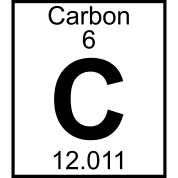
What does the C represent?
a)
atomic mass
b)
atomic number
c)
element name
d)
chemical symbol 
34.
what does the 6 represent?
a)
Atomic mass
b)
atomic number
c)
chemical symbol
d)
element name
35.
How is the number of neutrons in the nucleus of an atom calculated?
a)
Add the number of e- and p+ together
b)
Subtract the number of e- from p+
c)
Subtract the number of p+ from the mass number
d)
Add the mass number to the number of e-
36.

What is an ion?

a)

Ions have more protons.

b)

Ions have more neutrons.

c)

Ions have more electrons.

d)

Ions can have more or less electrons.

37.

Which of these is an ion?

a)

H2OH_2O  

b)

CO2CO_2  

c)

Li +2Li^{\ +2}  

d)

4(C6H12O6)4\left(C_6H_{12}O_6\right)  

38.

If potassium (K) looses an electron what is its chemical symbol?

a)

K K^{\ -}  

b)

K+K^+  

c)

K2K^{2-}  

d)

K2+K^{2+}  

39.

How many protons does carbon have?

a)

12

b)

9

c)

6

d)

3

40.

How many protons does Na2Na^{2-}  have?

a)

9

b)

10

c)

11

d)

12

41.

How many electrons does Fe2Fe^{2-}  have?

a)

24

b)

26

c)

28

d)

None of the above.

42.

How many electrons does O3O^{3-}  have?

a)

10

b)

11

c)

12

d)

13

43.

How many electrons does O3+O^{3+}  have?

a)

6

b)

5

c)

11

d)

10

44.

How many electrons does a neutral oxygen have?

a)

6

b)

7

c)

8

d)

9

45.

Which of these are nitrogen ions?

a)

NN^-  

b)

N2N^{2-}  

c)

N2+N^{2+}  

d)

C+C^+  

46.

Na2+Na^{2+}   is a .....

a)

conductor.

b)

cation.

c)

insulator.

d)

anion.

47.

How many electrons does H+H^+   have?

a)

0

b)

1

c)

3

d)

4

48.

What is the chemical symbol for an element with 21 protons and 19 electrons?

a)

K2+K^{2+}  

b)

KK  

c)

  Sc2+Sc^{2+}  

d)

Sc2Sc^{2-}  

49.

What is the chemical symbol for an element with 37 protons and 36 electrons?

a)

KrKr^-  

b)

KrKr  

c)

Rb+Rb^+  

d)

RbRb^-  

50.

What charge does an atom have when it GAINS electrons?

a)

Positive

b)

Negative

c)

Neutral

51.

What is a representation of an ion?

a)

Li

b)

Na-22

c)

O-2

52.

What is the mass number of bromine?

a)

35

b)

45

c)

80

d)

79.904

53.

How many neutrons does this bromine atom have?

a)

35

b)

45

c)

80

54.

What type of atom is this?

a)

Neutral atom

b)

Cation

c)

Anion

d)

Isotope

55.

What two particles determine the mass number?

a)

Protons and electrons

b)

Electrons and neutrons

c)

Protons and neutrons

56.

What type of atom is this?

a)

Normal Atom

b)

Cation

c)

Anion

d)

Isotope

57.

What is the mass number of this Neon atom?

a)

10

b)

11

c)

21

d)

20

58.

What does it change in an ion?

a)

The number of electrons

b)

The number of protons

c)

The number of neutrons

59.

How many neutrons does this Neon atom have?

a)

21

b)

11

c)

10

d)

12

60.

What does it happen to this atom?

a)

It LOSES electrons

b)

It GAINS electrons

c)

It GAINS protons

d)

It LOSES protons

61.

What is the atomic number of this element?

a)

12

b)

24

c)

23

62.

What type of atom is element C?

a)

Normal atom

b)

Ion

c)

Isotope

63.

What is the mass number of this element?

a)

12

b)

24

c)

23

d)

11

64.
Two atoms of different elements will definitely have different numbers_____
a)
Nuclei
b)
Protons
c)
Neutrons
d)
Electrons
65.
An ion forms when an atom gains or loses
a)
Protons
b)
Neutrons
c)
Electrons
66.
A neutral atom would become an ion that has a charge of 2+ by 
a)
Losing two protons
b)
Losing two neutrons
c)
Losing two electrons
67.
Isotopes are atoms that have different
a)
Mass numbers
b)
Element names
c)
Atomic Numbers
68.
A positively charged ion is formed when
a)
A neutron is lost
b)
An electron is lost
c)
A neutron is gained
d)
An electron is gained
69.
Two atoms that have different numbers of protons are 
a)
Different ions
b)
Different isotopes
c)
Different elements
70.
An ion that has a negative charge is formed when an atom 
a)
Loses neutrons
b)
Loses electrons
c)
Gains neutrons
d)
Gains electrons
71.
What information would allow you to determine whether two atoms are of the same or different elements
a)
The charge on each atom
b)
The number of neutrons each has
c)
The number of protons in their nuclei
d)
The location of the electrons in their electron clouds
72.
Is the element shown in this image an ion, isotope or normal atom?
a)
atom
b)
isotope
c)
cation (+ ion)
d)
anion (- ion)
73.
The atomic mass is equal to _.
a)
the number of protons only
b)
the number of neutrons only
c)
the total number of protons and neutrons
d)
the number of protons, neutrons, and electrons.
74.

Alpha particles contain ____________.

a)

two protons and two electrons

b)

two electrons and two neutrons

c)

four electrons

d)

two protons and two neutrons

75.

Radioactivity can be harmful and cause disease because it affects __________.

a)

air

b)

water

c)

cells

d)

blood

76.

Gamma rays _________.

a)

have no mass and no charge

b)

have mass but no charge

c)

have no mass but have charge

d)

have both mass and charge

77.

During nuclear fission, a nucleus _________.

a)

grows

b)

divides

c)

shrinks

d)

combines with another

78.

What is the term for an ongoing series of nuclear reactions?

a)

fission

b)

chain reaction

c)

fusion

d)

nuclear

79.

When a neutron turns into a proton in a nucleus, what sort of particle is emitted?

a)

Alpha

b)

Beta

c)

Gamma

d)

Photon

80.

What are found in the nucleus of an atom?

a)

protons and electrons

b)

electrons and neutrons

c)

protons, neutrons, and electrons

d)

protons and neutrons

81.

The image represents a/an _________.

a)

Alpha Particles

b)

Beta Particles

c)

Gamma Rays

d)

Photons

82.

The image represents a/an _________.

a)

Alpha Particle

b)

Beta Particle

c)

Gamma Ray

d)

Photon

83.

The image represents a/an ________.

a)

Alpha Particles

b)

Beta Particles

c)

Gamma Ray

d)

Photons

84.

An Alpha particle has a ______ charge.

a)

None

b)

+2

c)

-1

85.

Gamma Rays have ______ charge.

a)

None

b)

+2

c)

+1

86.

________ occurs when a neutron strikes a nucleus.

a)

Nuclear

Fission

b)

Nuclear

Fusion

87.

__________ occurs when two nuclei combine to form another nucleus.

a)

Nuclear Fission

b)

Nuclear Fusion

88.
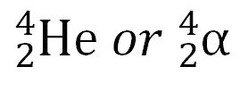
What do these symbols represent?
a)
alpha particle
b)
beta particle
c)
neutron
d)
gamma ray
89.
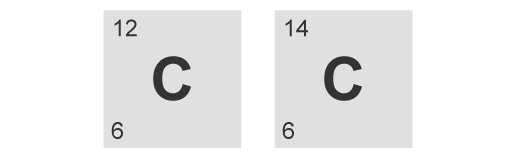
How are these isotopes different?
a)
Different atomic numbers
b)
Different number of protons
c)
Different number of neutrons
d)
Different number of electrons
90.
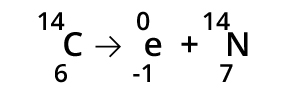
What type of nuclear equation is this?
a)
fusion
b)
fission
c)
alpha
d)
beta
91.
What happens to the atomic number during alpha decay?
a)
The atomic number decreases by 4
b)
The atomic number increases by 1
c)
The atomic number decreases by 2.
d)
The atomic number stays the same.
92.
Balance the following equation:
146C --> 0-1e + ________
a)
145B
b)
146C
c)
147N
d)
42He
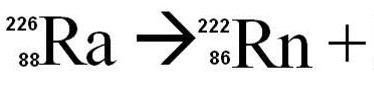
93.
Complete the nuclear equation and determine the type of decay that is occurring in this reaction. 
a)
alpha
b)
beta
c)
gamma
d)
none
94.
What is the missing isotope that will balance the following nuclear equation?
94Be  +  11H →  _____  +  42He
a)
105B
b)
105Ne
c)
63Li
d)
63C
95.
If Thorium-234 undergoes a beta decay, What element will be left in its place?
a)
Actinium-234
b)
Thorium-233
c)
Protactinium-234
d)
Radium-230
96.

How many valence electrons are shown in this Bohr diagram?

a)

2

b)

3

c)

5

d)

8

97.

This Bohr diagram has only one orbit (shell) with electrons in it. It must come from which row of the Periodic Table?

a)

1

b)

2

c)

3

d)

4

98.

This Bohr diagram shows 3 orbits (shells) with electrons. Which row of the Periodic Table?

a)

1

b)

2

c)

3

d)

4

99.

Recall that valence electrons are the electrons on the orbit (shell) farthest from the nucleus. How many valence electrons?

a)

2

b)

4

c)

6

d)

8

100.
What element is represented in this Bohr Model? 
a)
Carbon
b)
Hydrogen
c)
Aluminum
d)
Lithium