wayground logo

Free Printable Worksheets

Font size

S
M
L
XL
Worksheets

geometry

Total questions: 124

Worksheet time: 3hrs 39mins

Name
Class
Date
1.
The Triangle Sum Theorem states that the sum of all angles in a triangle is ______. 
a)
45°
b)
90°
c)
180°
d)
360°
2.
What is the third angle of a triangle whose 1st angle is 34 and 2nd angle is 101?
a)
32
b)
39
c)
45
d)
54
3.
What is the measure of angle b?
a)
36o
b)
56o
c)
63o
d)
117o
4.

Find the measure of the indicated angle.

a)

75o

b)

225o

c)

90o

d)

45o

5.

Find the measure of the missing angle

a)

235 degrees

b)

60 degrees

c)

55 degress

d)

75 degress

6.

Find the missing angle measure.

a)

0 degrees

b)

270 degrees

c)

110 degrees

d)

90 degrees

7.

Find <S

a)

A

b)

B

c)

C

d)

D

8.
What is the measure of angle b?
a)
36o
b)
56o
c)
63o
d)
117o
9.

Find the measure of the indicated angle. ONLY GIVE THE NUMBER IN YOUR ANSWER. EX: 25

(a)  

10.

If two angles in a triangle are 45°45\degree  and  75°\ 75\degree , what is the measure of the third angle? ONLY GIVE THE NUMBER IN YOUR ANSWER. EX: 25

(a)  

11.
Which of the following terms best describes Angle d?
a)
Remote interior angle
b)
Corresponding angle
c)
Exterior angle
d)
Interior angle
12.

To justify that a function is continuous you must show... 

a)

f(c) is defined

b)

limxc\lim_{x\rightarrow c}  exists

c)

f(c) = limxcf(x)f\left(c\right)\ =\ \lim_{x\rightarrow c}f\left(x\right)  

d)

All of these

13.

What must you do to show that a limit exists?

a)

Show that f(c)f\left(c\right)  exists

b)

show that limxy f(x) = limxy+f(x)\lim_{x\rightarrow y-\ }f\left(x\right)\ =\ \lim_{x\rightarrow y+}f\left(x\right)  

c)

show that limxcf(x) = f(c)\lim_{x\rightarrow c}f\left(x\right)\ =\ f\left(c\right)  

d)

All of these

14.

When does a curve have a horizontal tangent line?

a)

When x = 0

b)

When y = 0

c)

When dydx=0\frac{\text{d}y}{\text{d}x}=0  

d)

When dydxis undefined\frac{\text{d}y}{\text{d}x}is\ undefined  

15.

When does a curve have a vertical tangent line

a)

When x = 0

b)

When y = 0

c)

When dydx=0\frac{\text{d}y}{\text{d}x}=0  

d)

When dydxis undefined\frac{\text{d}y}{\text{d}x}is\ undefined  

16.

What is the justification for absolute extrema?

a)

Candidates Test

b)

First Derivative Test

c)

Second Derivative Test

d)

Intermediate Value Theorem

17.

What is the justification for a function to be decreasing?

a)

Function is increasing

b)

First Derivative is Positive

c)

First Derivative is Negative

d)

Second Derivative is Positive

18.

Given the graph of the derivative of a function, how can you tell if the function is concave up.

a)

The graph is positive

b)

The graph changes from positive to negative

c)

The graph changes from negative to positive

d)

The graph is increasing

19.

What must be true for an x-value to be a critical number?

a)

A) The x-value is in the domain of the function

b)

B) The derivative at the x-value is 0 or undefined

c)

C) The derivative at the x-value is equal to the average value

d)

D) Both A and B

20.

What is the justification for a function having a local minimum?

a)

The derivative changes from positive to negative

b)

The derivative changes from negative to positive

c)

The derivative changes from increasing to decreasing

d)

The derivative changes from decreasing to increasing?

21.

For a point to be a local maximum according to the second derivative, f'(x)=0 and what else?

a)

The second derivative is negative

b)

The second derivative is positive

c)

The function crosses the x-axis

d)

The function crosses the y-axis

22.

If the second derivative of a function at an x-value is 0, then we call that a point of inflection

a)

True

b)

False

23.

A tangent line approximation is an overestimate if the original function is

a)

Increasing

b)

Decreasing

c)

Concave Up

d)

Concave Down

24.

A Left Riemann Sum is an overestimate if the function is

a)

Increasing

b)

Decreasing

c)

Concave Up

d)

Concave Down

25.

A Right Riemann Sum is an overestimate if the function is

a)

Increasing

b)

Decreasing

c)

Concave Up

d)

Concave Down

26.

A Trapezoidal Approximation is an overestimate if the function is

a)

Increasing

b)

Decreasing

c)

Concave Up

d)

Concave Down

27.
a)

ACUTE

b)

RIGHT

c)

OBTUSE

d)

STRAIGHT

28.

What is the vertex?

a)

(2,3)

b)

(3,2)

c)

(3,0)

d)

(0,2)

29.

What is the axis of symmetry?

a)

x = 2

b)

x = 6

c)

x = 3

d)

x = 0

30.

Maximum or Minimum?

a)

Max = 3

b)

Max = 2

c)

Min = 3

d)

Min = 2

31.

What is the Vertex?

a)

( 0, 3)

b)

( 3, 0)

c)

( 0, 0)

d)

( 0, -3)

32.

Axis of Symmetry

a)

x = 0

b)

x = -3

c)

x = 3

d)

x = -9

33.

Maximum or Minimum?

a)

Max = 0

b)

Min = 0

c)

Min = 3

d)

Max = 3

34.

What is the Vertex?

a)

(1, -5)

b)

(-5, 1)

c)

(5, 1)

d)

(1 , 5)

35.

Axis of Symmetry?

a)

x = 5

b)

x = -5

c)

x = -1

d)

x = 1

36.

Maximum or Minimum?

a)

Max = 5

b)

Max = -5

c)

Min = -5

d)

Min = 5

37.

What is the Vertex?

y=(x4)21y=-\left(x-4\right)^2-1  

a)

( -4, -1)

b)

( 1, -4)

c)

( -1, -4)

d)

( 4, -1)

38.

Axis of Symmetry?

y=(x4)21y=-\left(x-4\right)^2-1  

a)

x = -1

b)

x = 1

c)

x = -4

d)

x = 4

39.

Maximum or Minimum?

y=(x4)21y=-\left(x-4\right)^2-1  

a)

Max = -4

b)

Max = -1

c)

Min = -1

d)

Min = 4

40.

What is the vertex?

y=2(x3)2+6y=2\left(x-3\right)^2+6  

a)

(2, 6)

b)

(3, 6)

c)

(2, -3)

d)

(-3, 6)

41.

Axis of Symmetry?

y=2(x3)2+6y=2\left(x-3\right)^2+6  

a)

x = 3

b)

x = -3

c)

x = 6

d)

x = -6

42.

Maximum or Minimum?

y=2(x3)2+6y=2\left(x-3\right)^2+6  

a)

Max = -3

b)

Min = 3

c)

Min = 6

d)

Max = 6

43.
1. Find X 
a)
28
b)
5
c)
55
d)
40
44.
2. Find X
a)
9
b)
27
c)
45
45.
2. FIND ∠SOR
a)
45
b)
135
c)
90
d)
180
46.
3. Find X
a)
59
b)
31
c)
177
47.
3. Find ∠NOQ
a)
31
b)
59
c)
180
d)
149
48.
4. Find X
a)
1
b)
30
c)
53
d)
10
49.
If m∠1 = 30°, then m∠3 = 
a)
30°
b)
60°
c)
150°
d)
undetermined
50.
Which are pairs of vertical angles?
a)
∠COB & ∠COA
b)
∠AOD & ∠AOC
c)
∠COB & ∠AOD
d)
∠BOD & ∠AOD
51.
What are vertical angles?
a)
Angles that are adjacent to each other
b)
Angles that add up to 180°
c)
Angles that are opposite of each other when lines intersect
d)
Angles that add up to 90°
52.
Vertical angles are always
a)
acute
b)
total 180 degrees
c)
congruent (equal measures)
d)
adjacent angles
53.
What is the value of x?
a)
37
b)
72
c)
108
d)
18
54.

What is a linear pair?

a)

two angles that are non-adjacent and whose non-common sides form a straight line.

b)

two angles that are adjacent and whose non-common sides form a straight line.

c)

two angles that are non-adjacent and whose common sides form a straight line.

d)

two angles that are adjacent and whose non-common sides form a straight line.

55.

Which of the following is a linear pair?

a)
b)
c)
d)
56.

Identify the linear pair in the given figure.

a)

2 and 5\angle2\ and\ \angle5  

b)

1 and 2\angle1\ and\ \angle2  

c)

1 and 4\angle1\ and\ \angle4  

d)

2 and 3\angle2\ and\ \angle3  

57.

All of the following are linear pairs, EXCEPT

a)
b)
c)
d)
58.

What is the measure of  BOC\angle BOC  

a)

122

b)

142

c)

132

d)

128

59.

Identify the value of a in the given figure.

a)

133°133\degree

b)

143°143\degree

c)

147°147\degree

d)

137°137\degree

60.

Find the value of x.

a)

88

b)

78

c)

84

d)

74

61.

Find the value of x.

a)

24

b)

34

c)

44

d)

54

62.

Given the figure. What is the measure of  ABD\angle ABD  

a)

108 °\degree  

b)

122 °\degree  

c)

112 °\degree  

d)

172 °\degree  

63.

Which of the following statements is NOT true?

a)

A linear pair creates a 180 degree angle.

b)

A linear pair is made using three or more angles.

c)

A linear pair is created using two adjacent, supplementary angles.

d)

A linear pair creates a line.

64.
Name the image
a)
Line segment
b)

Line

c)

Point

d)

Ray

65.
Name the Image
a)
Angle
b)
Line
c)
Line Segment
d)
Ray
66.

A flat surface made up of points that has two dimensions and extends without end.

a)
Point
b)
Plane
c)
Angle
d)
Line
67.
Points that lie on the same line are _________.
a)
coplanar
b)
collinear
c)
parallel
d)
perpendicular
68.
A line is named by...
a)
Any 2 points on the line, or a lowercase script letter.
b)
Any 3 points on the line.
c)
Any 1 point on the line.
d)
Any 3 points on the line, or a uppercase script letter.
69.
How many points do you need to make a line?
a)
1
b)
at least 2
c)
3
d)
4
70.
Two lines intersect at a ....
a)
angle
b)
point
c)
line
d)
intersection
71.
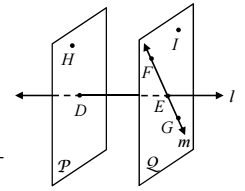
Two planes intersect at a...
a)
line
b)
point
c)
plane
d)
letter
72.
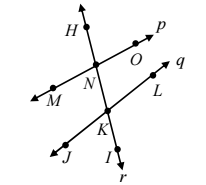
Name two points collinear to Point K
a)
H & M
b)
J & L
c)
N & J
d)
M & L
73.
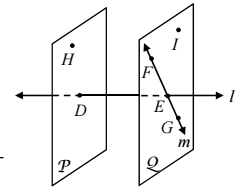
Give another name for plane Q.
a)
Plane FEGI
b)
Plane FEG
c)
Plane m
d)
Plane FGI
74.
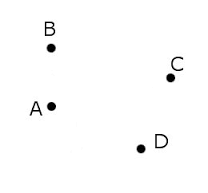
An example of coplaner points
a)
D, E, B
b)
C, B, A
c)
M, E, C
d)
A, F, E
75.
A line that contains point M.
a)

Line q

b)

Line p

c)

Line r

76.
Name the intersection of Plane ADE and Plane W
a)
Point E
b)
Point A
c)
Line AD
d)
Line EA
77.
Name 3 coplaner points.
a)
ZRW
b)
VZX
c)
VWX
d)
WYZ
78.
A plane containing point A.
a)
Plane DEA
b)
Plane k
c)
Plane CDF
d)
Plane F
79.
Are points D and E collinear or coplanar?
a)
Collinear
b)
Coplanar
80.
True or False: Line DE lies in plane ABC
a)
True
b)
False
81.
True or False: Line AB lies in plane ABC
a)
True
b)
False
82.

True or False: Points B, C, and D are coplanar.

a)

True

b)

False

83.
True or False: Points A, B, and C are collinear.
a)
True
b)
False
84.
Identify this picture. 
a)
ray AB
b)
line AB
c)
line segment AB
d)
point AB
85.
What is a line segment?
a)
Part of a line with 2 endpoints
b)
Part of a line that has 1 endpoint
c)
Part of a line with 0 endpoints
d)
Part of a line with 5 endpoints
86.
What is a ray?
a)
Part of a line with 2 endpoints
b)
Part of a line with 1 end point and goes on forever 
c)
Part of a line with 0 endpoints
d)
Part of a line with 5 endpoints
87.
What is a point?
a)
a straight path
b)
an exact location
c)
endless flat surface
d)
lines that cross
88.
What is a line?
a)
a straight path of points that goes on and on in two directions
b)
an endless flat surface
c)
an exact location in space
d)
lines that never intersect
89.

What is an exact location in space?

a)

ray

b)

point

c)

line

d)

line segment

90.

What is part of a line that has one endpoint and goes on and on in one direction?

a)

Point

b)

Line

c)

Line Segment

d)

Ray

91.

What is part of a line that has two endpoints?

a)

Line

b)

Line Segment

c)

Ray

d)

Point

92.

The picture shows examples of

a)

Points

b)

Lines

c)

Line Segments

d)

Rays

93.

How many planes are in the figure?

a)

2

b)

3

c)

5

d)

7

94.

Identify the image

a)

Angle

b)

Line

c)

Line Segment

d)

Ray

95.

Idendify the Image.

a)

Ray

b)

Point

c)

Line

d)

Line segment

96.
Points that lie on the same line are _________.
a)
coplanar
b)
collinear
c)
parallel
d)
perpendicular
97.
Points that lie on the same plane are ________. 
a)
collinear
b)
coplanar
c)
parallel
d)
perpendicular
98.
Name 4 collinear points
a)
HMNO
b)
IKNO
c)
MJOL
d)
HNKI
99.

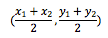
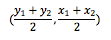
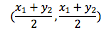
Which of the following is the correct midpoint formula given two endpoints (x1, y1) and (x2, y2)?
a)
b)
c)
d)
100.

Find the midpoint:

a)


(3,1)\left(3,-1\right)

b)

(1,3)\left(-1,3\right)

c)

(3,4)\left(3,4\right)

d)

(4,3)\left(4,3\right)

101.

Find the midpoint:

a)

(32,52)\left(-\frac{3}{2},-\frac{5}{2}\right)

b)

(1,3)\left(-1,-3\right)

c)

(12,52)\left(-\frac{1}{2},-\frac{5}{2}\right)

d)

(3,1)\left(-3,-1\right)

102.

Find the midpoint: (2,7),(10,1)\left(2,-7\right),\left(10,1\right)  

a)

(-3,6)

b)

(6,-3)

c)

(4,4)

d)

none

103.

Find the midpoint: (3,9),(1,5)\left(3,9\right),\left(-1,-5\right)  

a)

(1,2)\left(-1,-2\right)  

b)

(2,7)\left(2,7\right)  

c)

(2,7)\left(-2,-7\right)  

d)

(1,2)\left(1,2\right)  

104.

What is the midpoint of the segment with endpoints (1, 9) and (-3, 5)?

a)

(-1, 7)

b)

(2, 7)

c)

(7, -1)

d)

(2, 2)

105.
What is the midpoint between (-4,4) and (-2,2)?
a)
(3,2)
b)
(-3,3)
c)
(4,5)
d)
(6,7)
106.
What is the midpoint between (3, -1) and (7, -5)
a)
(5, -2)
b)
(10, -6)
c)
(5, -3)
d)
(2, -2)
107.
What is the center of MN given M(3, -1) and N(7, -5)
a)
(5, -2)
b)
(10, -6)
c)
(5, -3)
d)
(2, -2)
108.
What point is halfway between (3, -1) and (8, -6)?
a)
(11, -7)
b)
(-5.5, -3.5)
c)
(5.5, -3.5)
d)
(2, -2)
109.

Find the length indicated.

(a)  

110.
Find measurement for QT.
a)
10
b)
6
c)
-10
d)
2
111.

If M, N, O, and P are four points on a segment MP, what will be the correct expression to find the value of OP?

a)

OP = MP + (MN + NO)

b)

OP = MP + MN + NO

c)

OP = MP - (MN + NO)

d)

OP = MP - MN + NO

112.

If points A, B, C are collinear with B between A and C, the segment addition postulate is:

a)

AB + BC = AC

b)

BA + CB = AC

c)

CA + CB = AB

d)

BC + AC = CA

113.
RM=
a)
RM=6
b)
RM=3
c)
RM=12
d)
RM=9
114.
XY =
a)
6
b)
28
c)
11
d)
7
115.
This point divides a line segment into 2 equal parts.
a)
point
b)
vertex
c)
midpoint
d)
segment
116.
a)
-3
b)
0
c)
1
d)
3
117.

Write an equation that correctly models the lengths shown.

a)

2x + 20 + x + 21 = 9

b)

2x + 20 + 9 = x + 21

c)

9 + x + 21 = 2x + 20

d)

2x + 20 - 9 = x + 21

118.

Write an equation that could be used to relate the lengths shown.

a)

4 + 3x + 2 = 7x - 2

b)

7x - 2 + 4 = 3x + 2

c)

7x - 2 + 3x + 2 = 4

119.

Given the diagram, which is correct?

a)

BC+CD=BD

b)

BD+BC=CD

c)

CD+BC=BD

d)

BC+BD=CD

120.
If GH = 8 and HI = 17, Find GI
a)
8
b)
9
c)
24
d)
25
121.

If RT=36, find the value of x.

a)

3

b)

4

c)

5

d)

6

122.
a)
8
b)
12
c)
-4
d)
-8
123.

Let B be between A and C.

a)

2

b)

-1

c)

11

d)

15

124.
Find ST.
a)
11
b)
12
c)
13
d)
14