wayground logo

Free Printable Worksheets

Font size

S
M
L
XL
Worksheets

Test 1 Review

Total questions: 125

Worksheet time: 7hrs 19mins

Name
Class
Date
1.

 2(x2)4=2x+2\frac{2\left(x-2\right)}{4}=2x+2 Solve the linear equatoin

a)

 y=2y=-2  

b)

 x=2x=2  

c)

 y=2y=2  

d)

 x=2x=-2  

2.

 3x66=4x8\frac{3x-6}{6}=4x-8  Solve the  linear equation

a)

x=0

b)

y=0

c)

x=2

d)

y=2

3.
Solve for x:
2(3x + 4) + 2 = 4 + 3x
a)
2
b)
-2/3
c)
10
d)
-2
4.
Solve for x:
3(5x + 10) + 10 = 6x - (x + 10)
a)
3
b)
-3
c)
-5
d)
5
5.

Which equation below would give you an answer of infinite solutions (all real numbers)?

a)

4x + 10 = 0

b)

4x + 10 = 4x

c)

4x + 10 = 4x + 8

d)

4x + 10 = 4x + 10

6.

 5a  23 = 3  a\frac{5a\ -\ 2}{3}\ =\ 3\ -\ a  Solve:

a)

 811\frac{8}{11}  

b)

 118\frac{11}{8}  

c)

8

d)

11

7.

 2x  + 13 = x2\frac{2x\ \ +\ 1}{3}\ =\ \frac{x}{2}  Solve

a)

-2

b)

6

c)

No Solution

d)

14

8.

 2x + 13  1  x6 = 2\frac{2x\ +\ 1}{3}\ -\ \frac{1\ -\ x}{6}\ =\ -2  Sove

a)

 513\frac{-5}{13}  

b)

 13-13  

c)

 5-5  

d)

 135\frac{-13}{5}  

9.

Convert 62 miles/hour to feet/second. (5,280 ft = 1 mi)

a)

5,456 ft/s

b)

.003 ft/s

c)

91 ft/s

d)

909 ft/s

10.

Convert 62 miles/hour to feet/second

a)

5,456 feet/second

b)

.003 feet/second

c)

90.9 feet/second

d)

909 feet/second

11.

Convert 20 tons/year to ounces/day

a)

.0004 ounces/day

b)

6.8 ounces/day

c)

109.6 ounces/day

d)

1,753.42 ounces/day

12.

Convert 50 decimeters/week to kilometers/year

a)

.026 kilometers/year

b)

2.6 kilometers/year

c)

.26 kilometers/year

d)

26 kilometers/year

13.

Convert 700 centiliters/day to Liters/year

a)

2,555 Liters/year

b)

255.5 Liters/year

c)

25.55 Liters/year

d)

2.555 Liters/year

14.

32,190 inches/year to yards/day

a)

88.19 yards/day

b)

7.3 yards/day

c)

2.4 yards/day

d)

4.9 yards/day

15.

Convert 9,500 feet/year to inches/day

a)

2.2 inches/day

b)

312.3 inches/day

c)

3,123.4 inches/day

d)

31.23 inches/day

16.

Julie and her friend, Brittney, took turns driving during their road trip. Julie drove for 2 hours at a constant speed of 55 miles per hour. Brittney drove for 3 hours at a constant speed of 60 miles per hour. How many miles did they drive altogether?

a)

110 miles

b)

290 miles

c)

120 miles

d)

575 miles

17.

For Benny, it takes six hours to clean the attic. However, Mary takes twelve hours to clean the attic. If working together, how long would they take?

a)

6

b)

4

c)

11

d)

3

18.

Joan can clean the store in five hours. If Dan helps, it takes them four hours. Without help, how long would it take Dan to complete this job ?

a)

10

b)

25

c)

20

d)

15

19.

Keith and Melanie were able to reupholster furniture in three hours together. It takes Melanie five hours to do this job alone. Without help, how long would it take Keith to do this job ?

a)

5.5

b)

6.5

c)

7.5

d)

8.5

20.
If it takes Heather 3 seconds to run from the batter's box to first base at an average speed of 6.5 meters per second, what is the distance she covers in that time?
a)
19.5 m
b)
0.46 m
c)
2.2 m
d)
3.5 m
21.
A passenger plane made a trip to Las Vegas, flying at an average speed of 432 mph. How much time did the trip take if the plane traveled 616 miles?
a)
0.70 hours
b)
1.43 hours
c)
2 hours
d)
3.4 hours
22.

A passenger plane left New York and flewtoward Las Vegas at an average speed of

217 km/h. A cargo plane left four hours

later and flew in the same direction but

with an average speed of 341 km/h. How

long did the passenger plane fly before the

cargo plane caught up?

a)

11

b)

19

c)

18

d)

9

23.

Mike left the White House and drovesouth. Two hours later Alberto left driving

16 mph faster in an effort to catch up to

him. After three hours Alberto finally

caught up. Find Mike's average speed.

a)

25

b)

10

c)

24

d)

40

24.

Maria left the hospital at the same time asJill. They drove in opposite directions.

Jill drove at a speed of 80 km/h. After

three hours they were 450 km apart. How

fast did Maria drive?

a)

70

b)

100

c)

30

d)

90

25.
Solve the literal equation for the given variable.
a)
2A/h
b)
2/(h)
c)
2Ah
d)
Ah/2
26.
Solving the formula P = 2L + 2W for W is not equivalent to which equation?
a)
(P-2L)/2 = W
b)
(P/2) - (2L/2) = W
c)
(1/2)P - L = W
d)
P - (1/2)L = W
27.
Solve for x:
a)
x = yb - v
b)
x = by - v
c)
x = by + v
28.
a)
h=V/(3πr2)
b)
h=(3V)/(πr2)
c)
h=V/(3πr2)
d)
h=(3π)/(Vr2)
29.
a)
(2.5+h)f
b)
g=1
c)
f(5+h)/2
d)
(5f+h) / 2
30.
a)
A
b)
B
c)
C
d)
D
31.
a)
b = 3A - a - c
b)
b = -3A + a - c
c)
b = -3A - a - c 
d)
b = 2A - c
32.

 3y = 2g(x+h)  solve for x3y\ =\ 2g\left(x+h\right)\ \ solve\ for\ x  

a)

 x = 3y+h2gx\ =\ \frac{3y+h}{2g}  

b)

 x = 3yh2gx\ =\ \frac{3y-h}{2g}  

c)

 x = 3y2g+hx\ =\ \frac{3y}{2g}+h  

d)

 x = 3y2ghx\ =\ \frac{3y}{2g}-h  

33.

 B = 12y(2x  3)  solve for xB\ =\ \frac{1}{2}y\left(2x\ -\ 3\right)\ \ solve\ for\ x  

a)

 x = 2By3x\ =\ \frac{2B}{y}-3  

b)

 x = 2By +3x\ =\ \frac{2B}{y\ }+3  

c)

 x = By +32x\ =\ \frac{B}{y\ }+\frac{3}{2}  

d)

 x = By32x\ =\ \frac{B}{y}-\frac{3}{2}  

34.
Express the following in Interval Notation
 -8 ≤ x < 8 
a)
[-8, 8]
b)
[-8,8)
c)
(-8, 8]
d)
(-8, 8)
35.
Write the inequality in interval notation.
a)
(-2,5)
b)
(-∞,-2) or (5,∞)
c)
[-2,5]
d)
(-∞,-2] or [5,∞)
36.
3x-4< -13 or 7x+1> 22
a)
All Real numbers
b)
  x>3   and x>-9
c)
The answer is not listed
d)
x<-3   or x>3
37.
Solve:  -3 ≤ 2x - 1 ≤ 5
a)
-1 ≤ x ≤ 3
b)
-1 < x < 3
c)
1 < x < 3
d)
1 ≤ x ≤ 3
38.
a)

k≤-6

b)

k≥-6

c)

k<6

d)

k>6

39.

What is the correct interval notation?

a)

{p/p≥-10}

b)

{p/p≥10 or p≥10}

c)

(∞, -10)

d)

(-10, ∞)

40.

Solve

a)

x>5

b)

x>0

c)

no solution

d)

all real numbers

41.

What is the correct interval notation?

a)

(-5, 0)

b)

{m/m≤-5 or m≥0}

c)

(-∞, 5] U [0, ∞)

d)

{m/-5≤m≤0}

42.
Write in interval notation
a)
(-∞ , -1) or [8 , ∞)
b)
(-∞ , 8) or [-1, ∞)
43.

Evaluate f(-2) if f(x) = x+3

a)

-1

b)

1

c)

5

d)

-5

44.
What is x if
f(x) = -2?
a)
4
b)
0
c)
3
d)
8
45.
Complete the function notation below
f(____) = 214
a)
1990
b)
1991
c)
1989
d)
1994
46.
What is the range?
a)
-4 < x ≤ 5
b)
-4 ≤ x < 5
c)
-3 < y < 3
d)
-3 ≤ y ≤ 5
47.
What is the domain of the graph?
a)
-7 ≤ x < 5
b)
-3 ≤ x < 1
c)
-3 ≤ y < 1
d)
-7 ≤ y < 5
48.

f(x) = x+3

Find x when f(x) = 8

a)

-1

b)

1

c)

5

d)

-5

49.
Evaluate f(-2) if f(x) = x2+ 3
a)
-1
b)
1
c)
7
d)
-7
50.
Given f(x) =
2x2 + 5x - 17, find f(-1). 
a)
f(-1) = -20
b)
f(-1) = -24
51.
If f(x) = -4x - 5 and
g(x) = 3 - x,
what is g(-4) + f(1)?
a)
7
b)
-2
c)
-9
d)
-10
52.
Is the relation a function? 
{(4,5), (4,-7), (4,2), (4,0), (4,9)}
a)
Yes
b)
No
53.
If h(a) = 3 - 2x2, find h(-3).
a)
33
b)
21
c)
39
d)
-15
54.
Given f(x) = 2x2 + 5x - 17, find f(-1). 
a)
f(-1) = -20
b)
f(-1) = -24
55.
Using the graph, what does f(8) equal?
a)
8
b)
2
c)
1
d)
0
56.

Perform the indicated operation.

a)
b)
c)
d)
57.

Perform the indicated operation.

a)
b)
c)
d)
58.

Complete the operation and evaluate.

a)
b)
c)
d)
59.

Perform the indicated operation.

a)
b)
c)
d)
60.

Perform the indicated operation.

a)
b)
c)
d)
61.

Perform the indicated operation and evaluate for the given value.

a)
b)
c)
d)
62.

f(x)= x3 - 3x

g(x)= - 4x + 1

Find f(x) ⋅ g(x)

a)

-4x3 -5x2 - 3

b)

-4x3 + 2x2 - 3x

c)

-4x4 + x3 + 12x2 - 3x

d)

-4x4 - x3 + 12x2 + 3x

63.

Given f(x) = 2x and g(x) = x2 + 3

find f(g(x)).

a)

x2 + 2x + 3

b)

4x2 + 3

c)

2x2 + 3

d)

2x2 + 6

64.
Given f(x)= -3x+7 and g(x)=2x2 - 8, find g(f(x)).
a)
g(f(x))= -6x2+31
b)
g(f(x))= -6x2+24
c)
g(f(x))=18x2-84x+90
d)
g(f(x))=9x2-42x-41
65.
f(x) = 3x + 10
g(x) = x - 2
Find g(f(-10))
a)
-42
b)
-26
c)
-18
d)
None of these.
66.
Given
f(x) = 3x2 + 7x and g(x) = 2x2 - x - 1, find (f + g)(x).
a)
11x2 - 1
b)
5x4 + 6x2 - 1
c)
5x2 + 6x - 1
d)
5x2 + 8x - 1
67.
f(x) = x2+9
g(x) = x-9
Find f(x)-g(x). 
a)
x2+x+9
b)
x2-x+9
c)
x2-x
d)
x2-x+18
68.

When f(x) = x2 - 9

and g(x) = x + 3 ,

find f(x) / g(x).

a)

x - 3

b)

x + 3

c)

x - 12

d)

x - 6

69.
f(x)=3x2+1
g(x)=4x+5
What is (f+g)(2)
a)
13
b)
0
c)
26
d)
6x2+8x+12
70.
Let
f(x) = -2x+2
g(x) = 2x2+9
Evaluate: (f∘g)(2)
a)
-32
b)
-34
c)
17
d)
19
71.
If the equation of f(x) goes through (1, 4) and (4, 6), what points does f-1(x) go through?
a)
(1, 4) and (4, 6)
b)
(-4, -1) and (-6, -4)
c)
(-1, -4) and (-4, -6)
d)
(4, 1) and (6, 4)
72.
What is the inverse of this function?
a)
A
b)
B
c)
C
d)
D
73.
Find the inverse of f(x) = x2 - 5
a)
f-1(x) = √(x) + 5
b)
f-1(x) = ∛(x-5)
c)
f-1(x) = ±√(x+5)
d)
f-1(x) = x2 - 5
74.
a)
A
b)
B
c)
C
d)
D
75.

 f(x)=x26f\left(x\right)=\frac{x-2}{6}  
Find  f1(x)f^{-1}\left(x\right)  

a)

 x62\frac{x-6}{2}  

b)

 6x+26x+2  

c)

 2x+62x+6  

d)

 6(x+2)6\left(x+2\right)  

76.

 f(x)=3x+107f\left(x\right)=\frac{3x+10}{7}  
Find  f1(x)f^{-1}\left(x\right)  

a)

 7x1037x-\frac{10}{3}  

b)

 7x310\frac{7x}{3}-10  

c)

 7(x10)3\frac{7\left(x-10\right)}{3}  

d)

 7x10³\frac{7x-10}{3}  

77.
Are these functions inverses?
a)
Yes
b)
No
78.
Are the following inverses of each other?
a)
True
b)
False
79.
If f-1(-25) = 7 then what is f(7) = 
a)
25
b)
7
c)
No enough information. 
d)
-25
80.
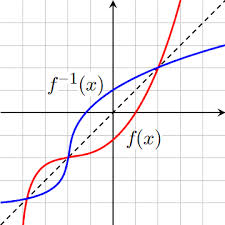
The inverse has been reflected over which line?
a)
y = x
b)
x = 0
c)
y = 0
d)
x = -y
81.

What is the domain restriction of f(x)=x+5f\left(x\right)=\sqrt{x+5} 

a)

 x0x\ne0  

b)

 x5x\ne-5  

c)

 x5x\ge-5  

d)

 x0x\ge0  

82.

What are the domain restrictions of f(x)=x+3x216f\left(x\right)=\frac{x+3}{x^2-16}  ?

a)

 x4,4x\ne4,-4  

b)

 x0x\ne0  

c)

 x16x\ge16  

d)

 (4,4)\left(-4,4\right)  

83.

Determine the domain of f(x)=6x+2f\left(x\right)=\frac{6}{\sqrt{x+2}}  

a)

 x>2x>2  

b)

 x0x\ge0  

c)

 (,2)\left(-\infty,-2\right)  

d)

 (2,)\left(-2,\infty\right)  

84.

What are the domain restrictions f(x)=3x2+6x+5f\left(x\right)=\frac{3}{x^2+6x+5} 

a)

 x5,1x\ne-5,-1  

b)

 x1,5x\ne1,5  

c)

 x>5, x<1x>5,\ x<1  

d)

 x<5, x>1x<-5,\ x>-1  

85.

Describe the transformation that occurred

p(x) = f(x + 3)

a)

Right 3 units

b)

Vertical Stretch

c)

Up 3 units

d)

Left 3 units

86.
What are the transformations?
y=(x-2)3+4
a)
Horz shift right 2      Vert shift up 4
b)
Horz shift left 2    Vert shift up 4
c)
Horz shift right 2      Vert shift down 4
d)
Horz shift left 2      Vert shift up 4
87.
When you translate, (x-4,y) will move _____.
a)
4 units right
b)
4 units left
c)
4 units up
d)
4 units down
88.
Point (-5,2) is reflected over the y axis.  Where is the new point located?
a)
(5,2)
b)
(-5,-2)
c)
(-5,2)
d)
(5,-2)
89.
Point (7,2) is translated vertically 2 units and horizontally -5 units.  Where is the new point located?
a)
(9,-3)
b)
(2,4)
c)
(2,0)
d)
12,4)
90.
When you translate, (x,y+6) will move _____.
a)
6 units right
b)
6 units left
c)
6 units up
d)
6 units down
91.

What does the transformation f(x)  f(x+1)9f\left(x\right)\ \rightarrow\ f\left(x+1\right)-9 do to the graph of  f(x)f\left(x\right)  ?

a)

translates it left one unit and down 9 units

b)

translates it right one unit and down 9 units

c)

translates it up one unit and right 9 units

d)

translates it down one unit and left 9 units

92.

What does the transformation f(x)  13f(x)+4f\left(x\right)\ \rightarrow\ \frac{1}{3}f\left(x\right)+4 do to the graph of  f(x)f\left(x\right)  ?

a)

Shrinks the graph vertically by a factor of 1/3 and translates up 4 units.

b)

Stretches the graph by a factor of 3 and translates up 4 units.

c)

Translates the graph left 1/3 of a unit and up 4 units.

d)

Translates the graph right 3 unites and down 4 units.

e)

Shrinks the graph horizontally by a factor of 1/3 and translates up 4 units.

93.
How is the graph of y = 2x2+ 3 different from the graph of y = 2x2?
a)
It is shifted 3 units left.
b)
It is shifted 3 units right.
c)
It is shifted 3 units down.
d)
It is shifted 3 units up.
94.

Describe the transformation of y = g(x) for the transformed function y = g(x - 3) + 5.

a)

Shifted up 5 units

Shifted right 3 units

b)

Shifted up 5 units

Shifted left 3 units

c)

Shifted down 5 units

Shifted left 3 units

d)

Shifted down 5 units

Shifted right 3 units

95.

The point (-2, 6) is on the function y = f(x). What are its new coordinates if y = f(x) is transformed to y = f(2x) + 2?

a)

(-2, 4)

b)

(-1, 6)

c)

(-6, 3)

d)

(-1, 8)

96.
If (-2, 5) is on the graph of y = f(x), which of the following coordinates will be on the graph of y = 2f(3x)
a)
(-2/3 , 10)
b)
(-6, 10)
c)
(-2/3 , 5/2)
d)
(-4 , 15)
97.

What does the rule  f(x,y)=(x6,y+4)f\left(x,y\right)=\left(x-6,y+4\right)  tell you to do? 

a)

Translate right 6 & up 4

b)

Translate left 6 & up 4

c)

Translate right 6 & down 4

d)

Translate left 6 & down 4

98.

Describe the transformation of the equation below from the parent function of y = I x I

y = 2 I x - 3 I + 3

a)

stretched by 2, right 3, up 3

b)

stretched by 2, left 3 up 3.

c)

shrunk by 2, right 3, up 3

d)

shrunk by 2, left 3, up 3

99.
Describe the transformation of the equation below from the parent function of y = I x I
y = I x + 3 I
a)
Left 3
b)
Right 3
c)
Up 3
d)
Down 3
100.

Describe the transformation of the equation below from the parent function of y = IxI

y = I x + 2 I - 5

a)

Left 2 up 5

b)

Right 2 up 5

c)

Left 2 down 5

101.

Which of the following has a domain of all real numbers greater than -3 and less than or equation to 5?

a)
b)
c)
d)
102.

What is the RANGE?

a)

(-3, 3]

b)

all real numbers

c)

[-4, 5]

d)

[-4, ∞)

103.
The graph of quadratic function g is shown.  The coordinates of the x-intercepts, the y-intercept, and the vertex are integers.
What is the maximum value of g?
a)
2
b)
9
c)
8
d)
-4
104.
What are the x- intercepts?
a)
x= 0 and x= -4
b)
x= 0 and x= 4
c)
y= 0
d)
x= 2
105.
What is the interval of increase for this function?
a)
(-6, -2)
b)
All real numbers
c)
[-6, -2]
d)
(-1, 3)
106.
What is the interval of decrease for this function?
a)
(-5, 3)
b)
All real numbers
c)
[-2, 6]
d)
(-2, 6)
107.
What is the interval of increase of this function?
a)
(1, infinity)
b)
None
c)
(2, infinity)
d)
All real numbers
108.

What is the Domain and Range?

a)

Domain: All real numbers

b)

Range: x3x\ge3

c)

Range: y4y\ge-4

d)

Domain: x3x\ge3

e)

Domain: y4y\ge-4

109.

What is the RANGE of this square root function?

a)

all real numbers

b)

x0x\ge0

c)

 y0y\le0 

d)

 y3y\ge-3 

110.

What is the DOMAIN of this cube root function?

a)

all real numbers

b)

x0x\ge0

c)

x0x\le0

d)

y0y\ge0

111.
When is the velocity decreasing?
a)
0 < t < 60
b)
40 < t < 60
c)
15 < t < 40
d)
-40 < t < 0
112.
When is this function increasing?
a)
-2.5 < x < 2.5
b)
0 < x < 5
c)
0 < x < 55
d)
-5 < x < 0
113.

What is/are the increasing interval(s) for the function shown?

a)

(3, 1)\left(-3,\ 1\right)

b)

(4, 8)\left(4,\ 8\right)

c)

(,1) and (3, 1)\left(-\infty,1\right)\ and\ \left(-3,\ 1\right)

114.

What is/are the decreasing interval(s) for the function shown?

a)

 (2, 4) and (8, )\left(2,\ 4\right)\ and\ \left(8,\ \infty\right) 

b)

 (, 1) and (8, )\left(-\infty,\ 1\right)\ and\ \left(8,\ \infty\right) 

c)

 (,1), (3, 1) and (8, )\left(-\infty,1\right),\ \left(-3,\ 1\right)\ and\ \left(8,\ \infty\right) 

d)

 (, 1), (2, 4) and (8, )\left(-\infty,\ 1\right),\ \left(2,\ 4\right)\ and\ \left(8,\ \infty\right) 

115.

What is the decreasing interval(s) on the function shown?

a)

(7, 6) and (2, 4)\left(-7,\ -6\right)\ and\ \left(-2,\ 4\right)

b)

(7, 0) and (2, 4)\left(-7,\ 0\right)\ and\ \left(-2,\ 4\right)

c)

(7, 6) and (2, 0)\left(-7,\ -6\right)\ and\ \left(-2,\ 0\right)

d)

(7, 0) and (4, 5)\left(-7,\ 0\right)\ and\ \left(4,\ 5\right)

116.

What is the increasing interval(s) on the function shown?

a)

(, 15) and (9, 15)\left(-\infty,\ -15\right)\ and\ \left(9,\ -15\right)

b)

(2, 9) and (2, )\left(-2,\ 9\right)\ and\ \left(2,\ \infty\right)

c)

(, 2) and (0, 2)\left(-\infty,\ -2\right)\ and\ \left(0,\ 2\right)

d)

(2, 0) and (2, )\left(-2,\ 0\right)\ and\ \left(2,\ \infty\right)

117.

What is the decreasing interval(s) on the function shown?

a)

(, 15) and (9, 15)\left(-\infty,\ -15\right)\ and\ \left(9,\ -15\right)

b)

(2, 9) and (2, )\left(-2,\ 9\right)\ and\ \left(2,\ \infty\right)

c)

(, 2) and (0, 2)\left(-\infty,\ -2\right)\ and\ \left(0,\ 2\right)

d)

(2, 0) and (2, )\left(-2,\ 0\right)\ and\ \left(2,\ \infty\right)

118.

What is the domain?

a)

[-2, 3]

b)

[-2, 3)

c)

(-2, 3]

d)

[-3, 4]

e)

(-3, 4]

119.

What is the range?

a)

(, 3]\left(-\infty,\ -3\right]

b)

[3, )\left[3,\ -\infty\right)

c)

(,3]\left(-\infty,3\right]

d)

None of the answer choices

e)

 [3, )\left[-3,\ \infty\right)  

120.

If A=[1,5] and B=[3,7], what is  ABA\cap B ?

a)

[1,3]

b)

[5,7]

c)

[1,7]

d)

[3,5]

121.

What is  ABA\cup B  if A=[1,3] and B=[4,5]?

a)

[1,4]

b)

[3,4]

c)

[1,3] \cup  [4,5]

d)

none

122.

If A=[1,3] and B=[5,7], what is  ABA\cap B  ?

a)

[1,5]

b)

[3,5]

c)

[1,7]

d)

empty set

123.

What is

[8,14) ∪ (-10, 10)

a)

(-10,14)

b)

[8,10)

c)

(-10,10)∪(10,14)

d)

(10,14)

124.

What is

[8,14) ∩ (-10, 10)

a)

(-10,14)

b)

[8,10)

c)

(-10,10)∪(10,14)

d)

(10,14)

125.

Use graphs to find each set:

(-4, 0) ∩ [-2, 1]

a)

(-4, 1]

b)

[-4, 1)

c)

[-2, 0)

d)

(-2, 0]