wayground logo

Free Printable Worksheets

Font size

S
M
L
XL
Worksheets

Alg 2 QR 4.5 - 4.7

Total questions: 124

Worksheet time: 6hrs 52mins

Name
Class
Date
1.
Which of the following is a difference of perfect squares?
a)
x2 - 18
b)
4x2 + 36 
c)
9x2 - 100
d)
x2 + 4
2.
What are the factors of
25x2 - 81?
a)
(5x - 9)(5x + 9)
b)
(5x - 9)(5x - 9)
c)
(5x + 9)(5x + 9)
d)
Cannot be factored
3.
What is the first step when factoring polynomials?
a)
Find the GCF
b)
List all the terms
c)
Make a triangle
d)
Write the answer
4.
Factor Completely.  
8x3 - 18x
a)
2x(4x2-9)                                    
b)
(4x2+3)(2x-3)
c)
2x(2x+3)(2x-3)
d)
PRIME
5.
Factor completely:
 3x² + 5x - 12
a)
(3x + 4)(x-3)
b)
(3x - 4)(x + 3)
c)
(3x + 3)(x -4)
d)
(3x - 3)(x + 4)
6.
Factor by grouping:
3x3-x2+6x-2
a)
(x2+2)(3x+1)
b)
 (x2+2)(3x-1)
c)
(3x3+6x)(x2-2)
d)
none of the aboe
7.
x- 225
a)
( x + 15) ( x + 15) 
b)
Prime
c)
( x - 15) ( x + 15) 
d)
( x - 15) ( x - 15) 
8.
Complete the formula
a³-b³=
a)
(a-b)(a²+ab+b²)
b)
(a+b)(a²-ab+b²)
c)
(a-b)(a²-ab+b²)
d)
(a+b)(a²+ab+b²)
9.

Complete the formula

a³+b³=

a)

(a-b)(a²+ab+b²)

b)

(a+b)(a²-ab+b²)

c)

(a-b)(a²-ab+b²)

d)

(a+b)(a²+ab+b²)

10.
Factor:   x+ 1
a)
(x + 1)3
b)
(x+1)(x- x + 1)
c)
(x - 1) (x2 + x - 1)
d)
(x + 1)(x2 - 2x + 1)
11.
Factor: 8x3 - 1
a)
(2x - 1)(4x2 + 2x + 1)
b)
(2x + 1)(4x2 - 2x + 1)
c)
(2x - 1)(4x2 - 2x - 1)
d)
(2x + 1)(4x2 +2x + 1)
12.
Factor
27x³-64
a)
(3x-4)(9x²+12x+16)
b)
(3x-4)(9x²-12x+16)
c)
(3x+4)(9x²-12x+16)
d)
(3x+4)(9x²+12x+16)
13.
Fully Factor the Following
8x3-27
a)
(2x+3)(4x2-6x+9)
b)
(2x-3)(4x2+6x+9)
c)
(2x-3)(4x2+6x-9)
d)
(2x-3)(2x2+6x+9)
14.

Which number is both a perfect square and a perfect cube?

a)

64

b)

27

c)

81

d)

16

15.

Identify if the expression can be factored as sum or difference of cubes:

3x3 + 24

a)

No

b)

Yes

c)

Yes, getting GCF first

d)

It is a sum of squares

16.

WHAT FACTORING TECHNIQUE YOU HAVE TO USE TO SOLVE FOR THE FACTORS OF 27X3-343?

a)

DIFFERENCE OF TWO CUBES

b)

DIFFERENCE OF TWO SQUARES

c)

FACTORING BY GCF

d)

SUM OF TWO CUBES

17.
Which of the following is a COMPLETE  list of all possible Rational Zeros?
f(x) = x3 + 2x2 - 6x + 8
a)
±1, ±8
b)
±1, ±2, ±4, ±8
c)
±1, ±2, ±4
d)
1, 2, 4, 8
18.
Which of the following is a COMPLETE  list of all possible Rational Zeros?
f(x) = 3x3 + 2x2 - 6x + 7
a)
±1, ±7, ±1/3, ±7/3
b)
±1, 7
c)
±1, ±3, ±7, ±7/3
d)
±1, ±3, ±7, ±1/3, ±7/3
19.
Which of the following is a COMPLETE  list of all possible Rational Zeros?
f(x) = 2x3 + 5x2 - 9x + 5
a)
±1, ±5, ±1/2, ±5/2
b)
±1, ±2, ±5, ±1/2, ±5/2
c)
±1, ±5
d)
±1, ±2, ±5, ±1/2, ±5/2, ±2/5
20.
Solve by using Rational Root Theorem: 
2x3 - 11x2 + 12x + 9 = 0
a)
-1, 1, 3
b)
-1, 3/2, 3 
c)
-1/2, 3, 3
d)
-1/2, 1, 3
21.
Solve by using Rational Root Theorem: 
x3 - 7x - 6 = 0
a)
1, 2, 3
b)
-1, -2, - 3
c)
-1, -2, 3
d)
1,-2,-3
22.
According to the Rational Root Theorem, what are the all possible rational roots? 
2x3 - 11x2 + 12x + 9 = 0
a)
±1,±2
b)
±1,±3,±9
c)
±1,±3±9,±1/2,±3/2,±9/2
d)
±1,±2,±1/3,±2/3,±1/9,±2/9
23.

Below are four possible zeros for this polynomial.

Figure out which one "works"

f(x) = x3 + 2x2 - 11x - 12

a)

-3

b)

-4

c)

1

d)

6

24.

Below are four possible zeros for this polynomial.

Figure out which one "works"

f(x) = x3 - 8x2 - 23x + 30

a)

3

b)

-1

c)

-10

d)

1

25.
Which of the following is a COMPLETE  list of all possible Rational Zeros?
f(x) = x3 + 2x2 - 6x + 8
a)
±1, ±8
b)
±1, ±2, ±4, ±8
c)
±1, ±2, ±4
d)
1, 2, 4, 8
26.

How many possible negatives solutions does the following polynomial have?

f(x) = x4 - 3x3 - 17x2 + 39x -20

a)

3 or 1

b)

3

c)

1

d)

2 or 0

27.

How many positive solutions does the following polynomial have?

f(x) =3x5 - x4 + 3x2 - 6x +11

a)

4, 2, or 0

b)

4

c)

3 or 1

d)

3

28.

How many possible negatives solutions does the following polynomial have?

f(x) = x4 - 3x3 - 17x2 + 39x -20

a)

3 or 1

b)

3

c)

1

d)

2 or 0

29.

How many positive solutions does the following polynomial have?

f(x) =3x5 - x4 + 3x2 - 6x +11

a)

4, 2, or 0

b)

4

c)

3 or 1

d)

3

30.

Use Descartes Rule of Signs to determine the possible number of positive and negative roots.

a)

1 positive, 2 or 0 negative

b)

1 positive, 1 negative

c)

0 positive, 1 negative

d)

1 positive, 0 negative

31.

Use Descartes Rule of Signs to determine the possible number of positive and negative roots.

a)

3 or 1 positive roots and 0 negative roots

b)

4, 2, or 0 positive roots and 1 negative root

c)

4, 2, or 0 positive roots and 0 negative roots

d)

2 or 0 positive roots and 1 negative roots

32.

Find the zeros of the polynomial given one factor. Use synthetic division.

a)

X= 3,4,5

b)

x=-3,-4,-5

c)

x=-3,4,5

d)

x= 3, -4, -5

33.

Using Descartes' Rule of Signs, how many possible NEGATIVE roots are there for the polynomial f(x) = x4+x3+x2+x+5. Select all that apply.

a)

0

b)

1

c)

2

d)

3

e)

4

34.

Write a polynomial function with rational coefficients that has zeros - 4 and 5i.

a)

P(x) = x3 + 4x2 + 25x + 100

b)

P(x) = 5x3 - 4x2 + 25x + 100

c)

P(x) = x3 + x2 - 25x + 100

d)

P(x) = 4x2 + 5

35.
Which transformation maps the graph of
f(x) = x2 to the graph of g(x) = (x + 4)2?
a)
a translation shifting f(x) 4 units up
b)
a translation shifting f(x) 4 units down
c)
a translation shifting f(x) 4 units to the left
d)
a translation shifting f(x) 4 units to the right
36.
In the equation f(x)=1/2(x+9)2-1, what happens to the parabola?
a)
Reflect, horizontal compress by 1/2, left 9, down 1
b)
Vertical compress by 1/2, left 9, down 1
c)
Horizontal Compress by 1/2, right 9, down 1
d)
Vertical Stretch by 1/2, left 9, down 1
37.

What are the transformations of the following polynomial from the parent function f(x)=x3f\left(x\right)=x^3  ?


g(x)=2(x+1)3g\left(x\right)=-2\left(x+1\right)^3  

a)

Vertical compression by a factor of 2, and shifted right by 1 unit

b)

Reflected over the x-axis, vertical stretch by a factor of 2, and shift left by 1 unit

c)

Reflected over the y-axis by a factor of 2, and shifted up by 1 unit

d)

Reflected over the x-axis, horizontal compression by a factor of 2, and shifted down by 1 unit

38.
Describe the transformations of the graph y = (x - 3)3 -2
a)
Right 3, Down 2
b)
Left 3, Up 2
c)
Right 3, Up 2
d)
Left 3, Down 2 
39.
Describe the transformation of the graph  y = -2(x + 5)3 
a)
Shrink by 2, Reflected over y-axis, Right 5
b)
Stretch by 2, Reflected over x-axis, Left 5
c)
Stretch by 2, Reflected over x-axis, Right 5
d)
Shrink by 2, reflected over y-axis, Left 5
40.

Describe the transformation of the graph y = - ½(x + 4)4- 1

a)

Left 4 and Down 1

b)

Reflected x-axis, Down 1, Left 4, Shrink by 1/2

c)

Reflected x-axis, Down 1, Left 4, Stretch by 1/2

d)

Reflected x-axis, Up 1, Right 4, Shrink by 1/2

41.
Describe the transformation of the graph  y = (x)3  + 6
a)
Right 6
b)
Left 6
c)
Up 6
d)
Down 6
42.

List the transformations to the parent function in y = -(x + 4)8- 3

a)

reflect over y, right 4, down 3

b)

reflect over y, left 4 down 3

c)

reflect over x, right 4, down 3

d)

reflect over x, left 4, down 3

43.
If f(x) = x3 is changed to f(x) = - (x + 3)3 + 2, how is the graph transformed?
a)
3 units right, 2 units up, reflected across the y-axis
b)
3 units right, 2 units up, reflected across the x-axis
c)
3 units left, 2 units up, reflected across the y-axis
d)
3 units left, 2 units up, reflected across the x-axis
44.
  The blue function is the original function f(x) = x3.  Which of the following is the correct equation for the red function, g(x)?
a)
g(x)=x3+1
b)
g(x)=x3-1
c)
g(x)=(x-1)3
d)
g(x)=(x+1)3
45.

What is the relative maximum?

a)

(2,0)

b)

(4.67, -9.48)

46.

What is the relative minimum?

a)

(2,0)

b)

(4.67, -9.48)

47.

As 

x, f(x) x\rightarrow\infty,\ f\left(x\right)\ \rightarrow  

a)

\infty  

b)

-\infty  

48.

As 

x, f(x) x\rightarrow-\infty,\ f\left(x\right)\ \rightarrow  

a)

\infty  

b)

-\infty  

49.

Increasing Interval(s): (Choose all that apply)

a)

(, 2)\left(-\infty,\ 2\right)  

b)

(2, 4.67)\left(2,\ -4.67\right)  

c)

(4.67, )\left(-4.67,\ \infty\right)  

d)

(, 0)\left(-\infty,\ 0\right)  

e)

(0, 9.48)\left(0,\ -9.48\right)  

50.

Decreasing Interval(s): (Choose all that apply)

a)

(, 2)\left(-\infty,\ 2\right)  

b)

(2, 4.67)\left(2,\ -4.67\right)  

c)

(4.67, )\left(-4.67,\ \infty\right)  

d)

(, 0)\left(-\infty,\ 0\right)  

e)

(0, 9.48)\left(0,\ -9.48\right)  

51.

Choose all that apply:

a)

Even Degree

b)

Odd Degree

c)

Positive Leading Coefficient

d)

Negative Leading Coefficient

52.

Choose all that apply:

a)

Even Degree

b)

Odd Degree

c)

Positive Leading Coefficient

d)

Negative Leading Coefficient

53.

Choose all that apply:

a)

Even Degree

b)

Odd Degree

c)

Positive Leading Coefficient

d)

Negative Leading Coefficient

54.

Describe the end behavior of a 15th degree polynomial with a positive leading coefficient.  Choose all that apply.

a)


As x, f(x)As\ x\rightarrow\infty,\ f\left(x\right)\rightarrow\infty  

b)

As x, f(x)As\ x\rightarrow\infty,\ f\left(x\right)\rightarrow-\infty  

c)

As x, f(x)As\ x\rightarrow-\infty,\ f\left(x\right)\rightarrow\infty  

d)

As x, f(x)As\ x\rightarrow-\infty,\ f\left(x\right)\rightarrow-\infty  

55.

What is the relative maximum?

a)

(5, -4)

b)

(3, 0)

56.

What is the relative minimum?

a)

(5, -4)

b)

(3, 0)

57.

As x, f(x)As\ x\rightarrow-\infty,\ f\left(x\right)\rightarrow  

a)

\infty  

b)

-\infty  

58.

As x, f(x)As\ x\rightarrow\infty,\ f\left(x\right)\rightarrow  

a)

\infty  

b)

-\infty  

59.

Increasing Interval(s): (Choose all that apply)

a)

(, 0)\left(-\infty,\ 0\right)  

b)

(, 3)\left(-\infty,\ 3\right)  

c)

(3, 5)\left(3,\ 5\right)  

d)

(5, )\left(5,\ \infty\right)  

e)

(4, )\left(-4,\ \infty\right)  

60.

Decreasing Interval(s): (Choose all that apply)

a)

(, 0)\left(-\infty,\ 0\right)  

b)

(, 3)\left(-\infty,\ 3\right)  

c)

(3, 5)\left(3,\ 5\right)  

d)

(5, )\left(5,\ \infty\right)  

e)

(4, )\left(-4,\ \infty\right)  

61.

Describe the end behavior:

a)

As x  f(x)As\ x\ \rightarrow\infty\ f\left(x\right)\rightarrow\infty
As x   f(x) As\ x\ \rightarrow\ -\infty\ f\left(x\right)\ \rightarrow-\infty

b)

As x   f(x) As\ x\ \rightarrow\ \infty\ f\left(x\right)\ \rightarrow-\infty
As x   f(x)As\ x\ \rightarrow\ -\infty\ f\left(x\right)\rightarrow-\infty

c)

As x  f(x) As\ x\ \rightarrow\infty\ f\left(x\right)\ \rightarrow\infty
As x  f(x)As\ x\ \rightarrow-\infty\ f\left(x\right)\rightarrow\infty

d)

As x  f(x) As\ x\ \rightarrow\infty\ f\left(x\right)\rightarrow\ -\infty
As x  f(x) As\ x\ \rightarrow-\infty\ f\left(x\right)\ \rightarrow\infty

62.

Is the function odd or even?

a)

Odd

b)

Even

63.

What is the sign of the leading coefficient of the function?

a)

Positive

b)

Negative

c)

Not enough information

64.

Describe the end behavior:

a)

As x  f(x)As\ x\ \rightarrow\infty\ f\left(x\right)\rightarrow\infty
As x   f(x) As\ x\ \rightarrow\ -\infty\ f\left(x\right)\ \rightarrow-\infty

b)

As x   f(x) As\ x\ \rightarrow\ \infty\ f\left(x\right)\ \rightarrow-\infty
As x   f(x)As\ x\ \rightarrow\ -\infty\ f\left(x\right)\rightarrow-\infty

c)

As x  f(x) As\ x\ \rightarrow\infty\ f\left(x\right)\ \rightarrow\infty
As x  f(x)As\ x\ \rightarrow-\infty\ f\left(x\right)\rightarrow\infty

d)

As x  f(x) As\ x\ \rightarrow\infty\ f\left(x\right)\rightarrow\ -\infty
As x  f(x) As\ x\ \rightarrow-\infty\ f\left(x\right)\ \rightarrow\infty

65.

Is the function odd or even?

a)

Odd

b)

Even

66.

What is the sign of the leading coefficient of the function?

a)

Positive

b)

Negative

c)

Not enough information

67.

Given the graph of the polynomial function, describe the relative minimum, round to the nearest hundredth.

(a)  

68.

Is this function even or odd?

a)

Even

b)

Odd

c)

Not enough information

69.
Classify by degree of polynomial:
3x2 – 8x + 1
a)
Constant
b)
Linear
c)
Quadratic
d)
Cubic
70.
a)
Even Degree
- Leading Coeff.
b)
Even Degree
+ Leading Coeff.
c)
Odd Degree
- Leading Coeff.
d)
Odd Degree
+ Leading Coeff.
71.
The domain of a polynomial function is always (-∞, +∞).
a)
True
b)
False
72.
What is the leading coefficient?
a)
Positive 
b)
Negative
73.

Select all the even degree functions.

a)

A

b)

B

c)

C

d)

D

74.

Which functions have a negative leading coefficient?

a)

A

b)

B

c)

C

d)

D

75.
Describe the type of polynomial shown.
a)
Even degree, negative leading coefficient
b)
Even Function
c)
Odd degree, negative leading coefficient
d)
Even degree, positive leading coefficient
76.
Find a polynomial function of degree 3 with zeros 3i and -2.
a)
P(x) = x3+2x2+9x+11
b)
P(x) = x3-2x2+9x+18
c)
P(x) = x3+2x2+9x+18
d)
P(x) = x2-3ix+2x-6i
77.
What is the degree of the polynomial function
P(x)=3x4-7x2-2x7-x+4
a)
4
b)
7
c)
2
d)
11
78.
How many zeros does the polynomial function
 P(x) = 3x4+4x-8 have?
a)
1
b)
2
c)
3
d)
4
79.
How many real zeros does the polynomial function
P(x) = x3+2x2+9x+18 have?
a)
0
b)
1
c)
2
d)
3
80.
How many negative zeros does the polynomial function
P(x) = x3+3x2-5x-15 have?
a)
0
b)
1
c)
2
d)
3
81.

If a+bi is a root of a polynomial, then _______ is also a root.

a)

i2i^2

b)

abia-bi

c)

a+bia+bi

d)

i2-i^2

82.

Use the Complex Conjugate Root Theorem to state another complex solution. Given that -2-5i is a root.

a)

25i-2-5i

b)

2+5i-2+5i

c)

2+5i2+5i

d)

5i5i

83.

Write the simplest polynomial in standard form given the following zeros. x = -2, 1, 4

a)

f(x)=(x+2)(x1)(x4)f(x)=(x+2)(x-1)(x-4)

b)

f(x)=x33x26x+8f(x)=x^3-3x^2-6x+8

c)

f(x)=x3+8f(x)=x^3+8

d)

f(x)=x33x2+8f(x)=x^3-3x^2+8

84.

Write a polynomial function of least degree for the given zeros:

a)

A

b)

B

c)

C

d)

D

85.

Write a polynomial function of least degree for the given zeros:

a)

A

b)

B

c)

C

d)

D

86.

Write a polynomial function of least degree for the given zeros:

a)

A

b)

B

c)

C

d)

D

87.

Write a polynomial function of least degree for the given zeros:

a)

A

b)

B

c)

C

d)

D

88.

Write a polynomial function of least degree for the given zeros:

a)

A

b)

B

c)

C

d)

D

89.

When using scientific notation, a negative exponent means ...

a)

the standard number is greater than one

b)

the standard number is less than one

c)

the negative sign doesn't have a meaning

d)

None of the above

90.

Convert this number to standard notation: 7.1 x 10⁴

(a)  

91.

Convert this number into scientific notation: 0.068

a)

6.9 x 10⁶

b)

6.8 x 10⁻⁹

c)

6.8 x 10⁻²

d)

None of the above

92.

When using scientific notation, a positive exponent means ...

a)

the standard number is greater than one

b)

the standard number is less than one

c)

the negative sign doesn't have a meaning

d)

None of the above

93.

Convert this number to standard notation: 1.4 x 10⁻²

(a)  

94.

Convert this number into scientific notation: 950,000

a)

9.5 x 10⁵

b)

9.5 x 10⁻⁹

c)

9.5 x 10²

d)

None of the above

95.

Which value is the greatest

a)

5.0 x 10⁻⁹

b)

5.0 x 10⁻⁴

c)

5.0 x 10⁶

d)

5.0 x 10⁸

96.

Which number is the least in value

a)

5.0 x 10⁻⁹

b)

5.0 x 10⁻⁴

c)

5.0 x 10⁶

d)

5.0 x 10⁸

97.
Write 6,700 in scientific notation.
a)
6.7 x 10³
b)
6.7 x10⁻³
c)
67 x 102
d)
67 x 10-2
98.
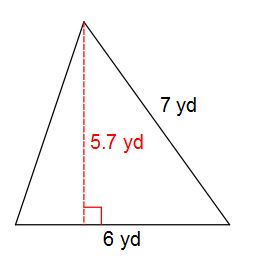
Find the area of the triangle.
a)
42 yd
b)
17.1 yd
c)
42 yd sq
d)
17.1 yd sq
99.
Find the perimeter of the triangle.
a)
16.5 cm
b)
13.4 cm sq
c)
13.4 cm
d)
15.8 cm
100.
Find the area of the triangle.
a)
25.5 cm sq
b)
16.83 cm sq
c)
18.51 cm sq
d)
15.81 cm sq
101.
Find the perimeter of the triangle.
a)
16 m
b)
17.9 m
c)
13.3 m 
d)
21 m
102.
The area of the triangle is 15.5 cm sq.  If the height of the triangle is 3.1 cm, what is the base?
a)
12
b)
11
c)
10
d)
9
103.
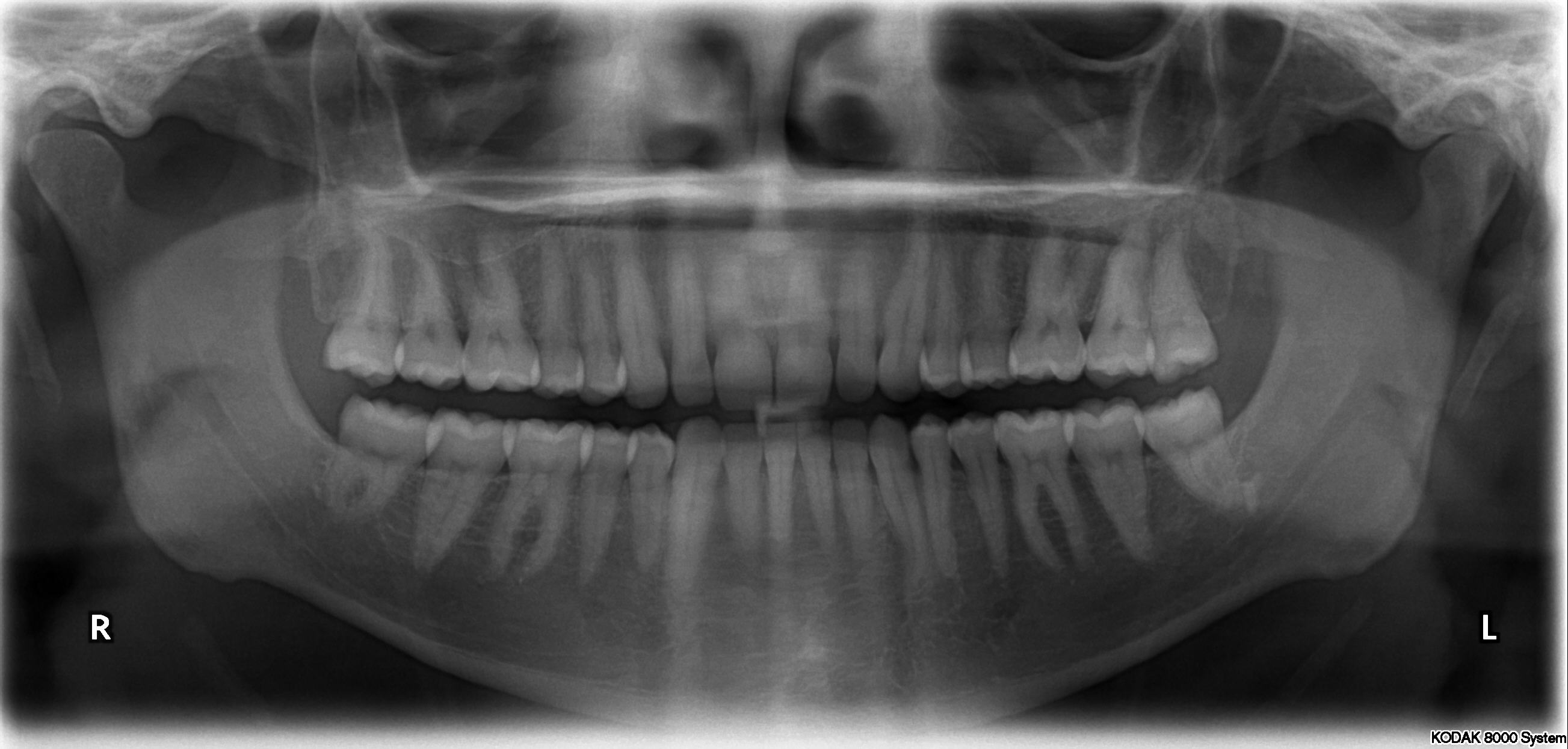
Dr. Dre is a dentist. He needs to report on the average number of cavities that his patients have.
1,0,1,5,6,3,4
a)
3.33
b)
2.85
c)
3
d)
3.5
104.
Find the mean of these numbers:
5,11,2,12,4,2
a)
4.1
b)
6
c)
4.5
d)
4
105.
Find the median of these numbers:
4,2,7,4,3
a)
2
b)
5
c)
7
d)
4
106.
Find the mean of these numbers:
2, 57, 38, 42, 6
a)
29
b)
38
c)
50
d)
145
107.
If there is an even number of data in the data set how do you find the median?
a)
order the data and find the middle value
b)
order the data add the 2 middle values and divide by 2
108.
Find the mean:
28, 18, 19, 18, 17
a)
20
b)
18
c)
11
d)
19
109.

Calculate the mean.

10, 4, 5, 9

a)

7

b)

5

c)

8

d)

4

110.
Find the mean:
28, 18, 19, 18, 17
a)
20
b)
18
c)
11
d)
19
111.
What is the mean of these numbers?
4,5,5,2,3,3,2,8
a)
40
b)
24
c)
4
d)
256
112.

25% of a circle is equal to:

a)

one-fifth

b)

a quarter

c)

a half

d)

two fifth

113.

32 people went to a ice hockey match. The pie chart shows the colours of their shirts. How many people wore black?

a)

45

b)


18\frac{1}{8}

c)

1

d)

4

114.

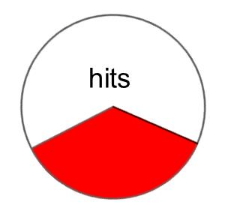
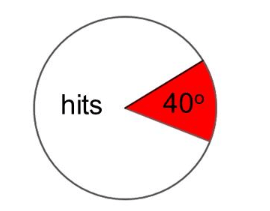
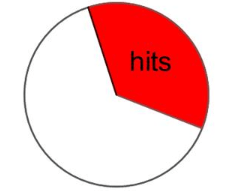
A darts player hits his target 40% of the time. Which pie chart represents his hits and misses?
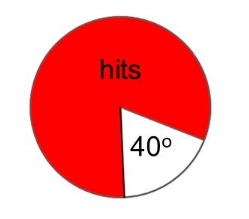
a)
b)
c)
d)
115.

This pie chart shows the colour of hats that Tom owns. Which colour hat does he own the second most of?

a)

red

b)

blue

c)

green

d)

yellow

116.

This pie chart shows the colour of hats that Tim owns. What fraction of Tim's hats are blue?

a)

14\frac{1}{4}

b)

2525

c)

13\frac{1}{3}

d)

impossible to say

117.

These pie charts show how people travel to work in 2 towns. In which town do more people travel to work by bike?

a)

town A

b)

town B

c)

both the same

d)

impossible to say

118.
Which Continent is home to 36% of the wild cats?
a)
Asia
b)
Africa
c)
North America
d)
South America
119.
Which Continent has the smallest % of wild cats?
a)
Asia
b)
Europe
c)
North America
d)
South America
120.

The pie chart shows the colours of 32 beads. How many green beads are there?

a)

90

b)

8

c)

11

d)

9

121.

The under 13's played 28 matches.

The under 15's played 18 matches.

Which team won more matches?

a)

Under 13's

b)

Under 15's

122.

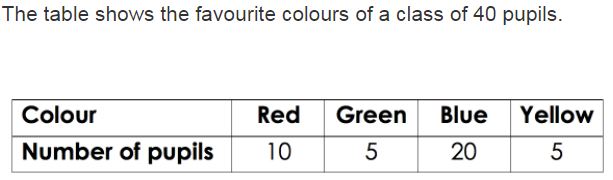
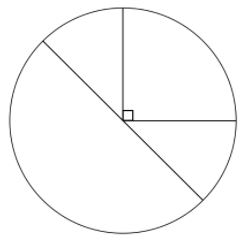
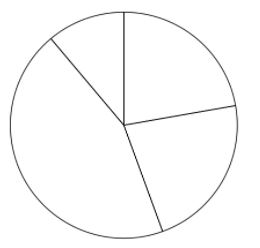
Which pie chart represents the same data as the table?
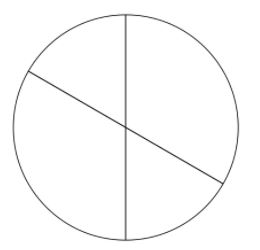
a)
b)
c)
d)
123.
There are 200 vegetable plants in a garden.  How many of the vegetable plants are green beans?
a)
16
b)
24
c)
28
d)
32
124.

600 people were surveyed. How many people rode the stationary bikes that day?

a)

150 people

b)

120 people

c)

90 people

d)

None of these