
 Worksheets
Pre-Calc Exam Review
Total questions: 122
Worksheet time: 6hrs 28mins
What does the transformation f(x) → f(x+1)−9 do to the graph of f(x) ?
translates it left one unit and down 9 units
translates it right one unit and down 9 units
translates it up one unit and right 9 units
translates it down one unit and left 9 units
Given the function y=(x+4)2+2 , what is the parent function?
y=x2
y=a(x−h)2+k
y=mx+b
y=0(x−0)2+0
What does the transformation f(x) → f(x+1)−9 do to the graph of f(x) ?
translates it left one unit and down 9 units
translates it right one unit and down 9 units
translates it up one unit and right 9 units
translates it down one unit and left 9 units
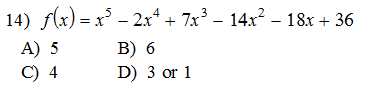
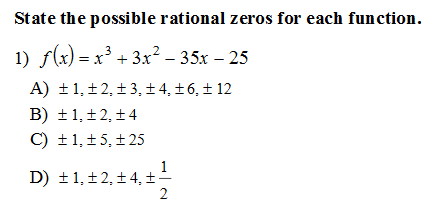
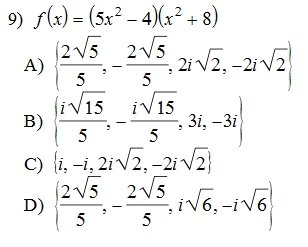
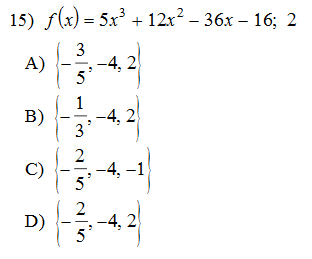
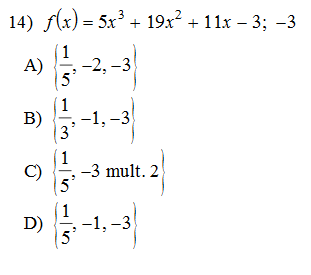
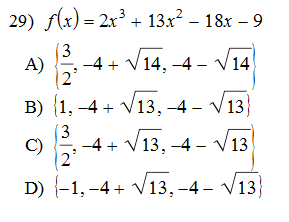
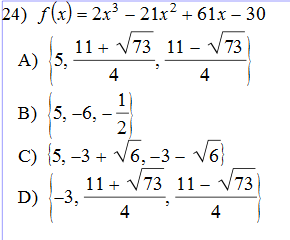
What is another zero?
(3 + 2i) + (4i + 6)
(-7+6i)2
49+36i
85
13-84i
13+84i
log381
3 log24
52 = 25
log232 = 5
logx1000=3
1
10
30
3
log2(x+3)=4
16
13
3
10
Solve: 3x=18
x = 6
x = 2.5
x = 2.63
2.47
Solve: 6x + 3 = 129
x = 21
x = 2.69
x = 2.43
x = 3.5
Solve log(1000)=x
x = 10
x = 3
x = 4
x = 100
log9(x)+log9(x+2)=log9(35)

Paul deposits $4000 in a bank which pays a compound interest rate of 4% per year. How much will he have in 5 years.
$4866.61
$5628.40
$6077.53
$6326.60
Interest Rate: 3.75%
Time: 25 years
Compounded Monthly
State the future account balance.


f(x)=log5(x+4) - 2
Describe the asymptote
Horizontal Asymptote x = -4
Vertical Asymptote x = -4
Horizontal Asymptote x = 4
Vertical Asymptote x = 4

f(x)=log5(x+4) - 2
Describe the transformation
translation 4 units to the right, 2 units down
translation 4 units to the left, 2 units down
translation 4 units to the up, 2 units right
translation 4 units to the up, 2 units left

What is the DOMAIN of the above graph?
−5<x<4
−5<y<−2
−5≤x≤4
−5≤y≤−2
What is the RANGE of the above graph?
−5<x<4
−5<y<−2
−5≤x≤4
−5≤y≤−2
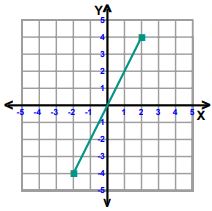
What is the domain in Interval notation?
[ -2 , 2 ]
[ 4 , -4 ]
(-2 , 2 )
(4 , -4 )

What is the range of the graph?
[-7, 5)
(-3, 1]
[-3, 1)
(-7, 5]
f(x)=x−51 Find the domain of
(−∞,5)(5,∞)
[5,∞)
(−∞,5]
(−∞,∞)
Find the domain of f(x)=7−xx2
(−∞,0)(0,7]
(−∞,∞)
(−∞,7)
(−∞,7)(7,∞)
Write the domain of f(x)=x2−16x
(−∞,0)(4,∞)
[4,∞)
(−∞,0)(0,4]
(−∞,−4)(−4,4)(4,∞)
Find the domain of g(x)=2x−4
(−∞,2)(2,∞)
[2,∞)
(−∞,2]
(−∞,21)(21,∞)
Find the domain of f(x)=x−51
(−∞,5]
(−∞,5)(5,∞)
(5,∞)
[5,∞)

What is the domain of f(x)=x2+3x−10
[5,∞)
(−∞,−2]
(−∞.∞)
[-2,5]
g(x) = x+3,
Find f(x) * g(x)
g(x) = x - 2
Find f(g(5))
g(n) = n2 + 5n
f(n) = n + 4
Find g(f(n))
n2 + 3n + 36
n2 + 13n + 16
n2 + 13n + 36
n2 + 3n + 20
f(a) = a2 + a - 3
g(a) = 3a
Find f(g(a))
9a2 - 3a + 3
9a2 + 3a - 3
3a2 - 3a + 3
3a2 + 3a - 3
If f(x)=2x+1 and g(x)=3x+2
f(g(x)) = 6x + 4
f(g(x)) = 6x + 5
f(g(x)) = 5x + 8
f(g(x)) = 5x + 5
If f(x)=x2−5 and g(x)=2x−3
-5
-3
0
2
FInd the inverse of the function.
f(x)=23x−15
f−1(x)=−x−5
f−1(x)=3x+5
f−1(x)=315+2x
f−1(x)=32x−319
Find the inverse of the function.
f(n)=−4−52n
f−1(n)=2−6−5n
f−1(n)=3n−4
f−1(n)=−25n−10
f−1(n)=5−2n−4
h(x)=−x−12−3
Find the inverse of the function.
h−1(x)=−x−32+1
h−1(x)=−x+22−1
h−1(x)=−x+32
h−1(x)=−x−33−2
f(n)=−n3+2
Find the inverse of the function.
f−1(n)=(n+1)5
f−1(n)=3−n+2
f−1(n)=2n5
f−1(n)=(n+3)5


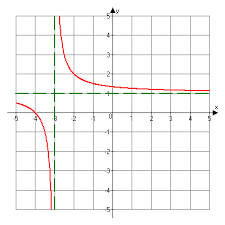
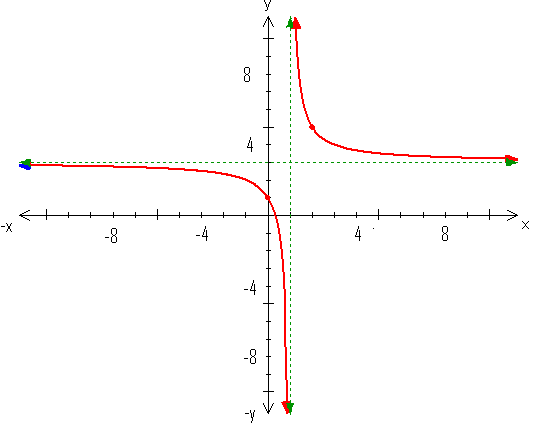
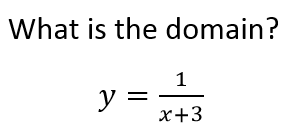
Use the quadratic formula to find the solutions for
y = -x2 - 5x + 12
No Real Solution


w2+7w+4=0
2−7±33
2−7±65
27±33
2−7±311
x2−6x+4=0
3±5
26±20
3±20
3±i13
y2=−9−9y
2−9±117
29±45
2−9±35
29±53
Solve using long division. (8x2+6x−20)÷(4x−5)
2x−4
2x+4
2x−1−4x−516
2x−4−4x−540

Use long division algorithm.
4x - 2
4x + 2
2x - 4
2x + 4
If sinθ=54 , then cscθ=
54
−54
−45
45
Find a coterminal angle to 45°.
360°
405°
315°
295°
Convert 150⁰ to Radians
5π/6
3π/4
7π/6
2π/3
Convert 210o to Radians
7π / 6
21π / 10
5π / 6
9π / 4
g(x) = x - 2
Find g(f(-10))
g(x) = x - 2
Find f(g(0))
g(x)=3x+4
h(x)=3x-1
Find (gh)(x)
-9x+11
4x2+4x
9x2+9x - 4
9x+11


(10, 1) and (5, 2)
Write the equation of a line in point slope form that passes through (3,8) and has a slope of 5.
y-8=5(x-3)
y=5x+8
y-3=5(x-8)
y-y1= m(x-x1)
What is the equation of the line y + 5 = -3(x - 6) in slope intercept form?
y = -3x - 23
y = -3x -13
y = -3x - 11
y = -3x+13
m = 5/4 through (-4, -3)
(x2y3)−3(x6y)−4
x5y
x18y5
x18y5
x5y
y=x4−6x3+5
Is the function even, odd or neither?
even
neither
odd
y=9x5−6x4x5
Is the function even, odd or neither?
even
neither
odd
y=4x+8x2−9 Find the horizontal asymptote.
none
y=1/4
y=1
y=0
y=4x+8x2−9
Find the vertical asymptote(s).
x = -2
x = 1/4
x = -3
x = 3
f(x)=x−91 g(x)=x+13
Find the domain of f(g(x)).
[-13, 94) U (94, oo)
[-13, 68) U (68, oo)
[-13, oo)
(-13, oo)
f(x)=x2−9 g(x)=x+3
Are f and g inverses? Find this using composition.
no
yes

Identify the degree of the polynomial and the sign of the leading coefficient
Degree - Even
Degree - Odd
Degree - Even
Degree - Odd

As x --> -∞, f(x) --> ____
As x --> +∞, f(x) --> ____
-∞
-∞
+∞
+∞

y=−2x4(x+3)(x−2)
Select the zeros and their multiplicities.
x=0, mult. 4
x=2, mult. 4
x=2, mult. 1
x=-3, mult. 1
x=-2, mult. 4
y=−2x4(x+3)(x−2)
Select the degree and leading coefficient.
Degree = even, LC = negative
Degree = odd, LC = negative
Degree = even, LC = positive
Degree = odd, LC = positive

A
B
C
D

A
B
C
D

A
B
C
D
Expand the following: log7(4x)
log7(4)+log7(x)
log7(4)−log7(x)
log7(x4)
4log7(x)
lognn= (a)
Expand the following: log5(z8)
5log8(z)
8log5(z)
log5(8z)
8+log5(z)
Simplify the following: log324−log36
log318
log3144
log34
log12
18log3
Expand the following: log(j4k7)
log(4j)+log(7k)
11log(j+k)
28log(jk)
4log(j)+7log(k)
Simplify the following: log4x+log4x
log4(x2)
log4(2x)
log16(x2)
log8(2x)
log4x
Simplify the following: log5(3)+log5(r)−log5(w)
log5(3rw)
log5(3+r−w)
log5(w3r)
log5(w)log5(3r)
Expand the following: log2(5a10)
hint: 5a10=5⋅a10
log25+10log2a
10log25+log2a
log2(50a)
log250+log2a
10log25−10log2a
Is the following true or false? Explain your answer!!
log6(10)+log(4)=log6(40)
Solve the equation for x: x+22+x −25=x2−46
7
6
14
0
Solve for x: x−25+x2−2xx−6=x1
x = 5
x = 54
x = 1
x = - 4
n−82n+16=2n−161−21
−523
7
−4
34

(a)

x→1 limf(x)=
(a)

x→1lim g(x)
(a)

