
 Worksheets
Exam 1 Review
Total questions: 53
Worksheet time: 18mins
Which statement best summarizes the opinion concerning segregation in Brown v. Board of Education?
The Fourteenth Amendment does not mention public education.
Some earlier court decisions allowed schools to segregate students on the basis of race.
It is unconstitutional for public schools to segregate students on the basis of race.
An earlier court decision allowed “separate but equal” school facilities for white and African American children.
Who helped launch the Montgomery, Al bus boycotts?
MLK Jr.
Rosa Parks
Little Rock 9
Malcolm X
Emmett Till
Segregation laws instituted by states following the Civil War were known as:
Discrimination Laws
Jim Crow Laws
Lincoln Laws


What is the name of the first 10 amendments?
Constitution
Declaration of Independence
Bill of Rights
Articles of Confederation
Separate but Equal
Dread Scott v. Sanford
Plessy v. Ferguson
Miranda v. Arizona
Brown v. Board of Education
desegregation of schools
Schenck v. U.S.
Griswold v Connecticut
Miranda v. Arizona
Brown v. Board of Education
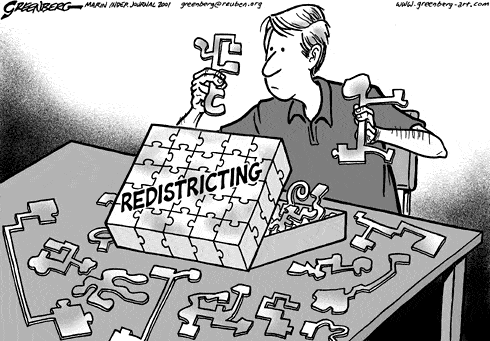

Reapportionment is:
When district boundaries are drawn in order to benefit the party in power and help it stay in power
When seats in the House of Representatives are redistributed among states because of changes in population
When district boundaries are redrawn to reflect changes in population.
A measurement of the US population that occurs every ten years
clear and present danger
Schenck v. U.S.
Griswold v Connecticut
Plessy v. Ferguson
Brown v. Board of Education
right to privacy
Plessy v. Ferguson
Schenck v. U.S.
Griswold v Connecticut
Dread Scott v. Sanford
5th Amendment to the states
Dread Scott v. Sanford
Miranda v. Arizona
Brown v. Board of Education
Schenck v. U.S.
Separate but Equal
Dread Scott v. Sanford
Plessy v. Ferguson
Miranda v. Arizona
Brown v. Board of Education
desegregation of schools
Schenck v. U.S.
Griswold v Connecticut
Miranda v. Arizona
Brown v. Board of Education
slaves were not to be considered citizens
Miranda v. Arizona
Dread Scott v. Sanford
Plessy v. Ferguson
Schenck v. U.S.
burning the American flag was protected speech under the First Amendment
Barron v. Baltimore
Texas v. Johnson
Citizens United v. FEC
Miranda v. Arizona
Freedom of the Press
Gideon v. Wainwright
Griswold v Connecticut
Schenck v. U.S.
New York Times v. U.S.
federalism in US constitutional law
Barron v. Baltimore
Citizens United v. FEC
Dread Scott v. Sanford
Griswold v Connecticut
campaign finance laws and free speech under the First Amendment
Schenck v. U.S.
Citizens United v. FEC
New York Times v. U.S.
Gideon v. Wainwright
exclusionary rule
Mapp v. Ohio
Plessy v. Ferguson
Brown v. Board of Education
Miranda v. Arizona
provide attorneys to criminal defendants who are unable to afford their own
Texas v. Johnson
Dread Scott v. Sanford
Gideon v. Wainwright
Positive vs. Negative Rights
Conferred the right to have an abortion
Mapp v. Ohio
Texas v. Johnson
New York Times v. U.S.
Roe v. Wade
Governmental authority shared by national and state governments, such as the power to tax residents
(a)
the transfer of authority from the national to the state or local government level
(a)
National government funding provided to state and local governments with relatively few restrictions or requirements on spending. block grant programs introduced a trade-off for state officials: more authority, few funds.
(a)
The Constitutional declaration empowering Congress to regulate commerce with foreign nations, between states, and with Indian tribes.
(a)
The first ten amendments of the U.S. Constitution, listing the rights guaranteed to every citizen.
Constitution
Bill of Rights
Magna Carta
Power divided between national and state government. Each has its own sovereignty (independent authority) and its own duties
(a)
A compact invoking religious or moral authority
Compact
Covenant
A mutual agreement that provides for joint action to achieve defined goals
Compact
Covenant
Who passes federal laws
(a)
Who enforces laws
(a)
Who decides disputes between states
(a)
Who was Daniel Shay?
All citizens enjoy the same privileges, status, and rights before the law.
(a)
All individuals enjoy the same status in society
Social Equality
Political Equality
Economic Equality
All citizens have the same political rights and opportunities
Social Equality
Political Equality
Economic Equality
A situation in which there are only small differences in wealth between citizens.
Social Equality
Political Equality
Economic Equality
Americans who value cultural diversity, government programs for the needy, public intervention in the economy, and individuals' right to a lifestyle based on their own social and moral positions. Also known as left or left-wing.
(a)
The ability to pursue one's own desires without interference from others.
(a)
Freedom from constraints or the interference of others
Positive Liberty
Negative Liberty
The ability and provision of basic necessities to pursue one's goals
Positive Liberty
Negative Liberty
No Limits
Constitutional
Totalitarian
Authoritarian
Codified
Constitutional
Totalitarian
Authoritarian
Few Legal Limits
Constitutional
Totalitarian
Authoritarian
Small Group
Oligarchy
Democracy
Autocracy
One Person
Oligarchy
Democracy
Autocracy
Many People
Oligarchy
Democracy
Autocracy
Americans who believe in reduced government spending, personal responsibility, traditional moral values, secure borders, and a strong national defense. Also known as right or right-wing.
(a)

