
Font size
 Worksheets
1103 Unit 1 Review
Total questions: 51
Worksheet time: 26mins

Which of the following is NOT an example of a natural resource?
Coal
timber
plastic
none of the above
sunlight

Predicted results/ observations that do not correlate with the actual results/observations ___________ your hypothesis.
supports
proves
refutes
disproves
none of the above

Environmentalism is the study of how the natural world works, how our environment affects us, and how we affect our environment.
True
False

A person holding a sign during a protest against cutting down trees in a forest would be considered a(n):
environmentalist
ecological footprint
peer reviewer
environmental

Which of the following is an example of quantitative data?
There are 3 tulips
Tulips are red
The tulips are prettier then the rose
The tulips smell nice

Results published in __________ are the most respected in science because they have passed through a rigorous evaluation process involving feedback from multiple sources.
news magazines
peer-reviewed journals
web journals
weekly newspapers
none of the above

A human centered view of our relationship with the environment is known as _____?
Biocentrism
ecocentrism
anthropocentrism
environmentalism
The study of good and bad, right and wrong
Ethics
Universalist
Utility
Values
The fundamental unit of matter
cell
atom
quarks
solution
The negatively charged particle of an atom.
Proton
Neutron
Electron
Quarks
are formed when two or more atoms are chemically bind to one another.
Element
Compound
Mixture
Colloids
Who were the hunter-gatherers?
A tribe of people who travel across the Isthmus.
People who obtain food by collecting plants and by hunting wild animals or scavenging their remains.
One of the indigenous people of the Southeastern Woodlands
were the seafaring Norse people from Southern Scandinavia.
What is agriculture?
is the science by which matter and energy are made useful to humans in structures, machines and products.
is the study of human population dynamics and statistics.
is the practice of growing, breeding, and caring of plants, animals used for food, clothing, housing, transportation, and other purposes.
is a combination of rapid climate changes.
All of the changes below happened during the Industrial Revolution except for...
Alexander Graham Bell invented the telephone.
There was a shift from energy sources such as animal muscle and running water to fossil fuels, such as coal and oil.
The use of fossil fuels and machines, such as steam engines, changed society and greatly increased the efficiency of agriculture, industry, and transportation.
The large-scale production of goods in factories became less expensive than the local production of handmade goods.
Three of the statements below are effects of the Industrial Revolution. Which one isn't an effect?
On the farm, machinery further reduced the amount of land and human labor needed to produce food.
Fewer people grew their own food, populations in urban areas steadily grew.
Fossil Fuels and motorized vehicles also allowed food and other goods to be transported cheaply across great distances.
As grasslands, forests and wetlands were replaced with farmland, habitats were destroyed.

What type of growth is shown on the right side of this graph?
Linear
Exponential
Logarithmic
Decreasing
REVIEW: Which of the following is a step in the Nitrogen Cycle?
Nitrogen gas is absorbed by animals
Nitrogen is released into the soil from wastes
Factories release carbon dioxide from burning fossil fuels
People exhale nitrogen gas through respiration
Which of the following make up our Ecological Footprint? Select all that apply.
Carbon use
Land used for forestry
Land used for cities
Land used for food
Which of the following is true about the average US ecological footprint?
The average US ecological footprint is the same as Earth can provide
The average US ecological footprint is less than Earth can provide
The average US ecological footprint is more than Earth can provide
__________________ is the process by which moisture is carried through plants from roots to small pores on the underside of leaves, where it changes to vapor and is released to the atmosphere. It is essentially evaporation of water from plant leaves.
Transpiration
Percolation
Infiltration
Plant Uptake
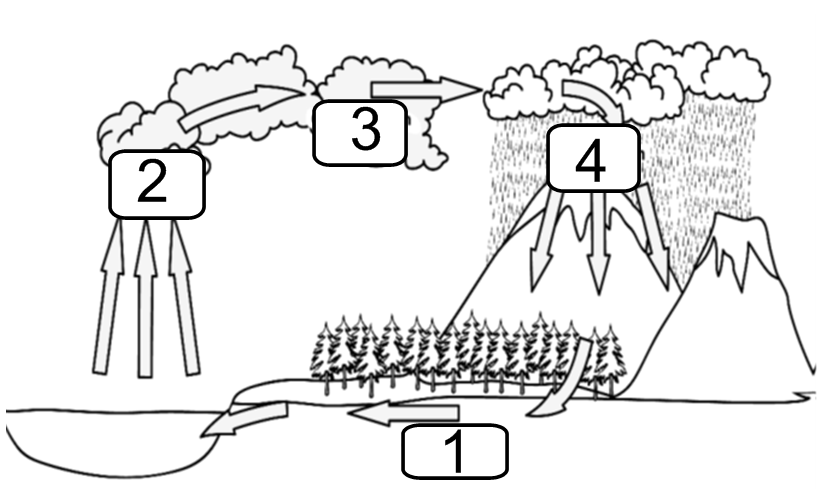

Why does cutting down trees contribute to global warming
Trees soak up CO2 from the air
Trees provide shade, which counteracts global warming
Trees absorb the sun’s energy without radiating any back into the atmosphere
Trees drain greenhouse gases like methane from the soil
Earth is considered a system because energy and matter are transferred or exchanged throughout its _ major spheres.
two
four
three
five
In a closed system, _.
energy is removed from the system's surroundings
energy and matter are transferred or exchanged with the system's surroundings
energy and matter are removed from the system's surroundings
energy is transferred or exchanged with the system's surroundings
Fresh water makes up _ of our planet's water supply.
15%
3%
97%
2%
The element nitrogen makes up the _.
smallest percent of our geosphere
largest percent of our atmosphere
smallest percent of our atmosphere
largest percent of our geosphere
A _ include the part of the Earth that contains all living organisms.
geosphere
atmosphere
biosphere
Atoms of the same element that differ from one another in the number of neutrons they contain
Cell
Compound
Element
Isotopes
Which of the following substances is inorganic?
table salt
peanut oil
orange juice
brown sugar

What is the manipulated variable in the experiment above?
The overal growth of each plant
The length of time that each plant grows
The amount of water that each plant received
The brand of fertilizer that is used on each plant

Which of the following conclusions is supported by the results of the experiment?
Nitrogen promotes root growth, and phosphorous promotes leaf growth.
Nitrogen promotes root growth, and phosphorous promotes flower growth.
Nitrogen promotes leaf growth, and potassium promotes root growth.
Nitrogen promotes leaf growth, and potassium promotes flower growth.
Which of the following substances is organic?
Silicon
Sulfur
Sugar
Salt

Which species has the greatest number of organisms present in the lake when the water is at a neutral pH?
Species A
Species B
Species C
Species D

If acid rain falls into the lake and changes the pH of the water from 6.3 to 5.0, then the species that is expected to increase in number of organisms is
Species A
Species B
Species C
Species D
Which of the following roles is played by carbohydrates in human nutrition?
Provide structural component of cells in the body
Store unused chemical energy
Act as an energy source
Assist enzyme function
Which of the following actions most clearly represents biological monitoring used to determine environmental quality?
The number and diversity of invertebrate species in a pond near a wastewater treatment plant are measured over 10 years.
The pH of a river is measured every two months for five years to track the impacts of a local industry.
The concentration of mercury in groundwater near a waste-disposal site is tracked over two years.
The population of geese in a wetland is measured and is compared to the population size 10 years ago.
Lipids are __________?
Organic
Inorganic
Too much of a good thing, such as _____________ and _________________nutrients in the lakes and ponds can cause an imbalance resulting in eutrophication
oxygen
phosphorus
xenon
nitrogen
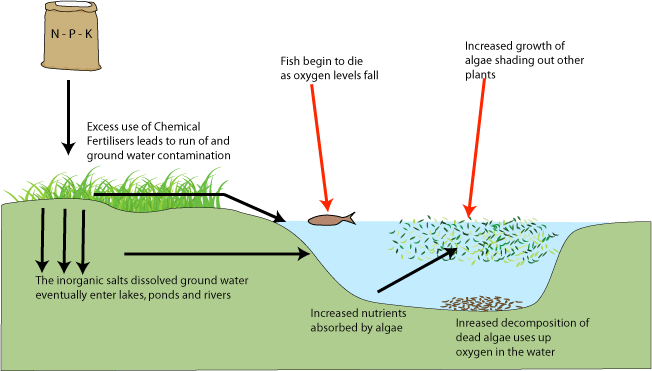
An increase in the amount of nutrients in a lake is known as
calcification
cellular respiration
eutrophication
photosynthesis
This is a chemical found in water from detergents
nitrates
turbidity
pH
phosphates
True or False? If water has a pH of 7.1, then it is good quality fresh water.
True
False

