wayground logo

Free Printable Worksheets

Font size

S
M
L
XL
Worksheets

Revision Inheritance and Space

Total questions: 56

Worksheet time: 34mins

Name
Class
Date
1.

Suppose it is 9:00 PM here in Dubai, what time will it be in the USA if Dubai is 8 hours ahead?

a)

10:00 PM

b)

10:00 AM

c)

1:00 PM

d)

1:00 AM

2.

Which are the planets in the Solar System

a)

Mercury, Earth, Pluto, Mars, Neptune, Saturn, Uranus, Venus

b)

Mercury, Venus, Earth, Mars, Jupiter, Saturn, Uranus, Neptune

c)

Earth and Only Earth

3.
How long is Earth's rotation?
a)
one day
b)
one year
c)
one decade
d)
one hour
4.
Why do other stars appear so much smaller than the sun?
a)
They are much smaller
b)
They are so far away
c)
They are not as bright
d)
They are dwarf stars
5.
What color of star is the hottest?
a)
Blue
b)
Red
c)
Yellow
d)
Orange
6.
What is the name of the largest stars?
a)
Protostars
b)
Supergiants
c)
Red Giants
d)
Dwarf Stars
7.
What color of star is the coolest?
a)
Red
b)
Yellow
c)
Blue
d)
White
8.
The color of the star tells us its 
a)
composition
b)
Temperature
c)
Luminosity 
d)
Mass
9.
Which star has the lowest luminosity?
a)
A
b)
B
c)
C
d)
D
10.
Which star has the lowest temperature?
a)
A
b)
B
c)
C
d)
D
11.
Why would you weigh more on Jupiter than you do on Earth?
a)
Jupiter has more mass and more gravitational pull
b)
Jupiter has less mass and less gravitational pull
c)
You would not weigh more on Jupiter
d)
Jupiter has more mass and less gravitational pull
12.

What is the difference between mass and weight?

a)

Mass is the force of gravity acting on you and weight is how much space you take up

b)

Mass is how much space you take up and weight is the force of gravity acting on you

c)

Mass is the force of gravity acting on you and weight is how much matter you have

d)

Mass is how much matter you have and weight is the force of gravity acting on you

13.

A solar eclipse is caused when the (a)   passes directly in front of the sun

14.
What force keeps the planets orbiting the sun?
a)
Gravity
b)
Magnetism
c)
Electricity
d)
Friction
15.

The greater mass a planet has,

a)

the greater the gravitational force it has

b)

the less gravitational force it has

c)

gravitational force does not depend on mass

16.
How long does it take from one full moon to the next full moon?
a)
About one day.
b)
About one year
c)
About one season
d)
About one month.
17.

What happens when the area you live in tilts away from the sun?

a)

It is summer

b)

It is spring

c)

It is fall

d)

It is winter

18.
The lunar cycle begins with which moon phase?
a)
New Moon
b)
Full Moon
c)
Waxing Crescent
d)
Waning Gibbous 
19.
When a planet spins on its axis, it is said to ___________________.
a)
orbit
b)
rotate
c)
revolve
d)
eclipse
20.
What you see, or the physical appearance.
a)
Genotype
b)
Phenotype
c)
Homozygous
d)
Heterozygous
21.

Aa, DD, Ba, and yy are all examples of ---

a)

genotypes

b)

phenotypes

22.
Which of the following genotypes is heterozygous?
a)
Bb
b)
BB
c)
bb
d)
B
23.
An organism’s physical appearance, or visible traits. 
a)
Genotype
b)
Phenotype
c)
Beanotype
d)
Notype
24.
Which of the following is homozygous dominant?
a)
Yy
b)
Y
c)
yy
d)
YY
25.
What allele combination should go in the missing box?
a)
AA
b)
Aa
c)
aa
d)
none of these
26.
What is the probability of heterozygous offspring?
a)
25%
b)
50%
c)
0%
d)
100%
27.

If black fur is dominant and white fur is recessive, what genotype would an organism with white fur have?

a)

FF

b)

Ff

c)

ff

28.

Where is DNA found???

a)

Cell membrane

b)

Nucleus

c)

Cell wall

d)

Auditorium

29.

How many chromosomes do human cells have?

a)

46

b)

23

c)

2

d)

44

30.
What is a gene?
a)
A bundle (like a hot dog bun) that the DNA is packed into
b)
something inside the nucleus
c)
a piece of DNA
d)
all of your DNA
31.
Which of the following best describes a DNA molecule?
a)
double helix
b)
contains ribose
c)
made of amino acids
d)
contains Uracil
32.

a)

A

b)

B

c)

C

d)

D

33.

a)

A

b)

B

c)

C

d)

D

34.

a)

A

b)

B

c)

C

d)

D

35.

a)

A

b)

B

c)

C

d)

D

36.

a)

A

b)

B

c)

C

d)

D

37.

_______ are the different forms of a gene.

a)

Duplicates

b)

Genes

c)

Pairs

d)

Alleles

38.

A _________ shows phenotypes of genetically related family members.

a)

Pedigree

b)

Punnett Square

c)

Codominance

d)

Genetic Chart

39.

A __________ is a model used to predict possible genotypes and phenotypes of offspring.

a)

Pedigree

b)

Punnett Square

c)

Codominance

d)

Genetic Make-up

40.

What is HETEROZYGOUS?

a)

AA or aa

b)

Aa

c)

Organism that has identical alleles for a trait

d)

Organism that has two different alleles for a trait

41.

Alleles that are hidden whenever the dominant allele is present

a)

Dominant alleles

b)

Recessive alleles

c)

Homozygous

d)

Heterozygous

42.

Alleles whose trait always shows up when the allele is present

a)

Dominant alleles

b)

Recessive alleles

c)

Phenotype

d)

Genotype

43.
In the punnett square shown, what must the genotype of the missing parent be?
a)
BB
b)
Bb
c)
bb
d)
Tt
44.
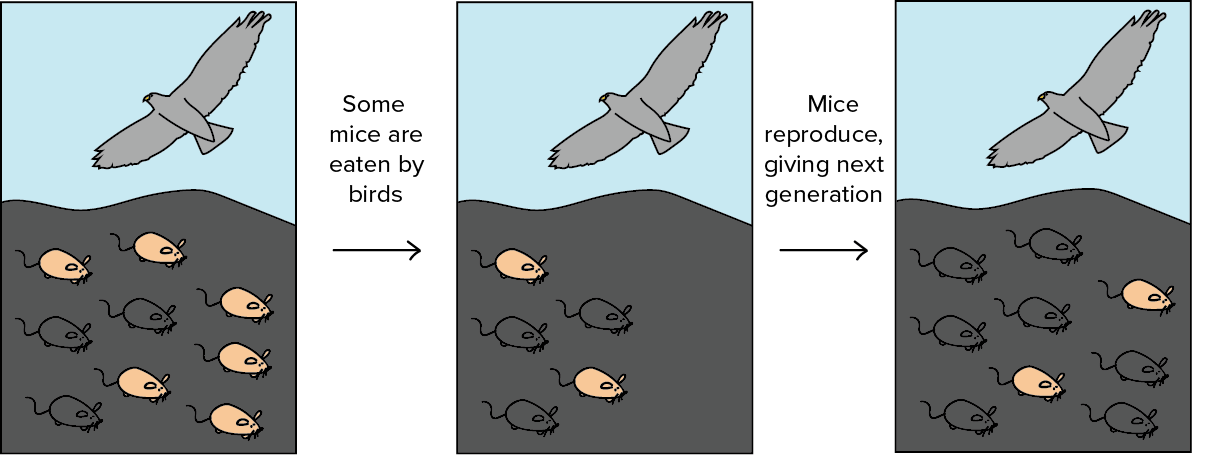
Why is the mouse population changing over time?
a)
The light mice can reproduce more successfully than the dark mice
b)
The hawks eat more dark mice than light mice because the dark mice taste better
c)
The hawks eat more light mice than dark mice because they can see the light mice more easily
d)
The hawks eat more dark mice than light mice because they can see the dark mice more easily
45.
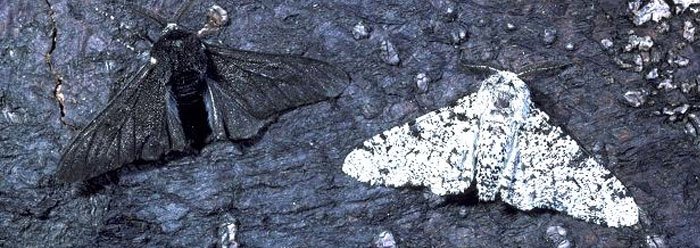
The trees these moths used to live on were white, but have been covered in soot from coal factories. Which moth will be more successful in this environment?
a)
Dark moth
b)
Light moth
c)
Both will be equally successful
d)
Neither will be successful
46.

What is genetic variation?

a)

Long strands of DNA that contain lots of genes.

b)

Different versions of a gene.

c)

The basic unit of heredity; controls a specific trait.

d)

A characteristic passed from parent to offspring

e)

The differences that occur from a mixture of genes

47.

What is a gene?

a)

Long strands of DNA that contain lots of genes.

b)

Different versions of a gene.

c)

The basic unit of heredity; controls a specific trait.

d)

A characteristic passed from parent to offspring

e)

The differences that occur from a mixture of genes

48.
Purple (P) is dominant to the white (p).
According to the Punnett Square, what is the probability of an offspring being purple?
a)
25%
b)
0%
c)
100%
d)
50%
49.
What does a filled in square represent?
a)
Not affected Female
b)
Not affected Male
c)
Affected Male
d)
Affected Female
50.
How many generations are shown in this pedigree?
a)
1
b)
2
c)
3
d)
4
51.
What do half colored symbols represent?
a)
The individual is a carrier (heterozygous).
b)
The individual expresses the trait.
c)
The individual has both recessive alleles.
d)
The individual has both dominant alleles.
52.
In the second generation-how many people are carriers of the trait?
a)
2
b)
3
c)
5
d)
6
53.
How many kids did the mother and father from the first generation have?
a)
2
b)
4
c)
5
d)
6
54.

How many males are color-blind in this family?

a)

2

b)

3

c)

4

d)

5

55.

Sam and Madeline are having another baby. Which statement is true?

a)

The baby will inherit the trait.

b)

The baby will be a carrier for the trait.

c)

The baby will not inherit or carry the trait.

d)

None of these are correct.

56.

What is the genotype for individual I-1?

a)

aa

b)

AA

c)

Aa