wayground logo

Free Printable Worksheets

NEW

Font size

S
M
L
XL
Worksheets

Life science - Chapter 1

Total questions: 51

Worksheet time: 31mins

Name
Class
Date
1.

Stimulus is

a)

organisms that are made up of more than one cell

b)

a membrane-covered structure that contains all of the materials necessary for life.

c)

a change that affects the activity of an organism.

d)

the maintenance of a stable internal environment.

2.
Green plants produce their own food through the process of photosynthesis.
a)
All living things use energy
b)
All living things contain cells
c)
All living things maintain homeostasis
d)
All living things grow
3.
A camel has eyelashes that work to keep the dust and sand out of its eyes.
a)
All living things adapt to their environment
b)
All living things grow
c)
All living things have cells
d)
All living things use energy
4.
Over three years, Tim's height has increased from 5'4" to 5'11".
a)
All living things contain cells
b)
All living things maintain homeostasis
c)
All living things use energy
d)
All living things grow
5.
The roots of a plant grow towards a source of ground water.
a)
All living things use energy
b)
All living things reproduce
c)
All living things respond to their environment
d)
All living things grow
6.
YOU are a multi-celled organism but an amoeba is a single celled organism.
a)
All living things have cells
b)
All living things grow
c)
All living things use energy
d)
All living things respond to their environment
7.
YOU are a multi-celled organism but an amoeba is a single celled organism.
a)
All living things have cells
b)
All living things grow
c)
All living things use energy
d)
All living things respond to their environment
8.

Living things are made up of units called

a)

DNA

b)

Cells

c)

Homeostasis

d)

Seeds

9.
Rocks are not living because
a)
they never move
b)
they aren't needed for humans
c)
they are not made of cells
d)
they don't break down
10.

Baby, child, pre-teen, teenager, adult refers to what characteristic of life?

a)

Growth and development

b)

Evolution

c)

Heredity

d)

Responding to the environment

11.
A microscope is an instrument that.
a)
makes faraway objects look closer.
b)
makes small objects appear larger.
c)
decreases the size of small objects.
d)
increases the size of small objects.
12.
If your teacher asks you to move a microscope to table, how do you carry it?
a)
by the body tube and the eyepiece
b)
with one hand
c)
one hand on the arm and the other under the base
d)
with one hand on the base and the other on the eyepiece.
13.
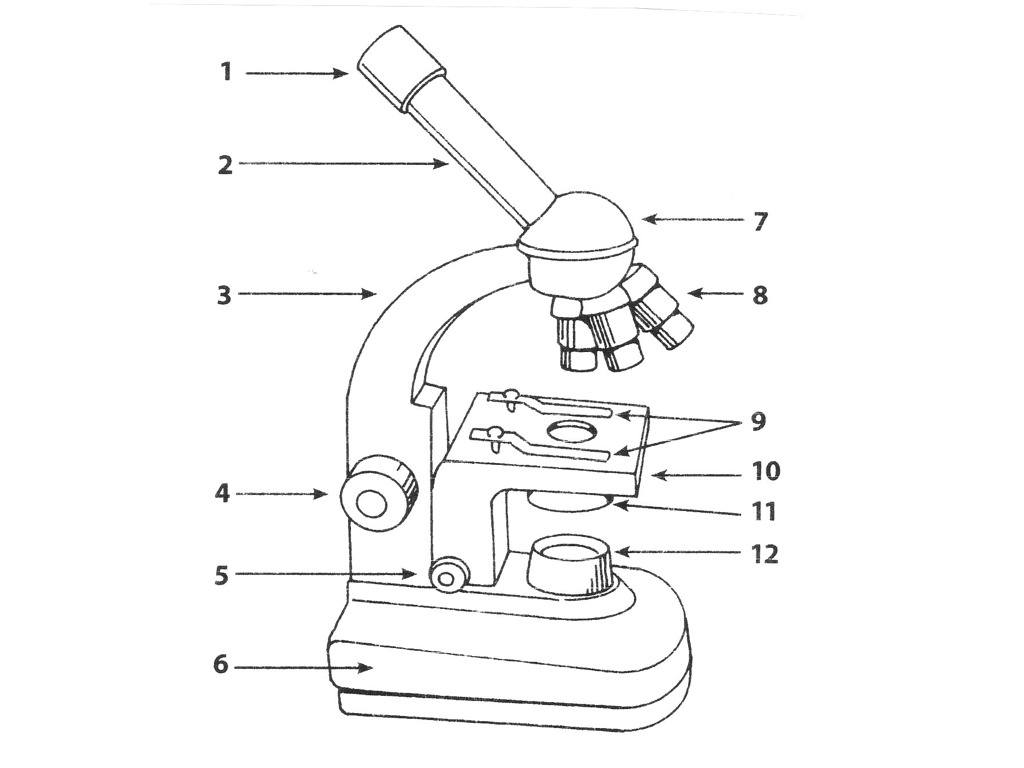
What is part 1?
a)
eye piece
b)
body tube
c)
arm
d)
coarse adjust
14.
What part is 3?
a)
eye piece
b)
base
c)
arm 
d)
coarse adjust
15.
What is part 11?
a)
coarse adjustment
b)
fine adjustment
c)
diaphragm
d)
stage
16.
What is part 6?
a)
arm 
b)
base
c)
body tube
d)
illuminator
17.

Moves stage up and down for focusing; locates the specimen

a)

Fine Focus Knob

b)

Large Focus Knob

c)

Course Focus Knob

d)

Small Focus Knob

18.
What will be the total magnification if ocular lens is 10X and objective lens is 4X?
a)
4X
b)
40X
c)
10X
d)
100X
19.
What will be the total magnification if the ocular lens is 10X and the objective lens is 40X?
a)
40X
b)
10X
c)
100X
d)
400X
20.

The microscopes we used in class had three ________________ which allows different amounts of magnification.

a)

detail

b)

magnification

c)

objectives

d)

body

21.

The smallest objective we used in class was _____X.

a)

two

b)

three

c)

four

d)

five

22.
Part 11
a)
Stage Clips
b)
Stage
c)
Diaphragm
d)
Illuminator
23.
Part 12
a)
Fine Adjustment Knob
b)
Coarse Adjustment Knob
c)
Diaphragm
d)
Objective
24.
Holds objective lenses; Rotatates to change objectives
a)
Arm
b)
Base
c)
Revolving Nosepiece
d)
Diaphragm
25.
Which of the following is NOT one of the basic points of Cell Theory?
a)
All living things are made of cells.
b)
The cell is the smallest living thing that can perform all the functions of life.
c)
Cells are too small to see without a microscope.  
d)
All cells must come from pre-existing cells.
26.
a value that tells the amount of something.
a)
Measurement
b)
Mars
c)
Dependent Variable
d)
Independent Variable
e)
Graph
27.
the variable that you believe is influenced by the independent variable.
a)
Dependent Variable
b)
Independent Variable
c)
Graph
d)
Control Variable
e)
Variable
28.
a variable that you believe might influence another variable.
a)
Independent Variable
b)
Graph
c)
Control Variable
d)
Variable
e)
Hypothesis
29.

What is a procedure to test a Hypothesis?

a)

Experiment

b)

Inference

c)

Observation

d)

Science

30.

What are the variables that are kept the same during an experiment?

a)

Controls

b)

Dependent Variables

c)

Independent Variables

d)

Observations

31.

What is the variable that is changed during an experiment?

a)

Control

b)

Dependent Variable

c)

Independent Variable

d)

Observation

32.

What is the variable that is measured during an experiment?

a)

Control

b)

Dependent Variable

c)

Independent Variable

d)

Observation

33.

What is a summary of your results using data from your experiment?

a)

Conclusion

b)

Law

c)

Observation

d)

Theory

34.

What are observations, facts or measurements from an experiment?

a)

Conclusions

b)

Data

c)

Flow Charts

d)

Graphs

35.
When you explain what you learned from your experiment through writing or speaking.
a)
Conclusion 
b)
Communicate Results 
c)
Record Data
d)
Question 
36.
When you explain what you learned from your experiment through writing or speaking.
a)
Conclusion 
b)
Communicate Results 
c)
Record Data
d)
Question 
37.

True or False: The independent variable causes something to change.

a)

True

b)

False

38.

True or False: The dependent variable changes in response to something else.

a)

True

b)

False

39.

The weight of a package (w), and the cost to mail it somewhere (c).

What's the independent variable?

a)

The weight of the package (w)

b)

The cost to mail it (c)

40.
Research Question: Does the type of gasoline put in a car effect how fast the car can drive. What is the independent variable?
a)
Type of gasoline
b)
which car the gas is put into
c)
how fast the car can drive
d)
how much gas is put into the car
41.
Research question: does the distance a person kicks a soccer ball effect how well they will do on their math test.  What is the dependent variable?
a)
How far they kick the soccer ball
b)
who the person is
c)
how well they do on the math test
d)
Type of soccer ball.
42.

You are testing how the amount you water a plant affects its growth. What would be the INDEPENDENT VARIABLE in this experiment.

a)

They type of pot you put the plants in.

b)

The amount you water each plant.

c)

The amount of sunlight the plants get.

d)

The amount the plant grows.

43.
An experiment is performed on plants to see how different liquids affect plant growth. Each plant in the experiment is given a different liquid; water, apple juice, or milk. Each plant has the same amount of soil, sunlight, and listens to the same music. In this investigation, the independent variable is ...
a)
The type of plant
b)
The amount of sunlight
c)
The type of music
d)
The type of liquid
44.

A student wants to test the hypothesis of "If salt is added to water then the boiling point of water will decrease (go down)." What is the independent variable?

a)

Whether salt is added or not

b)

Boiling Point

c)

Amount of water

45.

If you were testing the time it took for objects of different sizes to reach the ground after being dropped from 30 feet in the air, which of these would be the DEPENDENT VARIABLE?

a)

The time it takes for each object to hit the ground.

b)

The size of each object.

c)

The type of object you use.

d)

The height you drop the object from

46.

Which of the following is the correct order for least related to most related?

a)

Domain

Kingdom

Phylum

Class

Order

Family

Genus

Species

b)

Species

Kingdom

Phylum

Class

Order

Family

Genus

Domain

c)

Species

Genus

Family

Order

Class

Phylum

Kingdom

Domain

d)

Domain

Kingdom

Class

Phylum

Order

Genus

Family

Species

47.

Which of the following sets of animals would be the most closely related?

a)

Animals in the same order

b)

Animals in the same genus

c)

Animals in the same class

d)

Animals in the same family

48.

Which of the following sets of insects would be the most closely related?

a)

Insects in the same class

b)

Insects in the same family

c)

Insects in the same order

d)

Insects in the same species

49.

Which of the following taxonomic groups would contain plants with the greatest amount of variety and differences?

a)

Kingdom

b)

Phylum

c)

Order

d)

Family

50.

Which of the following taxonomic groups would contain the most related set of animals?

a)

Domain

b)

Species

c)

Family

d)

Order

51.

Which of the following sets of animals would contain the least closely related organisms?

a)

Animals in the same phylum

b)

Animals in the same genus    

c)

Animals in the same class

d)

Animals in the same family