
 Worksheets
UNIT 2 Review
Total questions: 40
Worksheet time: 36mins

What is the function of the rough endoplasmic reticulum
Transport of ribosomes
Transports of lipids
Makes ATP (energy)
Controls the cell
Which of the following is NOT part of Cell Theory
All cells come from preexisting cells
Cells is the basic functioning unit of life
All living things are make of cells
Cells form through spontaneous generation
If a molecule is moving from a direction of low to high concentration through the cell membrane, which of the following would be true?
going AGAINST the concentration gradient using energy
going WITH the concentration gradient using energy
going AGAINST the concentration gradient NOT using energy
going WITH the concentration gradient USING energy
Which of the following organelles is paired correctly with it's function
Mitochondria-Transport
Nucleus- storage
Golgi Complex- sorting and packaging
ER- energy

Which of the following is pointing to the mitochondria in the diagram provided
3
1
7
11
Osmosis is the movement of _____________ through a selectively permeable membrane
water
molecules
solutes
glucose

Osmosis is specifically.....
diffusion of water molecules through a semi-permeable mebrane from an area of low concentration to an area of high concentration
the diffusion of particles from an area of high concentration to an area of low concentration
diffusion of water molecules through a semi-permeable membrane from an area of high concentration to an area of low concentration
the diffusion of particles from an area of low concentration to an area of high concentration

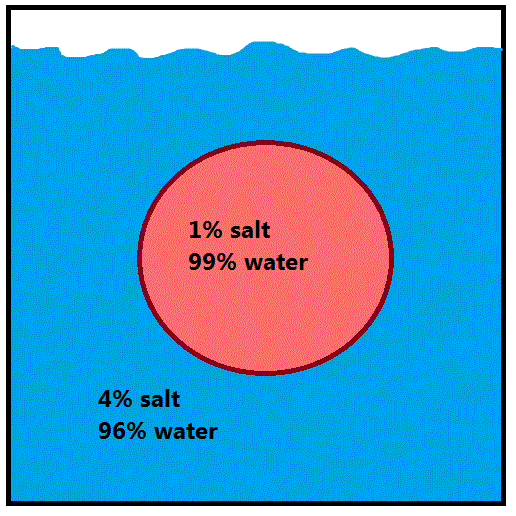

Nemo and other ocean dwelling fish cannot survive in freshwater because......
freshwater is hypertonic to Nemo's cells and will result in water leaving them causing the cells to shrink
freshwater is hypotonic to Nemo's cells and will result in water leaving them causing the cells to shrink
freshwater is hypertonic to Nemo's cells and will result in water entering them causing the cells to swell and burst
freshwater is hypotonic to Nemo's cells and will result in water enter them causing the cells to swell and burst

In the cell pictured, which way would water move?
Into the cell, causing the cell to swell
Out of the cell, causing the cell to shrink
In and out of the cell equally, keeping the shape the same

In the cell pictured, where would water move?
Into the cell, causing it to swell
Out of the cell, causing it to shrink
In and out of the cell equally, causing the shape to stay the same

In the cell pictured, which way would water move?
Into the cell, causing the cell to swell
Out of the cell, causing the cell to shrink
In and out of the cell equally, keeping the shape the same
What type of cell contains the following: Cellulose, nucleus, DNA, chloroplast and central vacuole?
plant cell
animal cell
bacteria
prokaryote
Which of the following organelles is NOT in both prokaryotes and eukaryotes?
cytoplasm
plasma membrane
mitochondria
ribosomes

What is a characteristic of the cell membrane?
it's selectively permeable
water cannot enter the cell
glucose cannot enter the cell
potassium cannot enter the cell
Eukaryotes (Eu-Do) have a nucleus
True
False
Prokaryotes (Pro-NO) have a nucleus
True
False
Which of these have membrane bound organelles?
Prokaryotes
Eukaryotes
Which of the following is NOT an example of a eukaryote?
Plant
Animal
Protist
Archaea

which organelle is made up of the image shown?
phospholipid bilayer
Endoplasmic Reticulum
Lysosomes
Nuclear envelope
Which organelle houses DNA in an animal cell?
Nucleus
Lysosomes
Cytoplasm
chloroplast
Which of the following is the correct function of a lysosome?
breaks down molecules into macromolecules
transports proteins to their final destination
packages and sorts proteins
Controls the cell
What do you think would happen if a cell lost it's Rough Endoplasmic reticulum (ER)?
proteins couldn't be packaged anymore
proteins transport and production would cease
the cell will lose energy
lipid transport and production would cease
receives proteins and materials from the ER, packages them, & distributes them
endoplasmic reticulum
nucleus
golgi apparatus
mitochondria
assembles amino acids to create proteins
ribosome
vacuole
lysosome
cytoplasm
gel-like fluid where the organelles are found
nucleus
cytoplasm
mitochondria
cell membrane
has passageways that carry proteins and other materials from one part of the cell to another
prokaryotic cell
golgi apparatus
endoplasmic reticulum
chloroplast
stores food, water, wastes, and other materials
vacuole
lysosome
nucleus
golgi apparatus
cylinder-shaped organelles made of short microtubules arranged in a circle
vesicle
centriole
vacuole
chromatin
ridged outer layer of a plant cell
chloroplast
cell wall
cytoskeleton
cell membrane
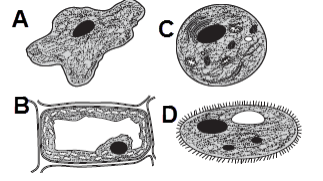
Which of these cells most likely came from an animal?

The ______ allows substances to pass in and out of the cell.
Cell Membrane
Vacuole
Nucleus
Cytoplasm

Which part on the diagram is like a brain?
1
4
2
3
Which part on the diagram is like Jell-O?
1
4
2
3

The function of mitochondria is...
Packages the cell products for transport.
Store nutrient and water.
Produce proteins that helps the cell grow.
Releases energy from digested foods.

