Wayground logo

Free Printable Worksheets

Font size

S
M
L
XL
Worksheets

First 9 WEEKS REVIEW

Total questions: 119

Worksheet time: 2hrs 24mins

Name
Class
Date
1.
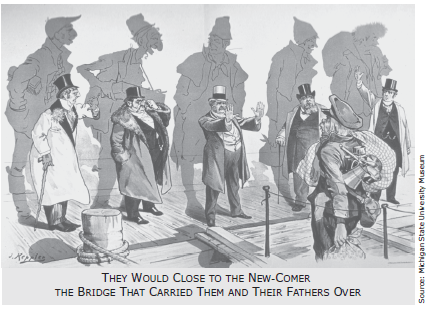
The political cartoon is a criticism of which practice in the 19th century? 
a)
vertical integration
b)
monopolization
c)
industrialism 
d)
laissez-faire capitalism 
2.
How did vertical integration benefit companies such as Carnegie Steel?
a)
Allowed labor unions to participate in decision-making
b)
Controlled production and distribution processes
c)
Invested in health and education of employees
d)
Included local politicians on boards of directors 
3.

The Chinese Exclusion Act was passed due to-

a)

low wages & unemployment in the West Coast

b)

low wages & unemployment in the South

c)

plenty of jobs and high wages in the country

d)

plenty of jobs and high wages in the West coast

4.

During the Gilded age, workers came together to work for better pay, working conditions, and less hours. Leaders such as Samuel Gompers help led many of this workers in....

a)

Philanthropy

b)

Labor Unions

c)

Political Bosses

d)

Credit Unions

5.

_____________________ gave awareness to the increase in difference between poor and rich in the country

a)

Populist Party

b)

Big Business

c)

Labor Unions

d)

Political Bosses

6.
In the late 19th century, the ideas of Social Darwinism were used primarily to 
a)
explain the differences in income between the rich and the poor
b)
urge Congress to end immigration
c)
encourage the passage of compulsory education laws
d)
support the growth of new political parties
7.
The management had taken measures to ensure that no worker would steal any material or sneak off for a break so they had all entrances except for one locked up and it turned deadly. 
a)
Homestead Steel Mill Strike
b)
Triangle Shirtwaist Company Fire
c)
Henry Clay Frick
d)
Haymarket Riot
8.

Which statement best describes an attitude shared by John D. Rockefeller, Andrew Carnegie, and J. P. Morgan?

a)

Economic competition is inefficient and wasteful.

b)

Strong labor unions are essential to the health of the economy.

c)

Natural resources belong to all citizens and should not be used for private gain.

d)

Concentrating economic power in the hands of a few individuals is a threat to the country.
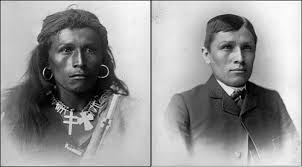
9.
Assimilation can be defined as
a)
when one becomes more like the dominant culture.
b)
when a person refuses to learn the dominant culture
c)
when a culture is practice all over the world
d)
when a culture is similar to another culture
10.
in 1882, the Government passed this legislation that restricted immigration for 10 years from a certain group into the United States.
a)
Nativist Act
b)
Mexican Reparition Act
c)
Dawes Act
d)
Chinese Exclusion Act
11.
Congressional action taken in 1887, during the Gilded Age, to stop the unfair and abusive practices of railroad companies.  That is, to stop railroad companies from giving low prices to large shippers (Corporations) and high prices to farmers who had no other shupping options.
a)
Sherman Antitrust Act
b)
Celler-Kefauver Act
c)
Clayton Antitrust Act
d)
Interstate Commerce Act
12.
Which legislation was a response to the public's growing concern over trusts and monopolies? 
a)
Monopolies Act
b)
Trust Act
c)
Trust and Monopolies
d)
Sherman Anti-Trust Act
13.
What was the name of the law, passed in 1883 during the Gilded Age, that sought to reform government?  It required government applicants to take competitive exams so that they would be hired based upon merit rather than political affiliation.  This law was passed in response to widespread political corruption and the assassination of President Garfield.
a)
Sherman Antitrust Act
b)
Pendelton Civil Service Act
c)
Underwood Tariff Act
d)
Celler-Kefaufer Act
14.
John D. Rockefeller used this method; when companies that produce a similar product merges together
a)
horizontal integration
b)
vertical integration
c)
scientific management
d)
time-study analysis
15.
Andrew Carnegie used this method; when a company owns the raw materials & transportation systems of a product
a)
vertical integration
b)
horizontal integration
c)
time-study analysis
d)
taylorism
16.
The Farmer's Alliance and the Grange, both founded during the Gilded Age, stood for additional government regulation of trade and creating the conditions for more political power and economic well being for farmers (as compared to industrialists).  What 1890s group was founded, supporting these ideas, and attacking the Gold Standard?
a)
Progressives
b)
Free Soil Party
c)
IWW
d)
Populists
17.
Both the Interstate Commerce Act and the Sherman Antitrust Act were
a)
inspired by the effectiveness of earlier state laws 
b)
designed to protect business from foreign competition 
c)
declared unconstitutional by the Supreme Court in the late 1800s 
d)
passed by the federal government to regulate big business 
18.

Books such as Ida Tarbell's The History of the Standard Oil Company, How the Other Half Lives by Jacob Riis, and The Jungle by Upton Sinclair exposed problems associated with:

a)

naturalization of immigrants.

b)

westward expansion.

c)

rapid industrialization.

d)

environmental conservation.

19.

The United States government’s use of laissez-faire principles during the late 19th century resulted in the

a)

commitment of aid to small American businesses

b)

decline in the number of factory jobs

c)

opposition of American businesses to protective tariffs

d)

growth of trusts and monopolies

20.
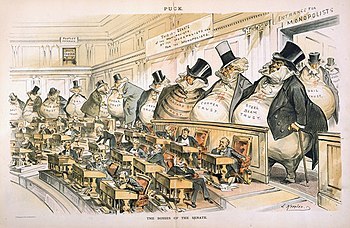
Which group of people most likely inspired the creation of this 1893 cartoon?
a)
Union Leaders
b)
Philanthropists
c)
Nativists
d)
Political Bosses
21.
What gave 160 acres to people willing to settle the plains?
a)
Dawes Act
b)
National Grange
c)
Farmers' Alliances
d)
Homestead Act
22.
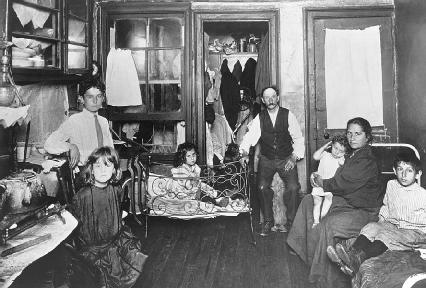
The photo demonstrates one of the problems with
a)
overcrowding urban tenements.
b)
labor union activism in urban areas.
c)
the overproduction of consumer goods.
d)
the growth of political machines.
23.
What act divided up Indian reservations into plots of land to be given to the Indian families and led to assimilation of natives?
a)
Hayes Act
b)
Sherman Anti-Trust Act
c)
Bland-Allison Act
d)
Dawes Act
24.
Political machine who took advantage of New York city to make millions
a)
Susan B. Anthony
b)
Boss Tweed
c)
Jacob Riis
d)
Jane Addams
25.

Which of the following was not a Progressive reform introduced

a)

Primary

b)

Spoils System

c)

Initiative

d)

Recall

26.

In The Gospel of Wealth, he argues that very wealthy men like him had a responsibility to use their wealth for the greater good of society

a)

Andrew Carnegie

b)

John D. Rockefeller

c)

Cornelius Vanderbilt

d)

JP Morgan

27.

Cities populations grew in the West, expand in communication and commerce, and growth in settlers are due to-

a)

The Transcontinental Railroad

b)

The Klondike Gold Rush

c)

The Chinese Exclusion Act

d)

The Telegraph

28.

Big Business, Westward Expansion, bad working conditions, political machines, and immigration were issues of what time period in the U.S

a)

Gilded Age

b)

Progressive Era

c)

Building an Empire

d)

Civil Rights and the 60's

29.

the practice of a successful political party giving public office to its supporters without any political experience

a)

The Spoils System

b)

Civil Service Reform

c)

Interstate Commerce Act

d)

Dawes Act

30.

Based on this poster, which is an accurate statement?

a)

Immigrants were encouraged to learn and to speak English

b)

Granite City had laws prohibiting immigrants from moving there

c)

The people in the poster were native-born Americans

d)

Granite City encourged diversity in its immigrant population

31.

The Homestead Act (1862) promoted the development of western lands by -

a)

creating a system of dams for crop irrigation

b)

providing land for $10 to settlers

c)

removing all restrictions on immigration

d)

Moving Native American Indians to reservations

32.

How did passage of the Dawes Act affect Native American Indians?

a)

It supported their existing cultural traditions

b)

It started a series of Indian Wars on the Great Plains

c)

It attempted to assimilate them into mainstream American culture

d)

It forced their removal from areas east of the Mississippi River

33.
This act was intended to help Native Americans acquire private land in the reservations, but instead they sold them. It was also intended to have Native Americans assimilate.
a)
Homestead Act
b)
Dawes Act
c)
Interstate Commerce Act
d)
Sherman Anti-Trust
34.
Where did Asian immigrants arrive when they came to America?
a)
Angel Island
b)
Rhode Island
c)
Ellis Island
d)
Fools Island
35.

Why did urbanization happen during the Gilded Age?

a)

People were trying to escape the problems of the cities.

b)

People wanted to farm more so they moved to urban areas.

c)

People were escaping tenements and overcrowding in the country.

d)

So many people needed jobs that they moved to the city for factory work.
36.

Which of the following is a strategy used by unions to force employers to meet labor demands?

a)

Injunctions

b)

lockouts

c)

Strikes

d)

Scabs

37.

In 1889, during the Gilded Age, a Settlement House called Hull House was opened in Chicago. It was designed to help working class women, many recent immigrants, move out of poverty and dependence on others. It sought to address some of the excesses of industry and business. Who founded Hull House?

a)

Margaret Sanger

b)

Jane Addams

c)

Elizabeth Cady Stanton

d)

Susan B. Anthony

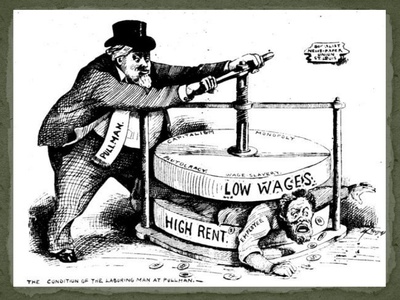
38.

What does this image say about the need for labor unions?

a)

labor unions were desirable because the workers were being crushed by difficult living conditions and poor pay.

b)

Labor unions decreased nativism

c)

Labor unions helped big business keep control of the workers

d)

Labor unions helped reduce the length of the work day

39.
What were new cities that sprang up around mining centers named?
a)
ghosttowns
b)
boomtowns
c)
funkytowns
d)
cowtowns
40.
Which law gave up to 160 free acres to a settler who paid a $10 filing fee and lived on the land for 5 years? 
a)
Homestead Act
b)
Indian Peace Commission
c)
Dawes Act
d)
Currency
41.
This was the first farmers' organization that offered farmers education, fellowship, and support.
a)
Farmers' Alliance 
b)
Populist Party 
c)
National Grange 
d)
Cooperatives 
42.
What is Manifest Destiny?
a)
The belief that it was America's destiny to control and civilize all of North America
b)
The belief that their destiny was to manifest
c)
A religious term used to explain how to be saved
43.
Which of the following contributed to the westward expansion of the United States?
a)
European warships attacked the eastern seaboard, forcing citizens to move westward for safety.
b)
Most of the land east of the Mississippi River was not suitable for farming.
c)
Many Americans felt it was their right and duty to move westward.
d)
The standard of living on the Pacific Coast was very high, so many people wanted to move there.
44.
How did railroads help with trade and economic growth?
a)
They did not help. They just polluted the environment for future generations.
b)
Helped cows eat more grass and grow bigger when they were moved to the train station by the cowboys.
c)
Provided a fast way to get crops and animals to the markets
d)
Provided a way to move the Native Americans farther West at a fast rate.
45.
What was one of the factors that changed Native American life? 
a)
White settlers moving onto their lands
b)
Financial backing by banks
c)
Moving to the east coast
d)
The buffalo population doubled 
46.
As Americans took over more and more land, what happened to Native Americans?
a)
They agreed to give up their land.
b)
They were given their choice of where to live.
c)
They were forced to live in reservations.
d)
They voluntarily moved to Canada and Mexico.
47.

What was the main purpose of the Transcontinental Railroad?

a)

To make China more powerful.

b)

To help with transportation, communication, and to connect the nation.

c)

To make Native Americans move off their land.

d)

To give immigrants a job, to feel important, and needed in America.

48.
Which is the best description of how economic factors impacted westward expansion?
a)
As the region became more and more populated, the way of life of the Native Americans changed.
b)
People could use the land for its resources and make a living through ranching, mining, or farming.
c)
New land policies such as the Homestead Act of 1861 allowed “squatters” to claim land and keep it.
d)
Travelers to the West had to cross not only the plains, but also major rivers, and the Rocky Mountains.
49.
How did the Transcontinental Railroad effect Native American life?
a)
The railroad offered many jobs to Native Americans.
b)
The railroad offered many Native Americans a chance to travel west.
c)
Native Americans sold their land to settlers to pay for the railroad to be built.
d)
Railroad workers hired riflemen to decimate, or kill, buffalo and Native Americans depended on the buffalo for survival.
50.

Created to accelerate the process of assimilation, by replacing the reservation system with an allotment system. Congress hoped that younger natives would embrace farming and individual land ownership. This gave every Indian 160 acres of land.

a)

Indian Reorganization Act

b)

Indian removal Act

c)

Dawes Act

d)

Homestead Act

51.

All of the following were Populist demands except which one?

a)

open ballot elections

b)

graduated personal income tax

c)

easier access to credit

d)

restriction of immigration

52.

Which contributed to the rise of Populism?

a)
rising agricultural prices
b)

the use of silver instead of greenbacks

c)

calls for unrestricted immigration

d)

the inability of farmers to pay off their debts

53.
Why did the Populist party want unlimited coinage of silver?
a)

to increase the amount of money in circulation and raise farm prices

b)

to reduce economic inflation

c)

to raise campaign contribution limits

d)

to decrease the amount of money in circulation and lower farm prices

54.

What, if any, proposals listed below had Populist support? (select all that apply)

a)

graduated income tax

b)

direct election of state senators

c)

higher lending rates that cause foreclosures of farms

d)

unlimited coinage of silver

e)

nonrestrictive immigration policies

55.
Farmers support the ________standard for money.
a)

bimetallic (gold & SILVER)

b)

gold

56.

Established the ICC & gave the federal government the power to regulate the railroad industry.

a)
Interstate Commerce Act
b)

The Chinese Exclusion Act

c)

The Dawes Act

d)
Railroad Regulation Act
57.

The Populist Party arose in the late 1800s out of the concerns of:

a)

the middle class

b)

the wealthy

c)

factory owners

d)

farmers

58.

Which of the following was a factor that contributed to the formation of the Populist Party?

a)

farmers wanted to own their own banks

b)

farmers wanted jobs in the major cities

c)

farmers wanted higher shipping costs

d)

farmers wanted a political party that represented their best interests

59.
Which late nineteenth-century invention had greatest impact on literacy and use of public libraries?
a)
Braille
b)
Typewriter
c)
Lightbulb
d)
Computer
60.
Use of barbed wire most associated with which outcome?
a)
Completion of Union Pacific Railroad
b)
End of open range and frontier
c)
Increased prospecting and mining activity
d)
Increased demand for and production of steel
61.
How did vertical integration benefit companies such as Carnegie Steel?
a)
Allowed labor unions to participate in decision-making
b)
Controlled production and distribution processes
c)
Invested in health and education of employees
d)
Included local politicians on boards of directors 
62.
What issue split Booker T. Washington and W.E.B. DuBois?
a)
Washington's lesser emphasis on attainment of political and civil rights
b)
Washington's unwillingness to accept advice from anyone other than African Americans
c)
DuBois's belief that African Americans needed to achieve economic self-sufficiency
d)
DuBois's minimization of importance of education
63.

“Carnegie Donates Millions to Build Libraries”

“Rockefeller Creates Foundation for Medical Research”


These headlines reflect the actions of Andrew Carnegie and John D. Rockefeller as

a)

muckrakers

b)

socialists

c)

philanthropists

d)

conservationists

64.

The federal government follows the economic principle of laissez-faire when it

a)

places restrictions on land usage

b)

takes no action on corporate mergers

c)

controls methods of production

d)

determines the price of goods

65.

The United States government’s use of laissez-faire principles during the late 19th century resulted in the

a)

commitment of aid to small American businesses

b)

decline in the number of factory jobs

c)

opposition of American businesses to protective tariffs

d)

growth of trusts and monopolies

66.

The federal government responded to the railroad strikes of 1877 and the Pullman strike of 1894 by

a)

using military force against the workers

b)

requiring negotiation to resolve the disputes

c)

maintaining a neutral position between labor and management

d)

providing economic aid to striking workers
67.
The Interstate Commerce Act...
a)
Created jobs
b)
Promoted the steel industry
c)
Regulated businesses
d)
Expanded our natural resources
68.
Assimilation can be defined as
a)
when one becomes more like the dominant culture.
b)
when a person refuses to learn the dominant culture
c)
when a culture is practice all over the world
d)
when a culture is similar to another culture
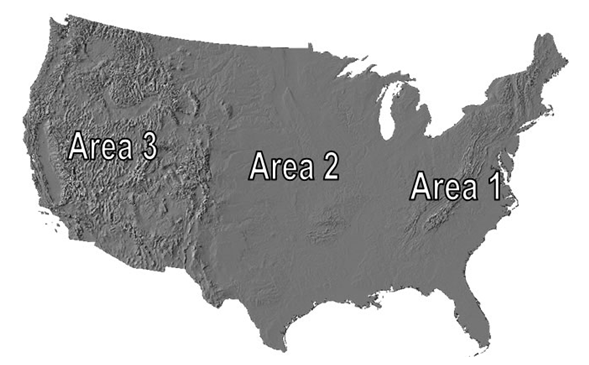
69.
The Great Plains can be found in what area?
a)
Area 1
b)
Area 2
c)
Area 3
d)
None of the above
70.
This period during the 1870s to 1900 is known for it's rise of railroads, big business, industrialization and social problems in the United States.
a)
World War I
b)
Progressive Era
c)
Gilded age
d)
Roaring Twenties
71.
Under this policy in 1887, the Government gave Native Americans land in order to farm land, just like European farmers. 
a)
Dawes Act
b)
Ghost Dance
c)
Trail of Tears
d)
Laws Act
72.
During the Gilded age, workers came together to work for better pay, working conditions, and less hours. Leaders such as Samuel Gompers help led many of this workers in....
a)
Philanthropy
b)
Labor Unions
c)
Political Bosses
d)
Credit Unions
73.
Due to the corruption of the railroads companies, the U.S. government created this act to regulate railroad companies to be reasonable in prices.
a)
Interstate Commerece Act
b)
Dawes Act
c)
Transcontiental Act
d)
Laizzez Faire Act 
74.
Complete control over an industry's production, wages, & prices
a)
monopoly
b)
capitalism
c)
socialism
d)
concentration of wealth
75.
One reason John D. Rockefeller, Andrew Carnegie, and J. Pierpont Morgan were sometimes called Robber Barons was that they:
a)
used ruthless business tactics against their competitors
b)
stole money from the federal government
c)
made unnecessarily risky investments
d)
robed from the rich to give to the poor
76.
In a United States history textbook, the terms Robber Barons, Gospel of Wealth, and The Men Who Built America would most likely be found in a chapter titled what? 
a)
Imperialism (1898-1905)
b)
The Roaring Twenties (1920-1929)
c)
Industrialization/Gilded Age (1870-1900)
d)
Reconstruction (1865-1877)
77.
The main purpose of labor unions was to:
a)
Eliminate anarchists from the work force
b)
Allow business owners to share information with each other
c)
Try to get better conditions and better pay for workers
d)
Provide labor when workers went out on strike
78.
After reading Upton Sinclair's "The Jungle", what do you think was most people's reaction?
a)
Enough people were disgusted and wanted the government to take action and do something to make sure our food was safe to eat.
b)
People figured it was just made up and that the meat industry could be trusted to do what was right
c)
People shrugged their shoulders because there was nothing that could be done about it and then kept on eating their food because it wasn't a big deal
d)
People read the book and didn't think anything of it and went about their lives like they normally would. 
79.
What is the main idea of this political cartoon from the 1800s?
a)
Government should support the expansion of railroads
b)
Most Americans support the labor movement
c)
Labor is gaining power over big business
d)
Business has many advantages over labor/working people
80.

was established that positions within the federal government should be awarded on the basis of merit instead of political affiliation

a)

Civil Service Reform

b)

Homestead Act

c)

Dawes Act

d)

Chinese Exclusion Act

81.
Which group provided basic services for immigrants & the poor for votes & made illegal fortunes
a)
Nativist
b)
Labor Unions
c)
Political Machines
d)
Robber Barons
82.
In 1889, during the Gilded Age, a Settlement House called Hull House was opened in Chicago.  It was designed to help working class women, many recent immigrants, move out of poverty and dependence on others.  It sought to address some of the excesses of industry and business.  Who founded Hull House?
a)
Margaret Sanger
b)
Jane Addams
c)
Elizabeth Cady Stanton
d)
Susan B. Anthony
83.
Which laws were passed to discriminate against African Americans?
a)
18th Amendment
b)
Temperance laws
c)
Jim Crow laws
d)
14th Amendment
84.
Which African American leader believed in full political, civil and social rights rather than to accept social segregation?
a)
Booker T. Washington
b)
J.P. Morgan
c)
W.E.B. DuBois
d)
Frederick Douglass
85.
What was the purpose of the Temperance Movement?
a)
Support immigrant rights
b)
Oppose the consumption of alcohol
c)
Gain women the right to vote
d)
Prevent unsafe working conditions
86.

What Supreme Court case set the precedent for "Separate but Equal", which would last until the Civil Rights Movement of the mid 1900s?

a)

Plessy v Ferguson

b)

Brown v Board of Education

c)

Marbury v Madison

d)

Roe v Wade

87.

Because of the rapid growth of Industrialization in the North people moved out of rural towns to?

a)

Rural farms

b)

Urbanzied cities

c)

Suburbs cities

d)

Homestead farms

88.

What was a city government marked by corruption, bribery, and Kickbacks (common during the Gilded Age) called?

a)

credit mobilier

b)

political machine

c)

corrected democracy

d)

electoral politics

89.

Who was the leader of Tammany Hall (New York Political Machine)?

a)

Andrew Carnegie

b)

Henry Ford

c)

John D. Rockefeller

d)

William Tweed

90.
prohibition of the sale, manufacture, transport of alcohol
a)
16th Amendment
b)
17th Amendment
c)
18th Amendment
d)
19th Amendment
91.
a new national political party representing the “common man” – farmers, industrial workers, and miners proposing a 8 hour workday, progressive income tax, government ownership of railroads, free silver  .
a)
populism
b)
progressivism
c)
Bull Moose Party
d)
Dixiecrat Party
92.
Who wrote the expose piece of literature that revealed the extensive corrupt monopolistic business practices of Standard Oil?
a)
Ida Tarbell
b)
Lewis Hines 
c)
Jacob Riis
d)
Upton Sinclair
93.
Who was the person who founded the settlement house (Hull House) for the Assimilation and Americanization of the immigrant poor?
a)
Elixabeth Cady Stanton
b)
Jane Addams
c)
Susan B. Anthony
d)
Belle Starr
94.
Which Progressive President used Big Stick Diplomacy and was known as a Trust buster?
a)
Teddy Roosevelt
b)
Taft
c)
Woodrow Wilson
d)
Luke Skywalker
95.
What was the purpose of Muckrakers?
a)
Writers who wanted to make money by selling newspapers
b)
Writers who wanted to cause change with their writings
c)
Writers who supported big business and corruption in politics
d)
Writers who wrote patriotic short stories
96.
The 17th Amendment gave people the right to vote for their ______ directly.
a)
President
b)
Vice President
c)
Senators
d)
House Representatives
97.
The Sherman anti-trust act was passed to
a)
break up monopolies
b)
give equal rights to women
c)
help people living in poverty
d)
end racism
98.
The famous immigration center in NYC is
a)
Angel Island
b)
Ellis Island
c)
Coney Island
d)
Long Island
99.
The major immigration center on the west coast known as Angel Island is located closest to what major city
a)
San Francisco, CA
b)
Los Angeles, CA
c)
San Diego, CA
d)
Sacramento, CA
100.

Which characteristics of the Industrial Revolution contributed to the rise of labor unions?

a)

The competition created by immigrant workers.

b)

The working conditions found in many factories.

c)

The results of mass production on agricultural prices.

d)

The influence of political machines on company towns.

101.

During the Industrial Revolution, how did the economic hardships of immigrants influence social reform.

a)

Business sponsored child-care programs.

b)

Political machines demanded improved working conditions.

c)

Settlement houses were established to provide services to the poor.

d)

Federal offices distributed relief payments to unemployed workers.

102.

Susan B. Anthony made this statement in 1872.

Based on this statement, what goal did the Women's Movement share with supporters of the Civil Rights Movement?

a)

Commitment to national security.

b)

Dedication to passive resistance.

c)

Organizing public protests to gain political attention.

d)

Securing voting rights to protect individual freedom.

103.
Susan B. Anthony and Elizabeth Cady Stanton are most closely associated with the idea that-
a)
Settlement houses should be built to help educate immigrants
b)
National Parks should be created by the federal government
c)
factories should be prohibited since they damage society
d)
suffrage should be granted to women
104.
The initiative, the referendum, and the recall were adopted by several states during the Progressive Era as ways to-
a)
restrict the use of presidential vetoes
b)
promote the formation of trusts
c)
make government more democratic
d)
limit immigration
105.
What act did The Jungle help establish?
a)
Pendleton Act
b)
Pure Food and Drug Act
c)
Federal Reserve Act
d)
Dawes Act
106.
All of the following were muckrakers EXCEPT
a)
Ida Tarbell
b)
J.P. Morgan
c)
Upton Sinclair
d)
Thomas Nast
107.

Use the list below to answer the question.

• Andrew Carnegie

• Cornelius Vanderbilt

• John D. Rockefeller

How did the contributions of these post-Reconstruction businessmen affect the United States?

a)

Their focus on foreign trade encouraged the movement of U.S. companies abroad.

b)

Their generous charities helped foster a system of social welfare in the United States.

c)

Their entrepreneurship helped the United States become a world industrial power.

d)

Their donations to the arts encouraged an increase in the U.S. tourism industry.

108.

What was the primary purpose of the Federal Reserve Act of 1913?

a)

to allow banks to print paper money

b)

to offer bank loans to successful businesses

c)

to provide retired workers with pensions

d)

to establish stability in the financial system

109.

The first antitrust law to include a provision prohibiting price setting and price discrimination was the

a)

Federal Trade Commission Act.

b)

Interstate Commerce Act.

c)

Sherman Antitrust Act.

d)

Clayton Antitrust Act.

110.

According to the theory of laissez faire, the economy functions best when the government

a)

does not interfere in business

b)

subsidizes business so that it can compete worldwide

c)

regulates businesses for the good of the majority

d)

owns major industries

111.
Teddy Roosevelt's set of reforms was known as...
a)
The Great Society
b)
The Square Deal
c)
The New Deal
d)
The Contract with America
112.

Law that authorized the Secretary of Agriculture to order meat inspections and condemn any meat product found unfit for human consumption.

a)

Pure Food Act

b)

19th Amendment

c)

Meat Inspection Act

d)

17th Amendment

113.
17th Amendment-
a)
Banned sale, distribution and manufacture of alcohol
b)
required direct election of US Senators
c)
established the Income Tax
d)
Gave women suffrage rights
114.

What do we call the crowded buildings that the poor (esp. immigrants) lived in?

a)

Tent cities

b)

Shanty towns

c)

Colonias

d)

Tenements

115.

What do we call the progressive reform movement that involved Protestants who wanted to end poverty?

a)

The Quaker Movement

b)

The Social Gospel Movement

c)

The Good Samaritan Movement

d)

The Christian Charity Movement

116.
What is laissez-faire? 
a)
A.  The belief that the government should do as little as possible to interfere with business practices
b)
A.  The belief that the government should pass strict laws to enforce fair business practices
c)
A.  The belief that the government should force business owners to provide health insurance benefits to their employees
d)
A.  The belief that the government should force trusts to break up to help promote trade and competition.
117.
The Social Gospel is the idea that
a)
The rich have a duty to help the poor
b)
Religious sects should segregate themselves
c)
wealthy people are hard working and poor people are lazy
d)
Alcohol is evil and should be banned
118.

Two Consitutional amendments that passed during Taft's Presidency were the _____ and _____ amendments. They were ratified the year after his Presidency ended.

a)

15th, 16th

b)

16th, 17th

c)

17th, 18th

d)

18th, 19th

119.

The amendment that gave the federal government the authority to levy personal income taxes was the _____.

a)

15th

b)

16th

c)

17th

d)

18th