
 Worksheets
biochemistry
Total questions: 37
Worksheet time: 28mins

What is this enzymes optimal temperature?
10*C
40*C
50*C
70*C

Which claim is best supported by this graph?
This enzyme has an optimal pH of 13
The enzyme prefers more of an acidic environment
The optimum pH for this enzyme is 4 and denatures at a pH of 9
The optimum pH for this enzyme is 9 but it denatures at a pH of 4

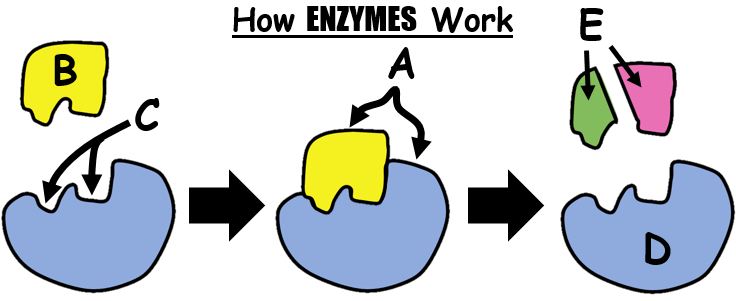
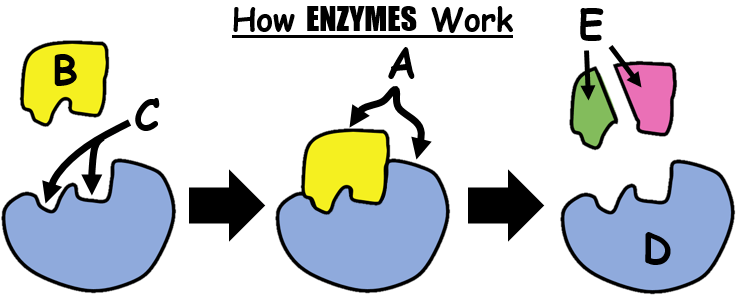
The structure labeled E represents-
Products
Enzyme
Substrate
Reactants

Which of the following lines shows the presence of an enzyme?
Black
Red
Which pair of answers correctly matches the monomer and the polymer?
Glucose- Protein
Amino Acid- Nucleic Acid
Nucleotide - Nucleic Acid
Fatty Acid- DNA
For enzymes to work, it has a spot where molecules dock in. What do we call this spot?
active site
substrate
inhibitor
Water is a _________ molecule.
nonpolar
polar
This is the attraction of water molecules for each other.
cohesion
adhesion
hydrogen bonding
Of all the elements, ________ is the most significant to life.
carbon
hydrogen
nitrogen
gold
Rice, potatoes, bread and legumes are good sources of _________.
carbohydrates
lipids
proteins
nucleotides
The positively charged particle in an atom is the
neutron
proton
ion
electron
(No Charge)
Which of the following is an example of ADHESION?
water sticking to water
water sticking to glass
oil sticking to plastic
hydrogen sticking to oxygen
Property of water that allows water to climb up thin narrow tubes, against gravity
Capillary action
Surface tension
Ice floats
High heat capacity
The atoms found in lipids are
Carbon, hydrogen, oxygen 1:2:1 ratio
Carbon, hydrogen, oxygen, nitrogen, phosphorous
Carbon, hydrogen, oxygen, nitrogen, sulfur
Carbon, hydrogen, oxygen, no ratio
The atoms found in proteins
Carbon, Hydrogen, Oxygen
Carbon, Hydrogen, Oxygen, and Phosphorous
Carbon, Hydrogen
Carbon, hydrogen, oxygen, nitrogen
What is an example of lipids
Fats, oils, waxes
Cellulose, starch
DNA, RNA,
Enzymes, hemoglobin, nails
Enzymes are an example of
Lipids
Carbohydrate
Protein
Nucleic Acid
Which of the following elements are found in all macromolecules? (Select all that apply).


Which macromolecule stores energy?
Carbohydrates
Proteins
Lipids/Fats
Nucleic Acids
Nucleic acids make up which of the two molecules listed below?
FDA
RNA
DNA
FDR

An avocado is an example of a which macromolecule?
Carbohydrate
Lipid/Fat
Protein
Nucleic Acid
Which type of fat is considered healthier than others?
Saturated Fat
Unsaturated Fat
Monounsaturated Fats
Trans Fat

4CF2Cl2
C = 4, F = 4, Cl = 2
C = 1, F = 8, Cl = 8
C = 4, F = 8, Cl = 8
C = 1, F = 4, Cl = 8
A ______ is a number written in front of a chemical formula.
Coefficient
Subscript
Exponent
Coordinator
How many atoms of oxygen are in
3Fe2O3
6
9
18
2


Condensation

