
 Worksheets
Astronomy Test 1 Review
Total questions: 45
Worksheet time: 4hrs 45mins

The movement of Earth around the Sun is called
Rotation
Revolution
Retrograde Motion
Transit
In the Heliocentric Model
Saturn is at the center of the Solar System
The Sun, Planets, and Moons orbit the Earth
The Earth orbits a black hole
The Earth, Planets, and Asteroids orbit around the Sun
The measured amount of "elongation" in the shape of a planet's orbit is called
Eccentricity
Terrestrial
Perihelion
Aphelion
Which planet has the highest eccentricity?
Venus
Mars
Jupiter
Mercury
Which planet takes less time to revolve around the Sun than it does to rotate one time on its axis?
Earth
Neptune
Venus
Uranus
The age of the Sun is estimated to be
13.8 billion years old
10 billion years old
11 years old
4.6 billion years old
The Doppler effect applies to light waves as well as sound waves. Astronomers use this to measure the motion of stars and galaxies. In 1929, Edwin Hubble discovered that light from distant galaxies was shifted away from the blue end of the spectrum and towards the red end of the spectrum. Red light has a longer wavelength (and a lower frequency) than blue light. What could Hubble conclude about these galaxies?
The distant galaxies are growing smaller.
The distant galaxies are moving towards the Earth.
The distant galaxies are moving away from earth

A large grouping of stars, planets, gas, and dust in space held together by gravity.
Universe
Galaxy
Space

A reaction in which two light nuclei combine to produce a nucleus of heavier mass, resulting in the release of a large amount of energy.
Nuclear Bomb
Nuclear Fusion
Nuclear Fission

The explosion of a massive star at the end of its life cycle
Planetary Nebula
Milky Way Galaxy
Supernova
Universe
What Galaxy is Earth located?
Andromeda
Milky Way
Sagittarius
Snickers
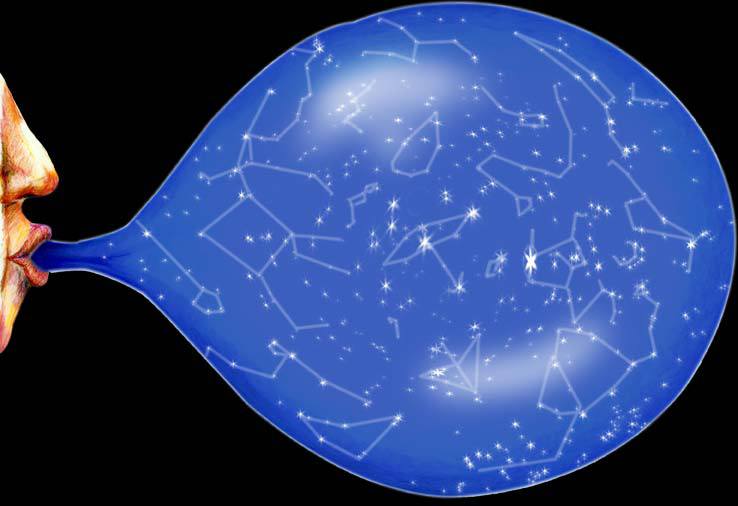
As galaxies move away from our galaxy
a shift on the electromagnetic spectrum is noticed. This phenomena is
called _____________.
redshift
blueshift
The Big Bang Theory states that all matter started as a small volume and then...
expanded in all directions
contracted even smaller
caused an atomic explosion
burned up and exploded
What do we observe when stars/galaxies are moving away from us?
Cosmic Background Radiation
Blueshift
Nothing
Redshift
On the electromagnetic spectrum, Red light
Has a shorter wavelength
Indicates movement towards the Earth
Has a longer wavelength
Is an X Ray
Aside from the Doppler effect, one piece of evidence that supports the theory of the big bang is
Spiral Galaxies
Blueshift
Cosmic Microwave Background Radiation
Gravitational Attraction
The Sun is a ___________ star.
red giant
main sequence
protostar
white dwarf

Aldebaran is a ____________
red giant
white dwarf
main sequence star
supergiant
Which planet has the greatest distance between the two foci of its orbit?
Mercury
Venus
Saturn
Uranus

Compared to the Sun, Spica is .......
hotter and brighter
cooler and brighter
hotter and dimmer
cooler and dimmer
A giant structure that contains dust, gasses, and hundreds of billions of stars.
Our solar system
The universe
A nebula
A galaxy
The force that governs the motion of our solar system.
Gravity
Mass
Magnetism
Acceleration

A star with a temperature of 15,000 K and a luminosity of 0.01 times dimmer than the Sun would be a ____________.
supergiant
red giant
white dwarf
main sequence star
The final stage of the star Sirius is going to be
A supernova
A white dwarf
Black hole
Supergiant
The immediate next stage of the Sun's life after it moves on from the main sequence is
Giant
Supergiant
White Dwarf
Supernova
A large cloud of gas and dust in interstellar space where stars are born is


Which star is the coolest?
An orbit with the eccentricity of 0.910 would have a
spherical orbit
very elongated orbit
circular orbit
spiral orbit
If the distance between foci is very low, the eccentricity will be
Higher
Lower
When a planet orbits the Sun, one of the foci of the elliptical orbit is _______________.
the axis
the perihelion
the center
the sun
What effect does increasing the distance between an ellipse’s foci have on the shape of an ellipse?
Increases eccentricity
Decreases eccentricity
no effect
Where will an object move at the greatest speed as it orbits the sun?
Perihelion
Aphelion
Between perihelion and aphelion

Which position would the Sun look the largest to someone standing on Earth
January (Perihelion)
July (Aphelion)
This planet has the longest period of rotation.
Mercury
Venus
Earth
Mars
This planet is approximately half the size of Earth.
Mercury
Venus
Mars
Jupiter
This planet has the most circular orbit.
Mercury
Venus
Earth
Mars
Which planet has a mass that is over 300 times that of Earth's mass
Earth
Mars
Jupiter
Saturn
Saturn is how many millions of km away from the sun?
1426.7 million km
2871.0 million km
778.4 million km
227.9 million km

Click the image to enlarge and select the correct answer below
1
2
3
4
Which planets orbit most eccentric?
Neptune
Mars
Earth
Jupiter
Compared to the Terrestrial Planets, the Jovian planets
are larger
are closer to the Sun
have shorter periods of rotation
have greater densities
Nuclear Fusion
combines Methane into Ozone and creates energy for stars
splits helium atoms to make energy
happens when a supermassive star explodes
combines hydrogen into helium to make energy for stars

