
 Worksheets
ENVI Q1 Review (2022)
Total questions: 58
Worksheet time: 43mins
What is an observation?
A scientific statement based on ideas
Using your senses to notice what is going on around you
To be unaware of your surroundings
The question that you want an answer to.
The information you collect while doing your experiment is called
conclusions
data
hypotheses
procedures
Dory set up an experiment to see how the mass of a ball affects the distance it rolls off a ramp. What is the independent variable?

According to the pie chart, how much of a house's water usage is for showers?
26.7%
13.7%
21.7%
16.8%
What type of graph would you make to show how many of your classmates were born in each month of the year?
line
bar
circle
scatter plot



You need to take a survey at school to see which type of lunch food is most preferred by 7th grade students.
Which type of graph would be best to display the data?
Line Graph
Bar Graph or Pie Chart
Scatter Plot
Funnel Chart

What conclusions can you draw from this graph?
The deer population went down over time.
The deer population went up over time.
The dear population went up quickly, then down, but then stayed the same.
There are less dear because of hunters
Which of the following is not an example of a base unit.
Inches
Meters
Grams
Liters
What is the base units of weight
gram
pounds
ounce
newton
What is the basic unit of length
foot
inches
meter
yards
The center of an atom where its neutrons and protons are is called the _____________.
nucleus
electron cloud
center
The positive particles of an atom are ___________.
electrons
protons
neutrons


Which passenger has the most potential energy?
A
B
C
D
Conservation of energy means that
energy can be created but not destroyed
energy can be destroyed but not created
energy can both be created and destroyed
energy can neither be created nor destroyed
Which of the following is an example of potential energy (check all that apply)
water in a stream
a block of ice in the freezer
a desk in a classroom
a ball sitting in a goal
scoring a goal
Which of the following are examples of kinetic energy? (check all that apply)
an arrow flying through the air
a book on a shelf
kicking a soccer ball
chewing gum
sitting at a stop light




The sum total of all water on Earth and in its atmosphere is called the:
Biosphere
Terrasphere
Hydrosphere
Liquisphere
What effect does the sun have on surface water?
It causes it to boil
It causes it to rain
It causes it to sink
It causes it to evaporate
What is it called when rainwater contributes to the flow of rivers and streams?
Transformation
Runoff
Irrigation
Desertification
Which of the following describes condensation?
Ice becoming water when placed into a warm liquid.
Water becoming ice in a freezer
Liquid water being heated until it turns into steam.
Steam from a teapot turning into liquid water.

What is the process of matter changing from a gas to a liquid?
Crystallization
Evaporation
Melting
Condensation

What is the process of matter changing from a liquid to a gas?
Crystallization
Evaporation
Melting
Condensation

What is the process by which plants release water vapor into the atmosphere?
Precipitation
Condensation
Transpiration
Evaporation
Which of these nitrogen cycle processes converts atmospheric nitrogen to a soil form of nitrogen that is usable by plants?
nitrogen fixation
nitrification
denitrification
ammonification
assimilation


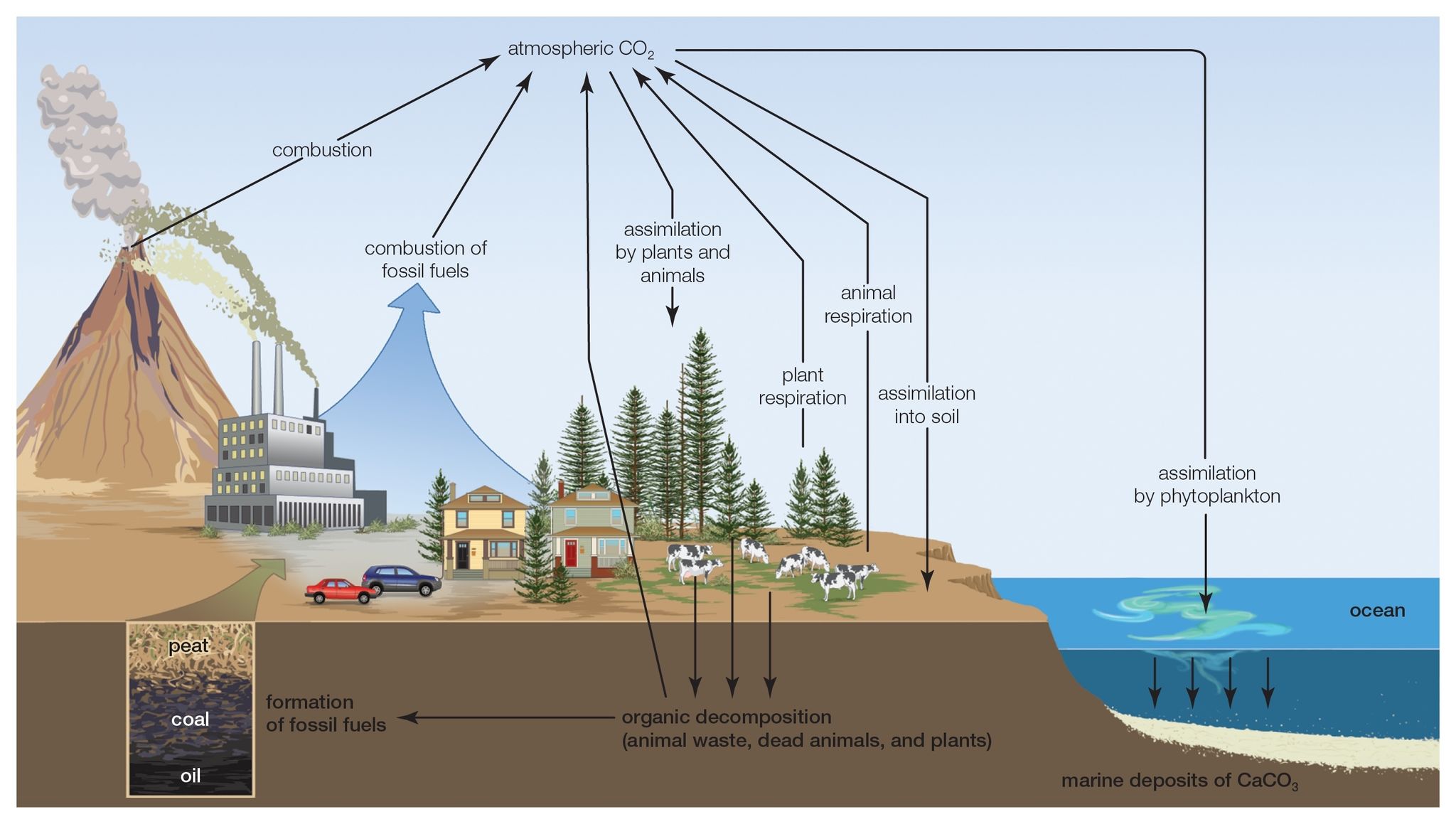
Which of the following is correct?
There is as much carbon on earth as when it was formed
Carbon is being created whenever it is recycled
Carbon is lost every time it is recycled
Carbon changes to different forms and is never recovered


What is the geosphere?
all the air and gases on the planet
all the frozen water on the Earth
the non-living soil, rocks, and minerals of the Earth
the rivers, lakes, and oceans of the Earth

What is the biosphere?
all the air and gases on the planet
made up of living things
the non-living soil, rocks, and minerals of the Earth
the rivers, lakes, and oceans of the Earth

What is the hydrosphere?
all the air and gases on the planet
made up of living things
the non-living soil, rocks, and minerals of the Earth
the rivers, lakes, and oceans of the Earth
The layer of gases that surrounds the Earth is the...
Atmosphere
Biosphere
Hydrosphere
Geosphere
Which layer of the atmosphere do we live in?
Troposphere
Mesosphere
Thermosphere
Stratosphere
Which atmosphere layer protects living things from the Sun's UV radiation?
Troposphere
Mesosphere
Thermosphere
Stratosphere
In which atmosphere layer does weather occur?
Exosphere
Troposphere
Mesosphere
Stratosphere
A ____________ is a low lying area of land between two mountains that often has a river running through it.
Mountain
Valley
Lake
Tree

What type of landform is this?
Lake
Hill
Coastal Plain
Mountain
True or False?
Virginia has a coastal plain.
True
False

