wayground logo

Free Printable Worksheets

NEW

Font size

S
M
L
XL
Worksheets

Cell Membrane

Total questions: 54

Worksheet time: 1hrs 6mins

Name
Class
Date
1.

Active transport is movement of particles through the cell membrane from a region of ...1... to a region of ...2... using energy in the form of ...3...

a)

1: lower concentration, 2: higher concentration, 3: NADPH

b)

1: higher concentration, 2: lower concentration, 3: NADPH

c)

1: higher concentration, 2: lower concentration, 3: ATP

d)

1: lower concentration, 2: higher concentration, 3: ATP

2.
What is NOT TRUE about the cell membrane
a)
It controls what enters and leaves the cell
b)
Semipermeable
c)
Phospholipid bilayer
d)
Contains digestive enzymes
3.
What is another term for "selectively permeable"?
a)
porous
b)
completely permeable
c)
permanent
d)
semipermeable
4.
Maintaining a constant internal state in a changing environment.
a)
Homeostasis
b)
Active Transport
c)
Mitosis
d)
Photosynthesis
5.

Which one is the definition of active transport?

a)

movement of particles through the cell membrane from a region of lower concentration to a region of higher concentration using energy in the form of ATP.

b)

passage of water molecules from a region of their higher concentration to a region of their lower concentration through a partially permeable membrane

c)

net movement of molecule from a region of higher concentration to region of lower concentration. Molecule down a concentration gradient

d)

net movement of molecule from a region of lower concentration to region of higher concentration. Molecule down a concentration gradient

6.
A type of passive transport that moves particles from high concentration to low concentration; like the iodine into the cornstarch bag
a)
Exocytosis
b)
Osmosis
c)
Diffusion
d)
Endoyctosis
7.
A type of passive transport that occurs when water crosses a cell membrane; like water entering raisin cells
a)
Osmosis
b)
Diffusion
c)
Mitosis
d)
Endocytosis
8.
Solutes move against the concentration gradient
a)
Passive Transport
b)
Active Transport
9.

Passive Transport is the movement of particles across the membrane from an area of [ ___ ] to an area of [ ___ ]

a)

high to low

b)

low to high

c)

low to low

d)

high to high

10.

Passive Transport uses ____ energy

a)

no

b)

a lot of

c)

a little bit of

d)

some

11.

The general name for movement of substances across cell membranes without need of energy input

a)

passive transport

b)

active transport

12.

The passage of a substance from an area of high concentration to an area of low concentration

a)

Active Transport

b)

Diffusion

c)

Vesicular Transport

d)

Exocytosis

13.
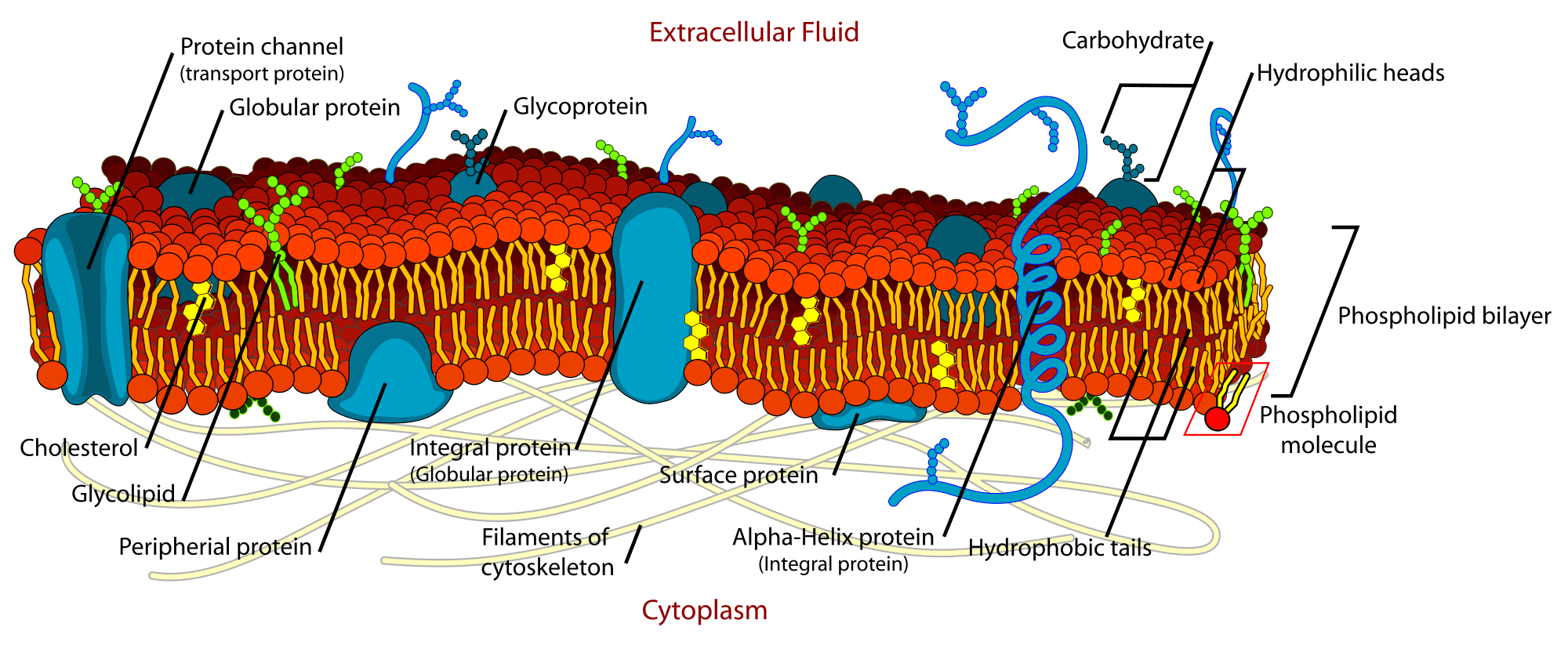
What is this image?
a)
cell membrane
b)
proteins
c)
carbohydrates
d)
lipids
14.
What does "bilayer" mean?
a)
one layer
b)
two layers
c)
laminated
d)
bilateral
15.
Most of the cell membrane is made of...
a)
Lipids
b)
Carbohydrates
c)
Proteins
d)
Nucleic acids
16.
What is embedded in the phospholipid bilayer?
a)
proteins
b)
salt
c)
water
d)
trapped animals
17.
What forms the channels and pumps in the phospholipid bilayer?
a)
carbohydrates
b)
proteins
c)
hydrophilic heads 
d)
lipids
18.
Hydrophilic means...
a)
water-loving
b)
water-fearing
c)
nonpolar
d)
lipid soluble
19.
Hydrophobic region of the cell membrane?
a)
E
b)
B
c)
C
d)
20.
Hydrophilic portion of cell membrane?
a)
A
b)
C
c)
D
d)
21.
A ______________ is composed of a phosphate and glycerol head and 2 fatty acid chain tails. 
a)
phospholipid 
b)
Carbohydrate
c)
Cholesterol 
d)
Protein 
22.
___________ have 2 functions in the cell membrane.
1.) They act like gatekeepers, only let certain things in. 
2.) Enzyme receptors embedded in the membrane.
a)
Carbohydrates 
b)
Proteins 
c)
Phospholipids 
d)
Cholesterol
23.
___________ form the two layers of the cell membrane. 
a)
Carbohydrates 
b)
Proteins 
c)
Phospholipids 
d)
Cholesterol
24.
It forms a boundary between the inside of the cell and the outside of the cell. 
a)
Cell Membrane
b)
Lipid Cleric Layer
c)
Membrane Gate
d)
Protein Receptors 
25.
Something is ___________ ____________
when some molecules can cross the membrane while others cannot. 
a)
Selectively (or Semi) Permeable 
b)
Totally Transparent
c)
Liquid Licorice 
d)
Heavily Patrolled 
26.
Cells sometimes use energy to transport materials across the cell membrane.  This is called
a)
photosynthesis
b)
osmosis
c)
cellular respiration
d)
active transport
27.

The _______________ of the phospholipids in a cell membrane face inward towards each other.

a)

heads

b)

tails

c)

stems

d)

sticks

28.
Which of the following is responsible for getting large or charged (polar) molecules across the cell membrane?
a)
E
b)
B
c)
C
d)
D
29.
True or false:  Some things are not allowed to enter the cell at all. 
a)
True
b)
False
30.
The cell is an _____ system.  It requires the constant inflow of matter and energy and outflow of waste. 
a)
closed
b)
open
c)
false
d)
circulatory
31.
Hypertonic solutions...
a)
water moves from hypotonic to hypertonic
b)
water moves from hypertonic to hypotonic
32.

Osmosis is specifically.....

a)

diffusion of water molecules through a semi-permeable mebrane from an area of low concentration to an area of high concentration

b)

the diffusion of particles from an area of high concentration to an area of low concentration

c)

diffusion of water molecules through a semi-permeable membrane from an area of high concentration to an area of low concentration

d)

the diffusion of particles from an area of low concentration to an area of high concentration

33.
Even though the concentration of salt is high in some gland cells and low in the blood, these cells can move salt out of blood and into the cells.  This is an example of
a)
passive transport
b)
active transport
c)
diffusion
d)
osmosis
34.
In which case would a cell most likely shrink?
a)
when placed in a solution containing a high salt concentration
b)
when placed in a isotonic solution
c)
when placed in a solution containing a low pH
d)
when placed in a solution containing distilled water
35.
The picture is an example of...
a)
active tranport
b)
passive transport
c)
diffusion
d)
osmosis
36.
Active transport requires energy because...
a)
The cell is moving something against a concentration gradient
b)
The cell is moving something with a concentration gradient
37.
A student noticed that placing wilted lettuce in a bowl of cool water caused the lettuce to become more crisp and firm. What is the best explanation for his observation?
a)
Water moved into the lettuce cells by active transport.
b)
Water moved into the lettuce cells by osmosis.
c)
Salt moved into the lettuce cells by diffusion.
d)
Water moved out of the lettuce cells by osmosis.
38.
_______ regulates what enters and leaves a cell.  
a)
Cell Membrane
b)
Nucleus
c)
Mitochondria
d)
Cytoplasm
39.
Where will the water go?
a)
Into the cell
b)
Out of the cell
c)
Equally in & out - it's isotonic
d)
There is no water
40.
What is the difference between active and passive transport?
a)
Active does not need energy and passive uses ATP (energy)
b)
Active uses ATP (energy) and passive does not need energy
c)
Active stores transport proteins and passive releases 
d)
Active uses hormones and passive does not 
41.
The roots of a plant contain a high concentration of minerals and the soil contains a lower concentration.  The roots absorb minerals from the soil.  This is an example of
a)
passive transport.
b)
active transport.
c)
diffusion
d)
osmosis
42.

A general term for the various types of active transport that move particles into a cell by enclosing them in a vesicle made out of plasma membrane.

a)

Endocytosis

b)

Exocytosis

c)

Osmosis

d)

Diffusion

43.

Nemo and other ocean dwelling fish cannot survive in freshwater because......

a)

freshwater is hypertonic to Nemo's cells and will result in water leaving them causing the cells to shrink

b)

freshwater is hypotonic to Nemo's cells and will result in water leaving them causing the cells to shrink

c)

freshwater is hypertonic to Nemo's cells and will result in water entering them causing the cells to swell and burst

d)

freshwater is hypotonic to Nemo's cells and will result in water enter them causing the cells to swell and burst

44.

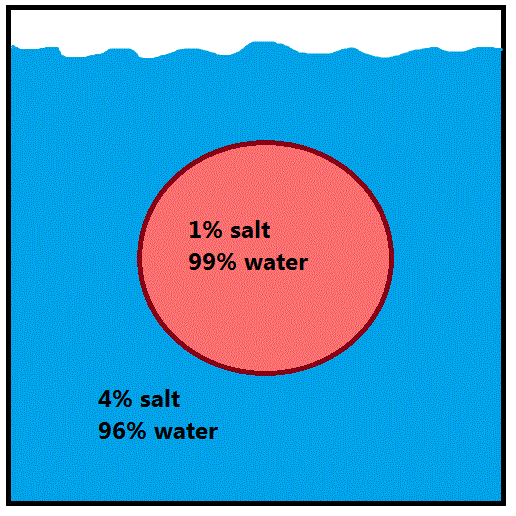
In the cell pictured, which way would water move?

a)

Into the cell, causing the cell to swell

b)

Out of the cell, causing the cell to shrink

c)

In and out of the cell equally, keeping the shape the same

45.

In the cell pictured, where would water move? 

a)

Into the cell, causing it to swell

b)

Out of the cell, causing it to shrink

c)

In and out of the cell equally, causing the shape to stay the same

46.

In the cell pictured, which way would water move?

a)

Into the cell, causing the cell to swell

b)

Out of the cell, causing the cell to shrink

c)

In and out of the cell equally, keeping the shape the same

47.

In the cell pictured, which way would water move?

a)

Into the cell, causing the cell to swell

b)

Out of the cell, causing the cell to shrink

c)

In and out of the cell equally, keeping the shape the same

48.

In the cell pictured, which way would water move?

a)

Into the cell, causing the cell to swell

b)

Out of the cell, causing the cell to shrink

c)

In and out of the cell equally, keeping the shape the same

49.

Active transport is the movement of large materials across a cell membrane from ______ to ______ concentration

a)

high to low

b)

low to high

c)

high to high

d)

low to low

50.

Active transport across a cell membrane from low to high concentration, requires

a)

energy (ATP)

b)

no energy

c)

water

d)

oxygen

51.

A form of bulk transport in which materials are transported from the inside to the outside of the cell in membrane-bound vesicles that fuse with the plasma membrane.

a)

Endocytosis

b)

Exocytosis

c)

Osmosis

d)

Diffusion

52.

white blood cells engulfing invading bacteria is an example of

a)

Endocytosis

b)

Exocytosis

c)

Diffusion

d)

Facilitated Diffusion

53.
What type of transport is this?
a)
Endocytosis
b)
Diffusion
c)
Exocytosis
d)
Osmosis
54.
What type of transport is this?
a)
Endocytosis
b)
Exocytosis
c)
Diffusion
d)
Sodium-Potassium Pump