
 Worksheets
7A+scientific method review
Total questions: 44
Worksheet time: 29mins

Susan said, “If I fertilize my geranium plants, then they will have more flowers.”
recognize a problem
test the hypothesis with an experiment
form a hypothesis
draw conclusions
How many independent variables should you have in an experiment?
two
as many as possible
four
one
The information you collect while doing your experiment is called
conclusions
data
hypotheses
procedures
What is an dependent variable?
What a scientist changes in an experiment to test their hypothesis
What scientist measure to see if it responded to a change
What happens when you do an experiment
What you keep the same throughout all experimental groups
What is an independent variable?
What a scientist changes in an experiment to test their hypothesis
What scientist measure to see if it responded to a change
What happens when you do an experiment
What you keep the same throughout all experimental groups
The main organ that works in our respiratory system is (are) ____
brain
blood vessels
mouth
lungs
The organs that produce urine are
lungs
intestines
ribs
kidneys
The function of this organ is absorbing nutrients. This organ is ____
gall bladder
esophagus
large intestine
small intestine
It controls all of the activities in human body. The organ is ____
brain
heart
liver
nerve

Organ pointed by letter A are called ____
heart
spinal cord
blood vessels
muscles

Study the human organs below.
The body system that works using these organs is ____ system.
nervous
respiratory
excretory
circulatory
The organ system that handling the food in our body is ___ system.
respiratory
excretory
digestive
circulatory
Which of the following is located in our chest ?
Heart
Kidneys
Small intestine
Stomach
This body system includes the nose, lungs, and windpipe...
respiratory
circulatory
skeletal
reproductive

The name of the organ is . . . .
stomach
large intestine
small intestine
gullet
an organ that stores and releases urine
bladder
kidney
stomach
organ
an organ that removes waste materials from the blood (2 in body)
bladder
kidney
liver
pancreas

What is the vascular tissue that carries water throughout a plant?
phloem
seedling
xylem
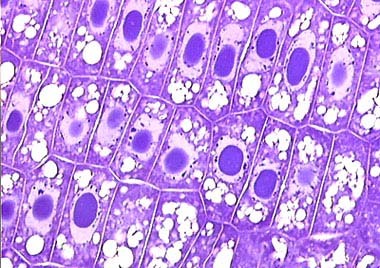
The smallest unit of organization shown in the picture is a
cell
tissue
organ
organ system
What is the main purpose of root hairs?
to make sugars for the plant
to obtain carbon dioxide for photosynthesis for the plant
to increase the surface area available for water and mineral absorption
to provide a place for plant reproduction to occur
This organelle controls what goes in and out of plant and animal cells.
Cell Wall
Cell Membrane
Chloroplasts
Cytoplasm
The _____________ holds the DNA, and controls the functions of eukaryotic cells.
Nucleus
Nuclear Membrane
Mitochondria
Chloroplast
What is the correct hierarchy of cells?
tissues-cells-organ systems-organs-organisms
cell-organisms-tissues-organs-organ systems
cells-tissues-organs-organ systems-organisms
organs-tissues-cells-organ systems-organisms
Where do plants get the energy for photosynthesis to take place?
nutrients in the soil
the sun
chlorophyll
bee pollination
What part of the plant soaks up water for photosynthesis?
roots
petals
leaf
stem
Where do the leaves and stems of plants get their green color from?
glucose
oxygen
carbon dioxide
chlorophyll
The process of photosynthesis takes place in the:
Leaves of the Plant.
Stem of the plant.
Roots of the plant.
All of the above.
Which of the following is NOT a life process?
eating
breathing
getting rid of waste
sleeping
Reproduction is the ability to ...............
detect and respond to changes in our surroundings
eat
have babies

Sensitivity is the ability to...
detect and respond to changes in the environment
provides your body with energy and nutrients
have offspring

The process of nutrition...
detect and respond changes in the environment
provides your body with energy and nutrients
have offspring
Which life process involves the use of oxygen and carbon dyoxide ?
Regulation
Synthesis
Nutrition
Respiration

What is a group of cells that are alike and work together?
a cell team
a tissue
a cell family
What is the term for the control center for the entire body that sends signals from throughout the body to the brain?
circulatory system
respiratory system
excretory system
muscular system
nervous system

