
 Worksheets
Y9 Red Week 1 Revision
Total questions: 69
Worksheet time: 1hrs 3mins

The physical appearance of an organism based on traits
Genotype
Phenotype
Meiosis
Genetics
The genotypes codes for
phenotype (physical trait)
DNA
allele
The letters that represent different forms of a gene.
Allele
Mutation
Trait
Trait of an organism that can be HIDDEN by the dominant form of a trait.
Recessive Trait
Phenotype
Allele
Having two of the SAME alleles for a trait.
Recessive Trait
Homozygous
Genotype
The trait that overshadows and is expressed.
Dominant Trait
Phenotype
Allele
Having two DIFFERENT alleles for a trait.
Recessive Trait
Heterozygous
Genotype
In a heterozygous genotype, the ___________ allele takes over in the phenotype.
recessive
dominant
both

T - tall and t = short
In the Punnett square, what belongs in the missing square?
tt
Tt
TT

B = brown fur b = white fur
In the punnett square, what is the probability for white fur?
0%
25%
50%
75%

Each one of the boxes on the Punnett square represents what probability of an offspring's genotype?
25%
1%
10%
0%
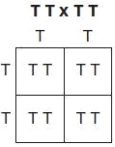
What is ratio of the offspring from the cross shown will be homozygous recessive for the trait of tallness? T = tall t = short
0 in 4
1 in 4
2 in 4
4 in 4


tt

What is the charge of a group 1 metal ion?
1+
2+
1-
2-
How does a group 1 metal atom form an ion?
lose 1 electron
lose 2 electrons
gain 1 electron
gain 2 electrons
Which alkali metal has the symbol Cs
Caesium
Ceasium
Calcium
Sodium
How many electrons do the alkali metals have in their outer shell?
1
2
8
7


The products of meiosis are genetically...
different.
identical.
Identify a purpose of mitosis. Select all that apply.
Produce gametes for reproduction.
Repair damaged or dead cells.
Reduce the chromosome number.
Growth of organisms from birth to adulthood.
Suppose a diploid animal cell has 16 chromosomes. How many chromosomes would a sex cell of this animal have
16
8
32
23
All cells in your body have genetic information (the code found within DNA). Sex cells (egg and sperm) have ________________ the amount of genetic information when compared to the body cells in your body
twice
equal
half
four times
Most human cells have 46 chromosomes (23 pairs). If egg and sperm cells each had this number of chromosomes when they combine during fertilization there would be problems. Therefore, egg and sperm cells have _______________________.
half the amount of chromosomes as compared to other cells.
twice the amount of chromosomes when compared to other cells.
four times the amount of chromosomes when compared to other cells.
a quarter of the amount of chromosomes when compared to other cells.
A 2n cell of a bat has 44 chromosomes, how many chromosomes will you find in one of his gametes
23
22
44
88
What is the left part of a chemical equation called?
2H2 + O2 ---> 2H2O
Reactants
Yields
Products
Chemical equation
What is the right part of a chemical equation called?
2H2 + O2 ---> 2H2O
Reactants
Yields
Products
Chemical Equation
What is the total number of atoms present in 5Na3PO4?
5
55
40
8
How many Mn atoms are found in the following compound?
2MnO4
1
2
4
8
What is the little number after an element in a chemical equation called?
Example: H2
Coefficient
Atom
Subscript
Equation
Is the following equation balanced?
Al + O2 ---> 2Al2O3
YES
NO
What is the number before a chemical formula called?
Example: 2H2 + O2 ---> 2H2O
Coefficient
Atom
Subscript
Equation
Which of the following equations are correctly balanced?
12CO2 + H2O ---> C6H12O6 + O2
CO2 + H2O ---> 3C6H12O6 + O2
CO2 + 9H2O ---> C6H12O6 + O2
6CO2 + 6H2O ---> C6H12O6 + 6O2
Balance this equation:
H2 + Cl2 ---> HCl
It is balanced.
H2 + Cl2 ---> 2HCl
3H2 + Cl2 ---> 6HCl
H2 + 3Cl2 ---> 6HCl
Balance this equation:
HgO ---> 2Hg + O2
It is balanced.
2HgO ---> 2Hg + O2
2HgO ---> Hg + O2
HgO ---> Hg + 2O2
Complete the sentence.
During a chemical reaction, atoms ________.
can appear
can disappear
get rearranged
stop moving and vibrating
What is the Law of Conservation of Mass?
It states that matter cannot be created or destroyed.
It states that energy cannot be created or destroyed.
It states that matter can be created or destroyed.
It states that sound can be created or destroyed.
Mg + __HCl ---> MgCl2 + H2
What are the numbers that you CANNOT change in a chemical equation?
Subscripts
Balance the following equation:
___ H2+ ___ O2→___ H2O
1, 1, 3
2, 2, 2
1, 2, 1
2,1, 2
What is the right ratio of chemicals for the balanced chemical equation?__Na + __H2O --> __NaOH + __H2
What is the right ratio of chemicals for the balanced chemical equation?
__Ca + __H2O --> __Ca(OH)2 + __H2
What is the right ratio of chemicals for the balanced chemical equation?
__CO + __Fe2O3--> __Fe + __CO2
What is the right ratio of chemicals for the balanced chemical equation?
__AgNO3 + __H2S --> __Ag2S+ __HNO3
What is the right ratio of chemicals for the balanced chemical equation?
__H2 + __S --> __H2S
What is the right ratio of chemicals for the balanced chemical equation?
__H2SO3 + __KOH--> __H2O+ __K2SO3
What is the right ratio of chemicals for the balanced chemical equation?
__MnO2 + __HCl --> __MnCl2 + __H2O __Cl2
What is the right ratio of chemicals for the balanced chemical equation?
__FeCl3 + __Ca(OH)2 --> __Fe(OH)3 + __CaCl2

