
 Worksheets
Development of the Atomic Theory
Total questions: 37
Worksheet time: 22mins
Who discovered the negatively charge of an atom known as electron and proposed the Plum Pudding Model to describe the structure of an atom?
Chadwick
Goldstein
Thomson
Rutherford
Who discovered the neutral charge of an atom known as neutron?
Chadwick
Goldstein
Thomson
Rutherford
Who discovered the center of an atom known as nucleus which is a positively charged using the Gold Foil Experiment?
Chadwick
Goldstein
Thomson
Rutherford
He believed that all matter in the universe are made up of indivisible units known as 'atomos'.
Democritus
Dalton
Mendeleev
Moseley
He gave us the early idea about the composition of compounds. According to him compounds are made up of two or more atoms of the same or different elements.
Democritus
Dalton
Mendeleev
Moseley

This is an example of which model of the atom?
Rutherford's Model
Plum Pudding Model
Atomic Model
Bohr's Model
What experiment did J.J. Thomson run to develop his model of the atom?
Gold-Foil Experiment
Definite Proportion Experiment
Cathode-Ray Tube Experiment
No experimentation was done
Which of these had scientific evidence to back their models of the atom?
Democritus
John Dalton
J.J. Thomson
Ernest Rutherford

Who developed this model of the atom?
Plum Pudding Model
J.J. Thomson
Proto-Electron Model
Ernest Rutherford
What did the cathode-ray tube experiment prove?
Atoms could be broken into smaller parts
Atoms caused the changes in matter
Atoms join to create compounds
The center of an atom has a nucleus
What is a nucleus?
An atom’s central region, which is made up of protons and neutrons
Subatomic particles that have negative charges
subatomic particles that have positive charges
Subatomic particles that have neutral charges
What are electrons?
an atom’s central regions, which is made up of protons and neutrons
subatomic particles that have negative charges
subatomic particles that have neutral charges
subatomic particles that have positive charges
Where did Rutherford propose that most of the mass of an atom resided?
In the middle of the atom
Along the edge of the atom
Scattered throughout the atom
Orbiting around the atom
Why wasn't Democritus' theory widely accepted?
All of his theory was based on thought
He wasn't respected
It wasn't based on scientific evidence
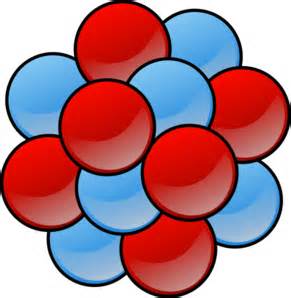

What is the atomic number?
35
18
17
52

How many protons and electrons does this element have?
35
18
17
52

How many neutrons does Chlorine have?
18
17
35
52
According to Dalton's atomic theory, atoms are indestructible and indivisible. True or False?
True
False
According to Dalton's atomic theory, different atoms are combined in fixed, whole number ratios to form _________
Compounds
Molecules
Isotopes
Mixtures
Dalton took isotopes into account when developing his atomic theory. True or false?
True
False
Which THREE postulates of Dalton's atomic theory have been proven false by later research?
All matter is made up of atoms
Atoms are indivisible and indestructible
Atoms of different elements have different masses
All atoms of the same element have identical properties
Atoms combine in fixed, whole-number ratios to form compounds

Which particles change the charge in atoms when ions are formed?
Protons
Electrons
Neutrons
What happens by changing the number of neutrons?
The atomic mass changes
The number of electrons changes
The atomic number changes
The number of protons changes

If a proton is added or removed from an atom, what happens?
It becomes a different element.
It becomes a different isotope.
Nothing happens.
What is the difference between Neon-20 and Neon-22?
They have different numbers of electrons.
They have different numbers of neutrons.
Only 1 is radioactive.
No difference.
The atomic mass of an element is the ___.
average of the mass number and the atomic number for the element
weighted average of the masses of the isotopes of the element
total mass of the isotopes of the element
total number of subatomic particles in the nucleus
What are the steps for finding the Average Atomic Mass?
1) write given mass, 2) write given %, 3) % to decimal, 4) Mass x abundance decimal 5) Add
1) % to decimal, 2) write given %, 3)write given mass, 4) Mass x abundance decimal 5) Add
1) write given mass, 2) write given %, 3) % to decimal, 4) Mass divided by abundance decimal 5) Add
1) write given mass, 2) write given %, 3) % to decimal, 4) Mass x abundance decimal 5) Subtract
The atomic mass of an element depends upon the ___.
relative abundance of protons in that element
mass and relative abundance of each isotope of that element
mass of each isotope of that element
mass of each electron in that element

