wayground logo

Free Printable Worksheets

NEW

Font size

S
M
L
XL
Worksheets

Cell Processes

Total questions: 50

Worksheet time: 53mins
Name
Class
Date
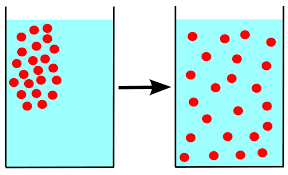
1.
The picture below is an example of _________________.
a)
osmosis
b)
isotonic
c)
diffusion
d)
active transport
2.
What is the definition of Osmosis?
a)
the movement of WATER molecules across the cell membrane.
b)
the state where molecules are equally concentrated (balanced) on both sides of the cell membrane.
c)
the process that brings LARGE particles INTO the cell through the cell membrane
d)
he movement of molecules across the cell membrane that REQUIRES ENERGY output from the cell
3.
Which of the following is the correct equation for PHOTOSYNTHESIS?
a)
CO+ light + H2O --> O+ Sugar
b)
CO+ sugar + H2O --> O+ light
c)
O2 + light + H2O --> CO+ Sugar
d)
CO+ O2 + H2O --> Light+ Sugar
4.
What is the pigment in chloroplasts that performs photosynthesis?
a)
Methylene blue
b)
Chlorophyll
c)
Carotene
d)
Green
5.
Cellular respiration takes place in the
a)
nucleus
b)
cytoplasm
c)
ribosomes
d)
mitochondria
6.
What is the correct equation for cellular respiration?
a)
O2 + C6H12O6 -> CO2 + H2O + Energy
b)
O2 + C6H12O6 + Energy -> CO2 + H2O
c)
CO2 + H2O -> O2 + CH12O6 + Energy
d)
CO2 + H2O + Energy -> O2 + C6H12O6
7.

The movement of substances across the cell membrane that does require the use of energy by the cell is:

a)

Active Transport

b)

Diffusion

c)

Passive Transport

d)

Osmosis

8.

This diagram shows a red blood cell in a beaker that contains a solution with a higher salt concentration than that inside the red blood cell.

What will happen to the red blood cell in this environment?

a)

The size of the red blood cell will remain constant.

b)

The red blood cell will swell at first and then shrink.

c)

The red blood cell will swell from absorbing salt molecules.

d)

The red blood cell will shrink from losing water molecules.

9.

A student noticed that the freshwater plant, Elodea, produced bubbles when placed in direct light. What could the student most likely conclude?

a)

Bubbles of carbon dioxide were produced as a result of photosynthesis.

b)

Bubbles of oxygen were produced as a result of photosynthesis.

c)

Bubbles of carbon dioxide were produced as a result of cellular respiration.

d)

Bubbles of oxygen were produced as a result of cellular respiration.

10.

How does the amount of energy resulting from fermentation compare with that of aerobic respiration?

a)

Aerobic respiration results in less energy.

b)

Aerobic respiration results in more energy.

c)

Each process results in equal amounts of energy.

d)

Each process results in variable amounts of energy.

11.
Which cell part is present in eukaryotic cells, but not in prokaryotic cells?
a)
cell membrane
b)
cell wall
c)
cytoplasm
d)
nucleus
12.
Which organic macromolecules are composed of chains of amino acids that join to form the structural components of organisms?
a)
carbohydrates
b)
nucleic acids
c)
proteins
d)
lipids
13.
The basic unit of structure and function in the human body is the....
a)
organ
b)
organ system
c)
cell
d)
tissue
14.
Movement of materials down the concentration gradient through a protein channel is an example of 
a)
facilitated diffusion
b)
active transport
c)
respiration
d)
osmosis 
15.
Which best describes the function of enzymes?
a)
to speed up chemical reactions in a cell
b)
to produce cellular energy
c)
to produce proteins
d)
to speed up cell division
16.

Which of the following converts food into energy for the cell?

a)

vacuole

b)

mitochondria

c)

cytoplasm

d)

cell membrane

17.
In this image, the cell is using which type of molecular transport?
a)
Osmosis
b)
Diffusion 
c)
Endocytosis
d)
Exocytosis 
18.
What are the two reactants of cellular respiration?
a)
C6H12O6 & 6CO2
b)
6 CO2 & 6H2O
c)
C6H12O& 6O2
d)
6CO2 & 6O2
19.
What molecule is this
a)
sucrose
b)
protein
c)
glucose
d)
cellulose
20.
The cell below is in a _________ solution.
a)
Hypotonic
b)
Hypertonic
c)
Isotonic
21.
What two products does a plant make during photosynthesis?
a)
Water and Glucose
b)
Oxygen and Glucose
c)
Oxygen and Water
d)
CO2 and Glucose
22.

Some students used vinegar to dissolve away the shells of three eggs and used the eggs as models of human red blood cells. The students observed the changes in the eggs when they were placed in different solutions. (View Image)


Which statement best describes the role of the cell membrane in this model?

a)

The cell membrane is an impermeable barrier that prevents water from entering the cell.

b)

The cell membrane allows solutes to enter the cell, which causes the cell to shrink.

c)

The cell membrane allows water to enter and leave the cell.

d)

The cell membrane removes solutes from the environment.

23.

Photosynthesis and cellular respiration both involve the use and release of gases. Which statement correctly identifies the role of gases in the two processes?

a)

Photosynthesis and cellular respiration both use carbon dioxide and release oxygen.

b)

Photosynthesis and cellular respiration both use oxygen and release carbon dioxide.

c)

Cellular respiration uses oxygen and releases carbon dioxide, while photosynthesis uses carbon dioxide and releases oxygen.

d)

Cellular respiration uses carbon dioxide and releases oxygen, while photosynthesis uses oxygen and releases carbon dioxide.

24.

The diagram represents one way an enzyme can be inhibited. (View Image)


Which statement explains the effect of an inhibitor on an enzyme?

a)

A substrate will be able to bond with the enzyme.

b)

The enzyme will likely be attacked by immune cells.

c)

The enzyme will be unable to produce more enzymes.

d)

A substrate will be unable to attach to the enzyme.

25.
Carbohydrates are made of... 
a)
C H O
b)
C H O N
c)
C H O N P
d)
C H O N S
26.
Which group of organic molecules serve as long-term energy storage and make the cell membrane is?
a)
proteins
b)
carbohydrates
c)
lipids
d)
nucleic acids
27.
The building blocks of nucleic acids are called ...
a)
amino acids
b)
nucleotides
c)
carbohydrates
d)
proteins
28.
ATP is...
a)

an energy carrier in cells

b)
a type of lipid
c)
a molecule of DNA
d)

an energy-poor molecule

29.
Enzymes are _________ that __________ chemical reactions.
a)
proteins, slow down
b)
proteins, speed up
c)
lipids, slow down
d)
lipids, speed up
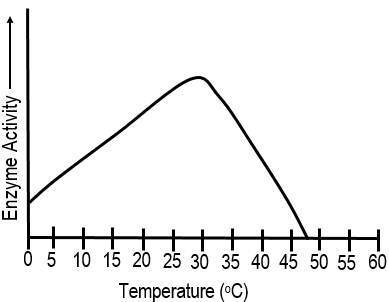
30.
Based on the graph, what temperature does this enzyme work best? 
a)
15 C
b)
40 C
c)
30 C
31.

AMINO ACIDS ARE THE BUILDING BLOCKS OF...

a)

CARBHYDRATES

b)

LIPIDS

c)

NUCLEIC ACIDS

d)

PROTEINS

32.

WHICH BIOMOLECULES STORES LONG-TERM ENERGY?

a)

PROTEIN

b)

CARBS

c)

LIPIDS

d)

NUCLEIC ACIDS

33.

This cell is a -

a)

PROKARYOTIC

b)

PLANT

c)

ANIMAL

d)

PROTIST

34.
How are cellular respiration and photosynthesis related, in terms of energy?
a)
The energy captured in photosynthesis is used to power cellular respiration.
b)
The energy transformed in cellular respiration is used to power photosynthesis.
c)
Photosynthesis and respiration perform the same task in terms of energy transformation.
d)
Energy is not involved in either photosynthesis or cellular respiration.
35.
Two different species of bacteria are examined. Scientists find that species X always produces CO2 and H2O during cellular respiration. Species Y always produces ethyl alcohol and CO2. Which conclusion can be made from these observations?
a)
Only species Y is aerobic.
b)
Only species Y is anaerobic
c)
Both species X and Y are aerobic.
d)
Both species X and Y are anaerobic.
36.
A diagram representing the relationship between photosynthesis and cellular respiration is shown below. The numbered boxes in the diagram represent which of the following?
a)
1 - water; 2 - nitrogen
b)
1- nitrogen; 2- oxygen
c)
1 - oxygen; 2- carbon dioxide
d)
1- carbon dioxide; 2- water
37.
Which organelle puts the finishing touches on proteins, packages and exports them from the cell? 
a)
Golgi Apparatus
b)
Rough ER 
c)
Mitochondria
d)
Nucleus
38.
Facilitated Diffusion uses a __ to aid in diffusion, but they do not require energy to function
a)
Protein channels 
b)
Pumps 
c)
Vesicles
39.
What is the name and function of the organelle displayed above?
a)
Mitochondria: breakdown glucose and produce ATP
b)
Chloroplast: converts solar energy into chemical energy
c)
Vacuole: Stores H2O, salt, food
d)
Nucleus: stores genetic information
40.
Which structure would be found in a grass cell but NOT on your cell?
a)
cell wall
b)
nucleus
c)
mitochondria 
d)
vacuoles 
41.
Rough endoplasmic reticulum has ________________ attached to it. 
a)
ribosomes 
b)
chromosomes 
c)
Golgi apparatus 
d)
nucleolus 
42.
Put the stages of mitosis in the correct order.
a)
prophase - metaphase - anaphase - telophase
b)
metaphase - anaphase - prophase - telophase
c)
anaphase - prophase - telophase - metaphase
d)
telophase - metaphase - prophase - anaphase
43.
What is the result of mitosis?
a)
1 cell
b)
2 genetically identical cells
c)
2 genetically different cells
d)
4 genetically identical cells
44.
Plant cells take in light energy and change it into chemical energy in the form of glucose (food). Occurs in the chloroplasts.
a)
Photosynthesis
b)
Cellular Respiration
c)
Osmosis
d)
Diffusion
45.
Process where food is broken down to release chemical energy. Occurs in the mitochondria.
a)
Cellular Respiration
b)
Photosynthesis
c)
Active Transport
d)
Passive Transport
46.

where is aerobic and anaerobic respiration located?

a)

aerobic: cytoplasm

anaerobic: stroma

b)

aerobic: mitochondria

anaerobic: stoma

c)

aerobic: chlorophyll

anaerobic: cytoplasm

d)

aerobic: mitochondria

anaerobic: cytoplasm

47.
Why is yeast used to bake bread? 
a)
The waste gas, CO2, makes bread rise
b)
The alcohol produced makes bread dangerous
c)
The yeast consumes O2, causing bread to rise
48.
What is a disadvantage of fermentation as a process? 
a)
It produces too much ATP
b)
It only produces 2 ATP
c)
It occurs in the absence of oxygen
d)
It is only for quick bursts of energy
49.
What cells in the body may undergo lactic acid fermentation during exercise? 
a)
Muscle cells
b)
Fat cells
c)
Liver cells
d)
Skin cells
50.
Lactic acid fermentation occurs in your muscles after a workout because your cells are struggling to get
a)
Glucose
b)
Sunlight
c)
Oxygen
d)
Water