
 Worksheets
Cell Transport Practice
Total questions: 55
Worksheet time: 47mins


Diffusion & Facilitated Diffusion are both __________ transport.
Passive
Active
Easy
Free
Passive Transport is the movement of particles across the membrane from an area of [ ___ ] to an area of [ ___ ]
high to low
low to high
low to low
high to high
Passive Transport uses ____ energy
no
a lot of
a little bit of
some

The type of transport that requires the use of transport proteins
Passive Transport
Facilitated Diffusion
Active Transport
Vesicular Transport

The passage of a substance from an area of high concentration to an area of low concentration
Active Transport
Diffusion
Vesicular Transport
Exocytosis
Which of the following are types of active transport?
(Select all that correct)
Endocytosis
Photosynthesis
Exocytosis
Plasmolysis
Diffusion is the movement of molecules from an area of ______ concentration to an area of ___ concentration. Diffusion required NO ______.
high
low
energy

A type of cellular transport is shown.
Which description best identifies this type of cellular transport?
Active transport, because energy is being used to move molecules against the concentration gradient
Facilitated diffusion, because energy is being used to move molecules with the concentration gradient
Osmosis, because energy is not being used to move molecules with the concentration gradient
Endocytosis, because energy is not being used to move molecules against the concentration gradient
Which type of passive transport uses proteins to help molecules pass through the membrane?
Cell membranes are described as selectively permeable.
Four students were asked to explain what this means. Which one is correct?
Student 1: Cell membranes prevent all materials from entering the cell.
Student 2: Cell membranes only provide structural support for the cell.
Student 3: Cell membranes regulate which substances can enter and exit the cell.
Student 4: Cell membranes allow water and water-soluble substances to enter the cell.
What is a difference between diffusion and facilitated diffusion?
movement of particles from [high] to [low]
a protein "helper"
movement of particles from [low] to [high]
energy


If the dots represent sugar which is more concentrated
Inside the cell
Outside the cell
Neither they are equal (equilibrium)

If the dots represent sugar, what direction will water flow?
Into the cell
Out of the cell
Into and out equally (equilibrium)

If the percentage represents sugar, what direction will water flow?
Into the cell
Out of the cell
Into and out equally (equilibrium)
Which cell would water move into?


Which cell would water move out of?


Why can't you drink salt water?
It's hypertonic to your cells
It's hypotonic to your cells
It's isotonic to your cells
It's paratonic to your cells



Is the image an example of osmosis or diffusion? (HINT: notice that solutes are moving)
Osmosis
Diffusion

Is the solution hypotonic, hypertonic, isotonic related to the cell?
hypertonic
hypotonic
isotonic

Is the solution hypotonic, hypertonic, isotonic related to the cell?
hypertonic
hypotonic
isotonic
A cell has 80% water 20% solute, the surrounding solution has 60% water and 40% solute. What type of solution is this?
Hypertonic
Isotonic
Hypotonic
Equilibrium
When placed in a solution of 30% water 70% salt, what would happen to a cell that is 70% water?
it will take in salt and swell
it will take in water and swell
it will lose water and shrink
it will remain the same size


When you have a cold, doctors will tell you to gargle salt water. What will happen to the bacteria cells?
Salt water is hypertonic, so the bacteria cells will shrink
Salt water is hypotonic, so the bacteria cells will shrink
Salt water is hypertonic, so the bacteria cells will expand
Salt water is hypotonic, so the bacteria cells will expand
When you go to the hospital, nurses will put in an IV that has a salt solution. What would happen if they put in freshwater?
The freshwater would be hypotonic to your cells, so they would burst
The freshwater would be hypertonic to your cells, so they would burst
The freshwater would be hypotonic to your cells, so they would shrink
The freshwater would be hypertonic to your cells, so they would shrink
The freshwater would be isotonic to your cells, so they would burst
Guppies are freshwater fish. What will happen if they are placed in salt water?
They would expand from water moving into them.
They would expand from the salt moving into them.
They would shrink from water moving out of them.
They would shrink from salts in their body moving out.
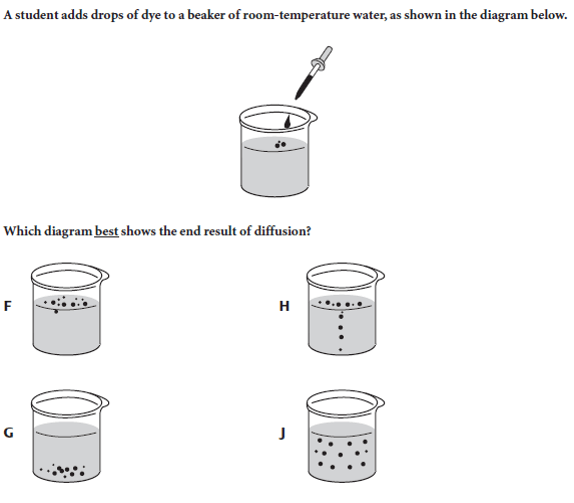
If you drop food coloring into a pitcher of water, and wait a while, the food coloring molecules will spread out evenly through the pitcher. What type of cell transport does this describe?
Diffusion
Osmosis
Facilitated Diffusion
Protein Pumps
Endocytosis
The air you breathe in has more oxygen than there is inside your lung cells. Since oxygen is a small molecule, it can easily pass through cell membranes. What type of cell transport does this describe?
Diffusion
Osmosis
Facilitated Diffusion
Protein Pumps
Exocytosis
A fresh water aquarium plant is placed in a salt water aquarium. The plant eventually withers and dies. What type of cell transport does this describe?
Diffusion
Osmosis
Facilitated Diffusion
Protein Pumps
Endocytosis
The cells in your intestines have special channel proteins that allow glucose to diffuse through the cell membrane. They only travel in the direction that goes against their concentration gradient. If you drink cool aid, what type of cell transport does this describe?
Diffusion
Osmosis
Facilitated Diffusion
Protein Pumps
Exocytosis
Your body needs calcium to build and maintain your bones. Since most food does not have that much calcium in it, your intestines use energy to get any calcium into your cells. What type of cell transport does this describe?
Diffusion
Osmosis
Facilitated Diffusion
Protein Pumps
Endocytosis

