wayground logo

Free Printable Worksheets

NEW

Font size

S
M
L
XL
Worksheets

Muscle/Connective/Nervous Tissue Quiz

Total questions: 33

Worksheet time: 18mins

Name
Class
Date
1.

What type of tissue is used for cushioning around organs?

a)

Skeletal muscle

b)

Simple squamous epithelium

c)

Pseudostratified columnar epithelium

d)

Adipose tissue

2.

Name this tissue.

a)

Skeletal muscle

b)

Cardiac muscle

c)

Smooth muscle

3.

This type of muscle tissue is found only in the heart

a)

Skeletal muscle

b)

Cardiac muscle

c)

Smooth muscle

4.

What type of muscle tissue is found in the walls of hollow organs such as the stomach?

a)

Skeletal muscle

b)

Cardiac muscle

c)

Smooth muscle

5.

Which types of muscle tissue are voluntary?

a)

Cardiac Muscle

b)

Smooth Muscle

c)

Skeletal Muscle

d)

Skeletal Muscle and Smooth Muscle

6.
Skeletal muscle is identifiable because it's the only one with....
a)
Nuclei on the surface
b)
Striations
c)
Intercalated Discs
d)
Branching Cells
7.
Which type(s) of muscle tissue have visible striations
a)
Only Cardiac Muscle
b)
Only Skeletal Muscle
c)
Only Smooth Muscle
d)
Skeletal and Cardiac Muscle
8.

What type of muscle tissue moves food through the digestive tract?

a)

Skeletal muscle

b)

Cardiac muscle

c)

Smooth muscle

9.

What muscle type reacts quickly?

a)

cardiac and skeletal

b)

smooth and skeletal

c)

cardiac and smooth

10.

What type of muscle tissue is this?

a)

cardiac

b)

skeletal

c)

smooth

11.

Label the muscle type from left to right.

a)

cardiac smooth skeletal

b)

skeletal cardiac smooth

c)

skeletal smooth cardiac

d)

cardiac skeletal smooth

12.
Connective tissue is
a)
The tissue that protects, supports, and binds together other body tissue
b)
Tissue that is the lining, covering, and glandular tissue of the body
c)
Tissue that contracts and shortens to produce movement
13.
Which of the following is NOT a type of connective tissue?
a)
Bone
b)
Cartilage
c)
Skin
d)
Blood
14.
Connective tissue fibers include
a)
proteoglycans, adhesion proteins and interstitial
b)
collagen, elastic and reticular
c)
osteoblasts, fibroblasts and hemoblasts
15.
Immature connective tissue cells that are actively dividing (mitotic) and help maintain the matrix end in
a)
blast
b)
clast
c)
cyte
16.
Mature, less active cells in Connective tissue end in 
a)
blast
b)
clast
c)
cyte
17.
The matrix of our blood would be described as a(n):
a)
Soild
b)
Gel 
c)
Liquid
d)
Vascular 
18.
Name this tissue
a)
Bone
b)
Cartliage
c)
Blood
d)
Dense fibrous connective tissue
19.
What tissue is this
a)
Bone
b)
Cartilage
c)
Blood
d)
Adipose
20.
This type of connective tissue forms strong rope like structures such as tendons and ligaments.
a)
Loose connective
b)
Dense connective
c)
Cartilage 
d)
Bone
21.
Most connective tissue is well vascularized. What does that mean?
a)
Poor blood supply
b)
Good blood supply
22.

What tissue is this?

a)

Transitional epithelium

b)

Cartilage

c)

Dense Fibrous

d)

Loose connective tissue

23.
a)
nerve
b)
elastic cartilage
c)
fibrocartilage
d)
cardiac muscle
24.
What type of tissue SIGNALS the intestines to move food along?
a)
Nervous Tissue
b)
Blood Tissue
c)
Smooth muscle tissue
d)
Skeletal Muscle Tissue
25.
What tissue type is this?
a)
Nervous tissue
b)
Cardiac muscle
c)
Smooth muscle
d)
Connective tissue proper
26.
Which of the following tissues is made up of cells that conduct impulses?
a)
Epithelial
b)
Connective
c)
Muscle 
d)
Nervous
27.
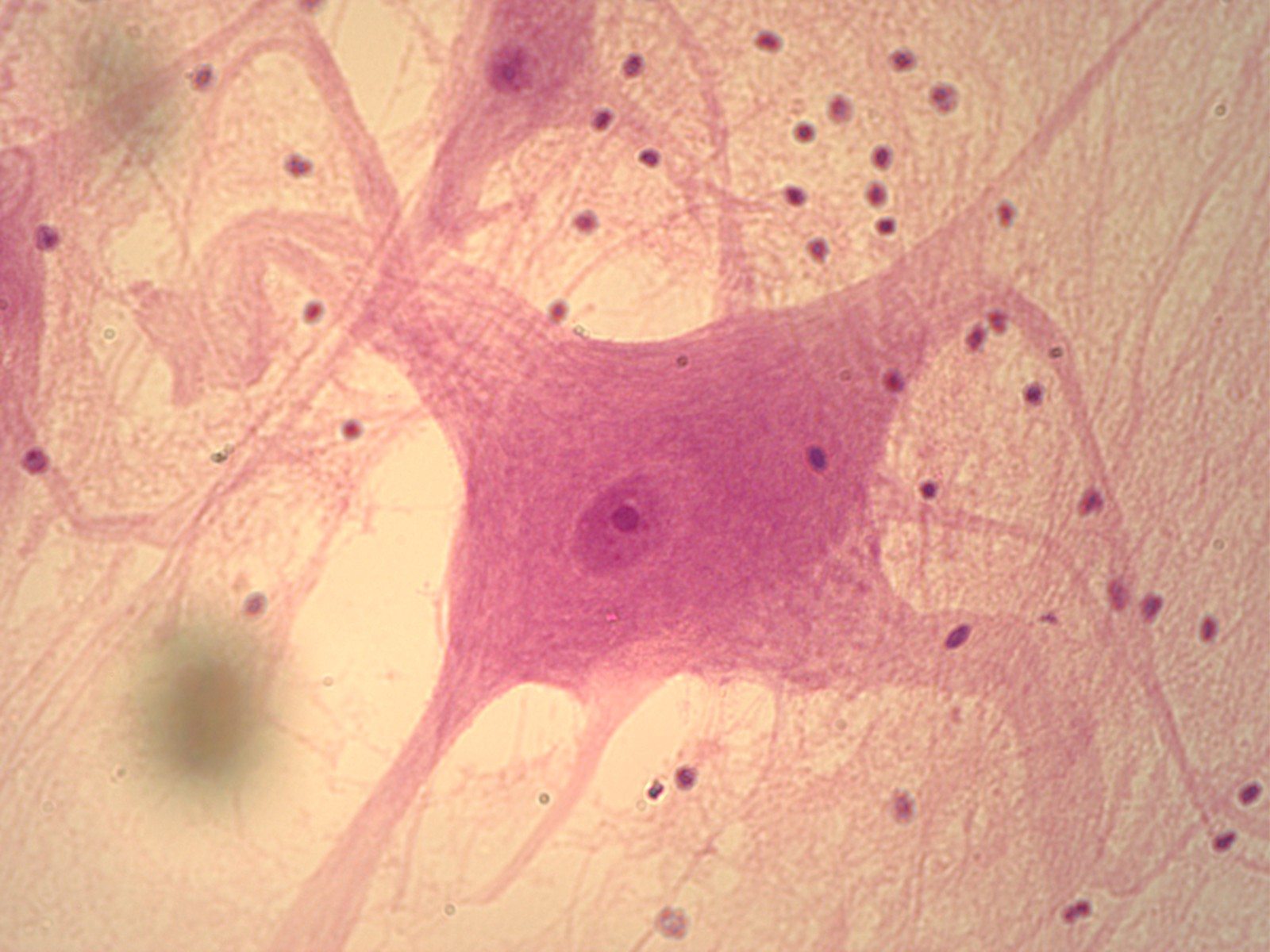
Name the tissue.
a)
bone
b)
blood
c)
nerve
d)
areolar
28.

What type of neuroglial cell is this?

a)

oligodendrocyte

b)

ependymal

c)

astrocyte

d)

microglial

29.

What part of the neuron is this?

a)

dendrites

b)

axon terminals

c)

nucleus

d)

cell body

30.

What part of the neuron is this?

a)

axon terminals

b)

dendrites

c)

axon

d)

cell body

31.

What part of the neuron is this?

a)

nodes of ranvier

b)

axon

c)

myelin sheaths

d)

dendrites

32.

What part of the neuron is this?

a)

nucleus

b)

axon

c)

axon terminals

d)

cell body

33.

What part of the neuron is this?

a)

myelin sheath

b)

nucleus

c)

nodes of ranvier

d)

axon