
 Worksheets
FX Chem 20 Bonding Unit Review
Total questions: 60
Worksheet time: 1hrs 26mins
Identify the IMF exist in CH4
dipole-dipole forces
london forces
ion-dipole forces
hydrogen bonding
Identify the IMF exist in HBr
london dispersion forces
hydrogen bonding
dipole-dipole forces
ion-dipole forces
To form a hydrogen bonding, Hydrogen needs to attract to the highly electronegative elements such us _____, _____, and ____
chlorine, fluorine, and oxygen
fluorine, oxygen, and sulfur
fluorine, bromine, and oxygen
fluorine, oxygen, and nitrogen
Forces that holds atoms together within the molecule
intermolecular forces
intramolecular forces
Dipole-Dipole forces are stronger than _______ and weaker than _________ interactions.
london dispersion, hydrogen bonding
hydrogen bonding, london dispersion
ionic bonds, london dispersion
Which of the following has the lowest boiling point?
PH3
H2O
SiH4
NH3
Forces that holds molecules together
intramolecular forces
intermolecular forces

Intermolecular forces for: NH3
dispersion forces only
dispersion forces and hydrogen bonding
dispersion forces, dipole-dipole forces, and hydrogen bonding
hydrogen bonding only

What types of intermolecular forces will be present between two molecules of acetone?
Dispersion forces only
dipole-dipole forces & dispersion forces
dispersion forces, dipole-dipole forces, and hydrogen bonding
dispersion forces and hydrogen bonding
Which substance would be expected to dissolve in polar water? Remember: like dissolves like - which of these molecules is also polar?
NH3
CH4
CO2
CH3CH2CH2CH3
Intermolecular force due to the formation of temporary dipole moments in molecules.
dispersion forces
dipole-dipole forces
hydrogen bonding
CCl4 has how many double bonds?
0
1
2
3

What bond is formed when a metal transfers electrons to a nonmetal?
Covalent bond
Ionic bond
Metallic bond
MgCl2
Ionic
Covalent
Metallic

This is a correct Lewis dot diagram for fluorine (F)


Choose the correct shape for this molecule:
Trigonal planar
Trigonal pyramidal
Bent
Tetrahedral

Name this element.
Neon
Magnesium
Sodium
Manganese
What is the basis of a metallic bond?
the attraction of neutral metal atoms.
the attraction between protons and neutrons.
the attraction between positive metal ions and interlocking electrons.
the attraction between positive metal ions and free moving electrons.
Why do metals conduct electricity?
They are shiny
The electrons are delocalised and able to move
The electrons are held tightly within the lattice
The electrons are shared between two metal ions

What is the molecular geometry of this molecule
tetrahedral
Linear
trigonal bipyramidal
bent

What is the MOLECULAR geometry for this molecule?
Linear
Bent
trigonal planar
square planar
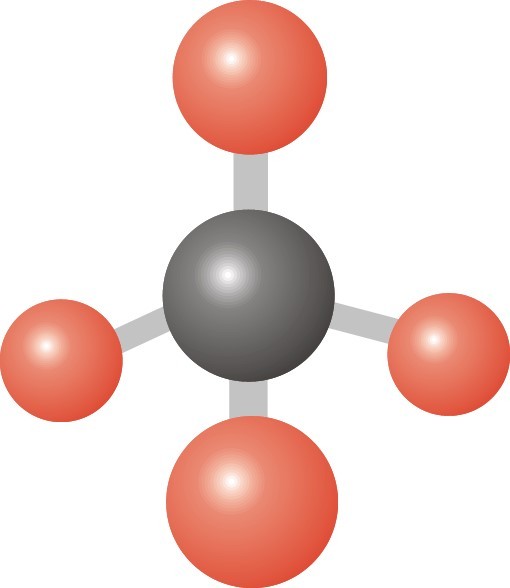
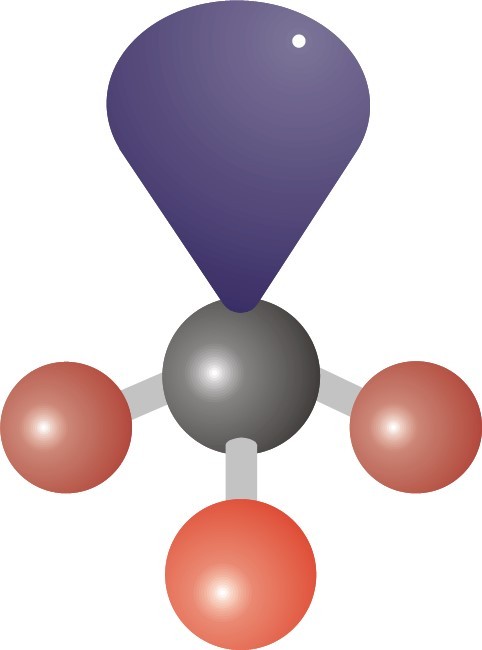
What molecular geometry would PH3 have?
Trigonal Pyramidal
Trigonal Bipyramidal
Bent
Linear
Is this molecule polar?
No
Yes

What shape would this have?
Trigonal planar
Pyramidal
Tetrahedral
Bent


What molecular geometry is the structure shown here? (BCl3)
linear
trigonal planar
tetrahedral
trigonal pyramidal
What is the molecular geometry/shape of a molecule with 3 shared pairs and 0 unshared pairs?
Linear
Trigonal Planar
Trigonal Pyramidal
Tetrahedral

For polarity to occur in a bond, you need two elements with a difference in their electronegativities of ___
0.5 or less
between 0.5 and 1.6
less than 1.6
greater than 1.6

Liquids made up of polar molecules are really good at dissolving ___
metallic solids
lipids and fats
molecular solids
solids composed of polar or ionic compounds
What type of bond would form between O and O?
Polar Covalent
Non-Polar Covalent
Ionic
What type of bond would form between Li and O?
Polar Covalent
Non-Polar Covalent
Ionic
The bond between C and Cl is polar covalent. That means
there is a pair of electrons shared equally between them
there is a pair of electrons shared unequally between them
an electron will be stolen from one and given to the other
The bond between K and N is ionic. Which atom will steal the electrons from the other?
K will steal electrons from N and become (+)
K will steal electrons from N and become (-)
N will steal electrons from K and become (+)
N will steal electrons from K and become (-)
The bond between C and H is non-polar covalent. That means
there is a pair of electrons shared equally between them
there is a pair of electrons shared unequally between them
an electron will be stolen from one and given to the other
What type of bond contains atoms with "partial" charges?
Polar Covalent
Non-Polar Covalent
Ionic
LiBr is called
lithium bromine
lithium (I) bromine
lithium bromide
lithuim (I) bromide
Name the following ionic compound: BeCl2
beryllium chlorine
beryllium II chloride
beryllium chloride
beryllium dichloride

According to the diagram below, how many bonds will this atom be able to make?

As you look down a group, ionization energy and electronegativity
increases
decreases
These bonds represent the strongest bonds and are limited to a few hard substances like glass and diamonds. There is no free movement of electrons. Uses include semiconductors and ceramics
covalent network Bonds
ionic bonds
metallic bonds
covalent bonds

1
2
3
4

This is the correct lewis dot structure for sodium floride
True
False

