wayground logo

Free Printable Worksheets

Font size

S
M
L
XL
Worksheets

HPS Midterm Review 1

Total questions: 269

Worksheet time: 4hrs 3mins

Name
Class
Date
1.

When metal atoms form ions, do they lose or gain electrons?

a)

Lose

b)

Gain

2.

Which type of bonding is between a metal and a non-metal?

a)

covalent

b)

ionic

c)

metallic

3.

Which type of bonding is found in sodium chloride?

a)

Ionic

b)

Covalent

c)

metallic

4.

Which of these is NOT a property of most metals?

a)

Good conductor of electricity

b)

Malleable

c)

Low melting point

d)

Ductile

5.

When would you find ionic bonding?

a)

Between metal and non-metal

b)

In metals

c)

Between two or more non-metals

6.

When would you find covalent bonding?

a)

Between metal and non-metal

b)

In metals

c)

Between two or more non-metals

7.

Why do all bonds form?

a)

To fill up the outer shell.

b)

To achieve the one or duplet electronic configuration

8.

An atom with 1 valence electron 'needs' a full shell, so it can either gain 7 electrons or lose 1. Which is more likely to occur?

a)

lose 1 electron

b)

gain 7 electrons

9.

What two types of atoms make a covalent bond?

a)

metal atom and metal atom

b)

metal atom and non metal non atom

c)

non metal atom and non metal atom

10.

When an atom loses an electron, it becomes a _________.

a)

noble gas

b)

anion

c)

cation

11.

Atoms are most stable when their outer shell is full or complete.

a)

True

b)

False

12.

What part of an atom is involved in chemical bonding?

a)

proton

b)

neutron

c)

electron

13.

Low melting point and low solubility in water are general properties of ______________________ compounds

a)

ionic

b)

covalent

c)

all

14.

Where are the non-metals located on the periodic table?

a)

all over

b)

On the left side of the "staircase"

c)

On the right side of the "staircase"

15.

Name the following: MgO

a)

Magnesium Oxide

b)

Monomagnesium monoxide

c)

Magnesium monoxide

d)

Magnesium (II) oxide

16.

Name the following: NO2

a)

Nitrogen oxide

b)

Mononitrogen dioxide

c)

Nitrogen dioxide

d)

Nitrogen (II) oxide

17.

Name the following: CF4

a)

Carbon fluoride

b)

Monocarbon tetrafluoride

c)

Carbon tetrafluoride

d)

Carbon fluorate

18.

Name the following: N2O5

a)

Nitrogen oxide

b)

Dinitrogen pentoxide

c)

Nitrous oxide

d)

Nitrogen pentoxide

19.

Name the following: CuO

a)

Copper oxide

b)

Copper (II) oxide

c)

Monocopper monoxide

d)

Copper monoxide

20.

Name the following: C3H8

a)

Tricarbon octahydride

b)

Carbon hydride

c)

Carbon octahydride

d)

Tricarbon hydride

21.

Name the following: NH3

a)

Nitrogen hydrogen

b)

Nitrogen trihydrogen

c)

Mononitrogen trihydride

d)

Nitrogen trihydride

22.

Is the following compound ionic or covalent?

LiBr

a)

Ionic

b)

Covalent

23.

Is the following compound ionic or covalent?

PBr5

a)

Ionic

b)

Covalent

24.

Is the following compound ionic or covalent?

Cl2

a)

Ionic

b)

Covalent

25.

Is the following compound ionic or covalent?

Ag2O

a)

Ionic

b)

Covalent

26.

Is the following compound ionic or covalent?

BaI2

a)

Ionic

b)

Covalent

27.

What is the formulas for sodium nitride?

a)

NaN

b)

Na2N

c)

Na3N

d)

NaN3

28.

Which of the following pair of elements is most likely to form an ionic compound?

a)

Magnesium and fluorine

b)

Nitrogen and sulfur

c)

Oxygen and chlorine

d)

Sodium and aluminum

29.
How do the following two elements bond together?
Cr3+  O2-         
a)
CrO
b)
Cr3O2
c)
Cr2O3
d)
CrO3
30.
How do the following two elements bond together?
Al3+  O2-         
a)
AlO
b)
Al2O3
c)
Al3O6
d)
Al3O2
31.
AgF
a)

silver (I) fluoride

b)
silver fluorine
c)
monosilver monofluoride
d)
silver monofluorine
32.
Mg2+ and Cl- create...
a)
Mg2Cl
b)
MgCl2
c)
Mg2Cl2
d)
MgCl
33.
Ca2+ and N3- create...
a)
Ca2N3
b)
Ca3N2
c)
CaN3
d)
Ca2N
34.

Na+ and Cl- create...

a)

Na2Cl

b)

NaCl2

c)

Na2Cl2

d)

NaCl

35.

Potassium and Sulfur create...

a)

KS

b)

KS2

c)

K2S

d)

K2S2

36.

The formula of calcium and phosphate is

a)

CaPO4

b)

Ca2(PO4)3

c)

Ca3PO4

d)

Ca3(PO4)2

37.

The chemical formula of Iron (III) and bromine is

a)

FeBr

b)

Fe(III)Br

c)

FeBr₃

d)

Fe₂Br₃

38.
Fe +2  and  SO4 -2
a)
FeSO4
b)
Fe4(SO4)2
c)
FeSO2
d)
correct answer is not given
39.
Ca +2  and  OH -
a)
Ca2OH
b)
CaOH2
c)
Ca(OH)2
d)
correct answer is not given
40.
Na +  and  S -2
a)
Na2S
b)
NaS2
c)
Na2S2
d)
NaS
41.
What is the correct formula for the compound, lithium oxide?
a)
LiO
b)
Li2O
c)
LiO2
d)
Li2O2
42.
What is the formula for manganese(III) oxide?
a)
MgO
b)
Mg2O3
c)
MnO
d)
Mn2O3
43.
The name of Al₂(SO₄)₃ is
a)
aluminum sulfur oxide
b)
aluminum sulfate
c)
aluminum trisulfate
d)
aluminum (III) sulfate
44.
Name the following ionic compound: BeCl2
a)
beryllium chlorine
b)
beryllium II chloride
c)
beryllium chloride
d)
beryllium dichloride
45.
When naming ionic compounds with transition metals you need to include roman numerals to show the _____ of the metal..
a)
atomic number
b)
mass number
c)
charge
d)
ionization energy
46.
Carbon dioxide
a)
C2O2
b)
C20
c)
CO
d)
CO2
47.
Phosphorous trichloride
a)
PCl3
b)
P3Cl
c)
P3Cl3
d)
PCL
48.
Bromine monoflouride
a)
Br1F1
b)
BrF
c)
Br2F
d)
BrF2
49.
Disulfur trioxide
a)
S3O2
b)
SO
c)
S2O3
d)
S2O
50.
CO
a)
Carbon Oxide
b)
Carbon Oxygen
c)
Dicarbon dioxide
d)
Carbon Monoxide
51.
As4O10
a)
arsenic oxide
b)
quadarsenic decoxide
c)
tetraarsenic decoxide
d)
arsenic decoxide
52.
P3F4
a)
Phosphorous fluoride
b)
Triphosphorous tetrafluoride
c)
Phosphate Fluoride
d)
Trifluoride hexafluoride
53.
BrP
a)
Bromide phosphide
b)
Bromide phosphate
c)
Monobromide monophosphide
d)
Bromide monophosphide
54.
N2O5
a)
Nitrogen Oxide
b)
Dinitrogen pentaoxide
c)
Nitrate pentaoxide
d)
Dinitrate pentaoxide
55.
Tribromine nonoxide
a)
Br3O9
b)
Br3O10
c)
Br3O6
d)
Br3O4
56.
What is the prefix for one?
a)
Mono
b)
Uno
c)
Due
d)
Muni
57.
The prefix for 4 is?
a)
quatro
b)
tetra
c)
quarto
d)
tri
58.
SeF4
a)
Tetraselenium fluoride
b)
Selenium Fluoride
c)
Selenium tetraflouride
d)
Selenium (IV) Fluoride
59.
Write the correct name for PN.
a)
monophosphorus nitride
b)
phosphorus mononitrogen
c)
phosphorus mononitride
d)
monophosphorus mononitride
60.
Write the correct name for SO3.
a)
sulfurous oxide
b)
sulfite
c)
monosulfur trioxide
d)
sulfur trioxide
61.

Name the compound: N2O5.

a)

dinitrogen pentaoxide

b)

binitrogen pentaoxide

c)

nitrogen oxide

d)

pentanitrogen dioxide

62.

Name the compound: (NH4)2S

a)

ammonium sulfide

b)

nitrogen tetrahydrogen sulfide

c)

diammounium sulfate

d)

ammonium sulfate

63.

Name the compound: MgCl2

a)

magnesium chloride

b)

magnesium dichloride

c)

monomagnesium chloride

d)

manganese chloride

64.

Name the compound: Cu(NO3)2

a)

copper nitrate

b)

copper(II) nitrate

c)

copper(II) dinitrate

d)

copper dinitrogen hepaoxide

65.

Name the compound: SO3-2

a)

sulfur trioxide

b)

sulfite ion

c)

sulfur oxide

d)

sodium trioxide

66.

Name the compound: CF4

a)

carbon tetrafluoride

b)

monocarbon tetrafluoride

c)

carbon fluoride

d)

chlorine tetrafluoride

67.

Name the compound: P4O8

a)

tetraphosphorus octoxide

b)

phosphorus oxide

c)

tetrapotassium octoxide

d)

potassium oxide

68.

Name the compound: SF6

a)

sulfur heptafluoride

b)

sulfur hexafluoride

c)

monosulfur hexafluoride

d)

monosulfur heptafluoride

69.

Name the compound: AgNO3

a)

silver mononitrogen trioxide

b)

silver (I) nitrate

c)

silver nitride

d)

monosilver mononitrogen trioxide

70.

Name the compound: Zn3P2

a)

zinc (II) phosphide

b)

trizinc diphosphide

c)

zinc phosphate

d)

zinc phosphite

71.

Write the formula: potassium hydroxide

a)

KOH

b)

POH

c)

KH

d)

KO

72.

Write the formula: tetraarsenic decoxide

a)

As4O10

b)

As10O4

c)

As6O9

d)

AsO

73.

Write the formula: iodine heptafluoride

a)

IF7

b)

I2F14

c)

IHF7

d)

IF6

74.

Write the formula: nitrogen trichloride

a)

NCl3

b)

N1Cl3

c)

N1Cl5

d)

Cl3N

75.

Write the formula: carbon monoxide

a)

CO

b)

CO2

c)

OC

d)

C2O4

76.

Write the formula: tin(II) phosphite

a)

Sn3(PO3)2

b)

Sn3PO8

c)

Sn2PO4

d)

Sn3(PO4)2

77.

Lithium nitride

a)

Li3N

b)

LiN

c)

Li3(NO3)2

d)

LiNO3

78.

Write the formula: lead(IV) sulfite

a)

Pb2(SO3)4

b)

Pb(SO3)2

c)

Pb2(SO4)4

d)

Pb(SO4)2

79.

Write the formula: silver (I) chlorate

a)

AgClO3

b)

AgCl

c)

AgCLO3

d)

AgCl3

80.

Write the formula: beryllium oxide

a)

BO

b)

BeO

c)

BeO2

d)

BO2

81.

What is ionic bonding?

a)

Bonding that is the result of two elements sharing electrons

b)

Bonding involving only one atom

c)

Bonding that is the result of an exchange of electrons between a metal and a nonmetal

d)

Bonding between two metals

82.

What is Covalent Bonding?

a)

Bonding that is the result of two nonmetals sharing electrons

b)

Bonding between two metals

c)

Bonding that is the result of a nonmetal and a metal exchanging electrons

d)

Bonding between more than two elements

83.

Which particle is responsible for bonding?

a)

Protons

b)

Electrons

c)

Neutrons

d)

Nucleus

84.
What is the formula for Calcium phosphate? 
a)
CaPO4
b)
Ca3(PO4)2
c)
Ca2PO4
d)
CaP
85.
What is the formula for calcium oxide? 
a)
Ca2O2
b)
Ca2O
c)
CaO
d)
CaO2
86.
What is the formula for calcium phosphide?
a)
CaP
b)
Ca2P3
c)
Ca3P2
d)
Ca2P
87.
What is the name of ZnSO4?
a)
zinc sulfide
b)
zinc sulfate
c)
zinc (II) sulfate
d)
zinc sulfite
88.
What is the formula for barium hydroxide?
a)
BaOH
b)
Ba(OH)2
c)
BaOH2
d)
Ba2(OH)2
89.
Name the following:
Mg3P2
a)
Magnesium Phosphide
b)
Magnesium Phosphorus
c)
Magnamide Phosphide
d)
Magnamide Phosphorus
90.
What is the formula for lead (II) iodide
a)
PbI
b)
PbI2
c)
Pb2I
d)
LbI2
91.
What is the name of BaO?
a)
barium (II) oxide
b)
barium oxide
c)
barium oxygen
d)
barium (I) oxide
92.
Name this compound: 
NH4F
a)
Ammonia fluoride
b)
Ammonium fluorite
c)
Ammonia fluorate
d)
Ammonium fluoride
93.
What is the formula for manganese (II) chloride?
a)
MgCl2
b)
MnCl2
c)
Mn2Cl
d)
MnCl
94.

What is the formula for potassium sulfite?

a)

K2SO4

b)

KSO3

c)

KSO4

d)

K2SO3

95.
What is the formula for ammonium sulfate
a)
NH4SO4
b)
(NH4)2SO4
c)
NH4S
d)
(NH4)2S
96.
What is the formula for iron (III) chloride
a)
FeCl
b)
FeCl3
c)
FeClO3
d)
Fe3Cl
97.

What is the formula for silver (I) nitrate?

a)
Ag3NO
b)
AgNO3
c)
Ag(NO3)2
d)
Ag2NO3
98.
What is the formula for copper (II) sulfate?
a)
Cu2SO4
b)
CuSO3
c)
CuS
d)
CuSO4
99.
Name this compound:
Li2SO3
a)
Lithium sulfate
b)
Lithium sulfite
c)
Lithite sulfide
d)
Sulfur lithite
100.
Write the formula for vanadium (IV) carbonate
a)
V(CO3)2
b)
V4C
c)
V(CO3)4
d)
V4(CO3)
101.
Write the formula for copper (I) phosphide?
a)
Cu3P
b)
CuP
c)
Cu1P
d)
CuP3
102.

NaBr

a)

Bromide sodide

b)

Sodium bromide

c)

Sodium bromate

d)

Sodium bromite

103.
All solids at room temperature
a)
ionic compounds
b)
covalent compounds
104.
Some are solids, some are liquids, and some are gases at room temperature.
a)
ionic compounds
b)
covalent compounds
105.
Molten compound conducts electricity.
a)
ionic compound
b)
covalent compound
106.
Molten compound does NOT conduct electricity.
a)
ionic compound
b)
covalent compound
107.
Have a high m.p. (1000°C-3000°C)
a)
ionic compounds
b)
covalent compounds
108.
Have a low m.p. (< 200°C)
a)
ionic compounds
b)
covalent compounds
109.
When dissolved in water, the solution is a good conductor of electricity.
a)
ionic compounds
b)
covalent compounds
110.
usually hard but brittle
a)
ionic compounds
b)
covalent compounds
111.
usually soft
a)
ionic compounds
b)
covalent compounds
112.
forms ions in solution
a)
ionic compounds
b)
covalent compounds
113.
electrolytes
a)
ionic compounds
b)
covalent compounds
114.

Compounds composed of a ______________ and _____________ like the compound CaCl2 , are ionic compounds.

a)

metal ... metal

b)

nonmetal ... nonmetal

c)

metal ... nonmetal

115.
Ionic Bonding involves...
a)
The transfer of protons
b)
The transfer of nuetrons 
c)
The transfer of electrons
d)
None Of the above
116.

Which of the following describes covalent bonds?

a)

Bonds form because of opposite charges

b)

electrons are shared to fill outer electron shells

c)

Electrons are transferred between atoms

d)

Covalent bonds are magical

117.

Is the following compound ionic or covalent?

A material that LOSES and GAINS electrons

a)

Ionic

b)

Covalent

118.

What two types of atoms make a covalent bond?

a)

2 Nonmetals

b)

1 Nonmetal and 1 Metal

c)

2 Metals

d)

2 Noble Gases

119.

Which of the following is TRUE about ionic compounds?

a)

They have low melting and boiling points.

b)

They can conduct electricity in the solid state.

c)

They are stronger than covalent bonds.

d)

They are usually formed from 2 metals.

120.

The following properties are all characteristics of ionic compounds EXCEPT

a)

high melting and boiling points

b)

soft

c)

crystal lattice structure

d)

conduct electricity when dissolved in water

121.
What type of bond forms between two or more atoms that are charged (+/-)?
a)
Covalent bond
b)
Incomplete bond
c)
Ionic bond
d)
Metallic bond
122.
As you move down a group, atomic radius increases because - 
a)
you add more and more neutrons
b)
you add more and more protons
c)
you add more and more shells (energy levels)
d)
you add more atomic mass
123.
The atom with the largest atomic radius in Group 18 is - 
a)
Ar
b)
He
c)
Kr
d)
Rn
124.
As you move across the periodic table from left to right, the atomic radius decreases.  This is because - 
a)
the number of protons increases, so attraction to electrons increases
b)
the number of energy levels increases
c)
the number of electrons increases
d)
the atomic mass increases
125.
The atom with the largest atomic radius in Period 4 (row 4) is - 
a)
K
b)
Kr
c)
Fe
d)
Fe
126.
Francium (Fr) has the lowest ionization energy in Group 1 because - 
a)
it has the smallest number of valence electrons
b)
it has the greatest atomic mass
c)
it has the greatest number of protons, so it attracts its electrons the strongest
d)
its 1 valence electron is very far from the nucleus, so little energy is needed to remove it
127.
The element with the smallest ionization energy in Period 6 is - 
a)
Rn
b)
Cs
c)
Os
d)
Tm
128.
As you move across the periodic table atoms tend to get smaller because, ______________.
a)
the atoms have more mass.
b)
the atoms have less mass
c)
the atoms have more protons.
d)
the atoms have less electrons.
129.
The energy required to remove electrons is the definition of: 
a)
Electronegativity
b)
Atomic Number
c)
Atomic Radius
d)
Ionization
130.
What is the name of family I
a)
Alkaline Earth Metals
b)
Boron Family
c)
Alkali Metals
d)
Halogen Family
131.

Groups 3-12 are known as the:

a)

Inner Metals

b)

Transition Metals

c)

Weirdos

d)

Changelings

132.
Families all have similar 
a)
Names
b)
atomic numbers
c)
atomic masses
d)
properties
133.
Electronegativity is...
a)
the ability of an atom to attract/ accept electrons
b)
the ability of an atom to lose electrons
c)
the energy required to remove an electron from a specific atom
d)
how easy it is to make friends. 
134.
Which has the greater Electronegativity: 
N or C?
a)
C
b)
N
135.
Electronegativity __________ from left to right within a period and __________ from top to bottom within a group.
a)
decreases, increases 
b)
increases, increases
c)
increases, decreases 
d)
stays the same, increases
136.

What are valence electrons?

a)

Any of an atom's electrons

b)

Electrons located on the first energy level

c)

Electrons not attached to any atom

d)

electrons located on the outer energy level

137.

What period is Lead (Pb) in?

a)

6

b)

4

c)

Metals

d)

4A

138.

What group or family is lead in?

a)

6

b)

4

c)

Metal

d)

14

139.

What category is silicon (Si) a part of?

a)

Metal

b)

Nonmetal

c)

Metalloid

d)

Halogens

140.

What Element is in period 4, group 15?

a)

Antimony

b)

Arsenic

c)

Tin

d)

Germanium

141.

How many electrons does Barium (Ba) have?

a)

13

b)

2

c)

71

d)

56

142.

What is the ionic charge of Phosphorus (P)?

a)

+5

b)

-3

c)

+3

d)

-5

143.

How many electrons does a Strontium (Sr) ION have?

a)

38

b)

10

c)

8

d)

36

144.

How many neutrons does Bromine (Br) have?

a)

35

b)

80

c)

45

d)

7

145.

What period contains the element Plutonium (Pu)?

a)

8

b)

6

c)

7

d)

Plutonium doesn't exist

146.

How many electrons does a Radon (Rn) ION have?

a)

86

b)

8

c)

33

d)

Radon does not form an ion

147.

What group or family is Mercury (Hg) in?

a)

12

b)

6

c)

Metals

d)

Alkali metals

148.

What is group and name of the most reactive metals?

a)

18- Noble gases

b)

17- Halogens

c)

1- Alkali metals

d)

2- Alkaline earth metals

149.

Why is group 17 so reactive?

a)

They want to get rid of their only valance electron

b)

They only need one more electron

c)

They are non reactive, they have a full shell

150.

How many valence electrons does a carbon atom have?

a)

8

b)

4

c)

2

d)

6

151.

Which element conducts electricity the best?

a)

Silicon

b)

Fluorine

c)

Silver

d)

Arsenic

152.

How do you remember the gases?

a)

The noble gases.

b)

The gas gun.

c)

Everything right of the staircase.

d)

The staircase.

153.

Which is the only nonmetal liquid at room temperature?

a)

Iodine

b)

Mercury

c)

Chlorine

d)

Bromine

154.

You find a solid object that is dull and brittle. It is most likely what?

a)

Metal

b)

Metalloid

c)

Nonmetal

d)

Cannot tell from the information provided.

155.

All of your gases are...

a)

Nonmetals

b)

Metals

c)

Metalloids

d)

A mixture of all.

156.

The most reactive nonmetal is?

a)

Astatine

b)

Fluorine

c)

Francium

d)

Lithium

157.

Elements 57-71 are classified as

a)

Metals

b)

Nonmetals

c)

Metalloids

d)

A mixture of all.

158.

With the exception of Aluminum, metalloids will...

a)

touch the staircase at least once.

b)

touch the corner of the staircase.

c)

be sit ON the staircase.

d)

touch two parts of the staircase.

159.

Groups 1, 2, and 13 will lose electrons to get a full octet. This will give them what kind of oxidation?

a)

negative

b)

positive

c)

neutral

d)

they will gain electrons, not lose.

160.

Phosphorus is in group 15, what will its oxidation number be?

a)

15

b)

5

c)

+3

d)

-3

161.

Subatomic particles with a negative charge

a)

Electrons

b)

Neutrons

c)

Protons

d)

Quarks

162.
subatomic particles found on the outermost shell & responsible for the atom's reactivity
a)
neutrons
b)
valence electrons
c)
isotopes
d)
ions
163.
Subatomic particles with a positive charge
a)
neutrons
b)
atomic mass
c)
protons
d)
isotopes
164.
Measure mainly of the nuclear particles: protons + neutrons
a)
Subatomic Particles
b)
Atomic Number
c)
Atomic Mass
d)
Gluons
165.
Value representing the number of protons in an element
a)
Atomic Mass
b)
Mass Number
c)
Valence Electrons
d)
Atomic Number
166.
Subatomic particles that are neutral in charge
a)
Neutrons
b)
Protons
c)
Nucleus 
d)
Electrons
167.
Atoms of the same element with a different number of neutrons
a)
Ion
b)
Gluons
c)
Isotope
d)
Quarks
168.
A charged atom
a)
Ion
b)
Isotope
c)
Electron Cloud
d)
Quark
169.
The smallest particle of an element that shows all the properties of that element.
a)
Subatomic Particles
b)
Atom
c)
Quarks
d)
Gluons
170.
Where electrons are likely to be found as they travel around the nucleus
a)
Nucleus
b)
Electron Cloud
c)
Within a Proton
d)
Within a Neutron
171.
A tiny but very dense, positively charged portion of the atom that holds most of the atomic mass
a)
Electron Shells
b)
Orbitals
c)
Electron Cloud
d)
Nucleus
172.
Arrangement of elements organized by atomic number
a)
Electron Cloud 
b)
Periodic Table 
c)
Electron Configuration
d)
None of these
173.
Calculation used to find the number of neutrons in an atom
a)
Atomic Mass - Atomic Number
b)
Atomic Number - Atomic Mass
c)
Atomic Mass - Electrons
d)
none of these
174.
The only element with no neutrons in its nucleus.
a)
Oxygen
b)
Helium 
c)
Hydrogen
d)
Lithium
175.
4.35% of all X atoms have a mass of 39.946 amu. 83.79% have a mass of 41.941 amu, 9.50% have a mass of 42.941 amu, and 2.36% have a mass of 43.939 amu. What is the average atomic mass of atom X?
a)
41.97 amu
b)
42.19 amu
c)
10.43 amu
d)
40.04 amu
176.
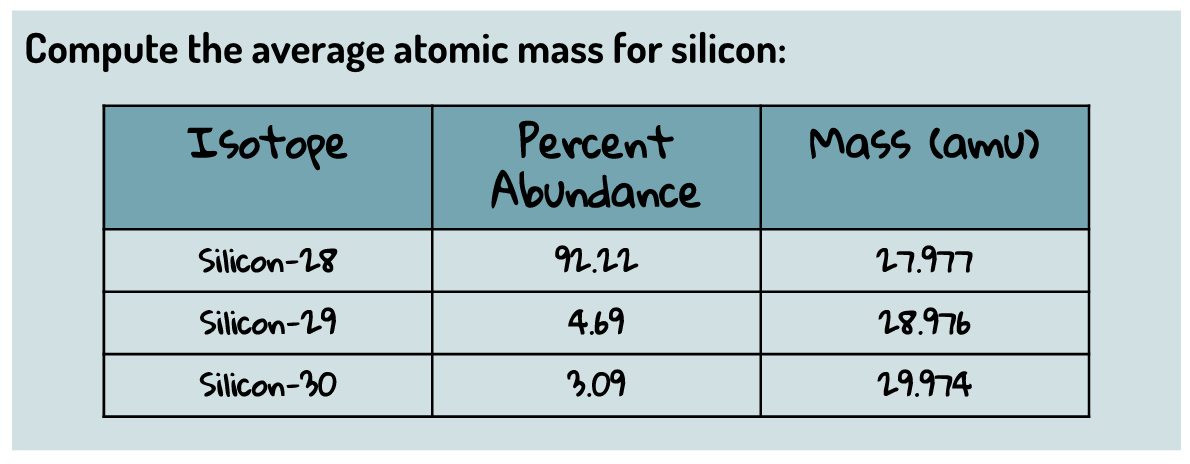
Compute the average atomic mass for silicon:
a)
27.977
b)
28.09
c)
28.976
d)
The average mass cannot be determined from provided information.
177.
24.1% of all the isotopes of a an element have a mass of 75.23 amu, 48.7% have a mass of 74.61 amu, and 27.2% have a mass of 75.20 amu.
How many protons does this element have?

a)
32
b)
33
c)
34
d)
no way to know
178.
An element has three different isotopes. One has a mass of 35.00 amu; another has a mass of 36.00  amu; and another has a mass of 38.00  amu. What is the average atomic mass of this element?
a)
36.33 amu
b)
37.00 amu
c)
12.11 amu
d)
impossible to tell
179.
An element with 4.35% have a mass of 49.9461 amu, 83.79% have amass of 51.9405 amu, 9.50% have a mass of 52.9407 amu, and 2.36% have a mass of 53.9389amu.
a)
51.99 amu
b)
52.19 amu
c)
53.45 amu
d)
17.33 amu
180.
An isotope has three forms.  30% have a mass of 4 amu, 20% have a mass of 5 amu and 50% have a mass of 3 amu.  Average atomic mass will be closest to
a)
2 amu
b)
3 amu
c)
4 amu
d)
5 amu
181.
Calculate the average atomic mass of silver.
a)
106.38649amu
b)
111.91896amu
c)
107.8677amu
d)
121
182.
An element has two naturally occurring isotopes. One is 10.013 amu and is 19.9% abundant. The other is 11.01 amu and is 80.1% abundant. What is the average atomic mass? What element is it?
a)
9.012, Beryllium
b)
12.011, Carbon
c)
6.941, Lithium
d)
10.812, Boron
183.
What is the name of the atom pictured here?
a)
Nitrogen
b)
Nitrogen-15
c)
Nitrogen-7
d)
Nitrogen-8
184.
Which of the following could have 82 neutrons?
a)
W-182
b)
Ta-181
c)
Cs-132
d)
Ba-138
185.
How many Protons does the element Titanium have?
a)
47
b)
22
c)
4
d)
48
186.
How many Protons does Chlorine have?
a)
17
b)
35
c)
18
d)
39
187.
How many electrons does the Chloride Ion have?
a)
17
b)
35
c)
18
d)
39
188.
What is the Atomic Mass of Gold?
a)
197g
b)
11g
c)
196g
d)
47g
189.
What is the Atomic Number of Silicon? 
a)
3
b)
28
c)
14
d)
16
190.
How many Neutrons does Uranium-238 have?
a)
92
b)
146
c)
238
d)
149
191.
How many Electrons does the
Potassium cation have?
a)
19
b)
20
c)
18
d)
39
192.
How many Electrons does 
Potassium have?
a)
19
b)
20
c)
18
d)
39
193.
What is the Atomic mass of Manganese?
a)
54
b)
24
c)
25
d)
55
194.
How many Electrons does Mercury have?
a)
80
b)
200
c)
201
d)
81
195.
What is the Atomic Mass of Barium?
a)
56
b)
137
c)
54
d)
131
196.
How many neutrons does Cobalt have?
a)
32
b)
27
c)
31
d)
59
197.
How many Protons does Neon have?
a)
18
b)
20
c)
2
d)
10
198.
Which has more Electrons the Rubidium cation or Iodide anion?
a)
Rubidium
b)
Iodine
199.
How many neutrons does Oxygen have?
a)
8
b)
10
c)
16
d)
11
200.
Radon has how many Electrons?
a)
86
b)
222
c)
18
d)
6
201.
How many Electron shells does Nickel have?
a)
10
b)
4
c)
2
d)
28
202.
How many neutrons are in the Calcium-42 isotope?
a)
20
b)
40
c)
22
d)
42
203.
Which of the following is an isotope?
a)
Hydrogen-1
b)
Helium-4
c)
Lithium-6
d)
Beryllium-9
204.
How many significant figures: 216 m
a)
1
b)
2
c)
3
d)
0
205.
How many significant figures: 2016 m
a)
1
b)
2
c)
3
d)
4
206.
How many significant figures: 153.0 mL
a)
1
b)
2
c)
3
d)
4
207.
How many significant figures: 0.012 km
a)
1
b)
2
c)
3
d)
4
208.
How many significant figures: 1000 mL
a)
1
b)
2
c)
3
d)
4
209.
How many significant figures: 100.000 cL
a)
1
b)
3
c)
5
d)
6
210.
How many significant figures: 0.001 g
a)
4
b)
3
c)
2
d)
1
211.
How many significant figures: 4.20 cm
a)
1
b)
2
c)
3
d)
4
212.
How many significant figures: 0.010 L
a)
1
b)
2
c)
3
d)
4
213.

How many significant figures: 450 m

a)

3

b)

2

c)

1

d)

0

214.
How many sig figs are there?
100000000
a)
1
b)
9
c)
10
215.
How many sig figs are there?
0.000008
a)
1
b)
2
c)
6
d)
7
216.

How many significant figures are there in 1008 grams?

a)

1

b)

2

c)

3

d)

4

217.
How many sig figs are there?
27000000
a)
2
b)
5
c)
8
218.
How many sig figs are there?
5.00000008
a)
2
b)
6
c)
9
219.
Solve and give your answer with the correct number of significant figures
(12.470)(271)
a)
3366.9
b)
3.37x10³
c)
3400
d)
3370
220.
Solve and give your answer with the correct number of significant figures
129.6/3
a)
43.0
b)
43
c)
 4x101
d)
40
221.
Solve and give your answer with the correct number of significant figures
24.28 + 12.5
a)
3.687 x 101
b)
36.8
c)
37
d)
3.70x101
222.
Solve and give your answer with the correct number of significant figures
1421-34
a)
1.39x10³
b)
1387
c)
1390
d)

1400

223.
Round 0.010229 to four sig figs
a)
1022
b)
1023
c)
0.01023
d)
0.01022
224.
How would you write 564,000,000 in scientific notation?
a)
5.64 x 10⁻⁷
b)
5.64 x 10⁶
c)
5.64 x 10⁸
d)
56.4 x 10⁷
225.
Express the following in scientific notation:
.000457
a)
457 x 106
b)
457 x 10-6
c)
4.57 x10⁴
d)
4.57 x 10⁻⁴
226.

Write 7.113 x 10⁷ in standard form.

a)

71,130,000

b)

7,113,000

c)

0.0000007113

d)

7,113

227.
Write 7.8 x 10⁻³  in standard form.
a)
0.0078
b)
7,800
c)
78
d)
0.078
228.
Multiply:
(3.4 x 10⁵)(1.2 x 10⁻³)
a)
4.08 x 10⁻⁸
b)
4.8 x 10²
c)
4.08 x 10²
d)
4.08 x 10⁻¹⁵
229.
Divide:
(6.9 x 10⁷) / (2.3 x 10⁻³)
a)
3 x 10¹⁰
b)
3 x 10⁴
c)
3 x 10⁻⁴
d)
3 x 10-11
230.

What do you do to your exponents when you are dividing in scientific notation?

a)

Subtract

b)

Divide

c)

Multiply

d)

Add

231.

What do you do to your exponents when you are multiplying in scientific notation?

a)

Subtract

b)

Multiply

c)

Divide

d)

Add

232.

If you add to your exponent of 10, you move your decimal...

a)

Left

b)

Right

c)

Up

d)

Down

233.

If you subtract from your exponent of 10, you move your decimal to the ....

a)

Right

b)

Left

c)

North

d)

South

234.
Subtract withing scientific notation 
(7.32 x 10⁶) - (4.01 x 10⁸)
a)
-3.937 x 10⁸
b)
3.937 x 10⁸
c)
3.937 x 10⁷
d)
3.937 x ⁻²
235.
Add withing scientific notation 
(5.2 x 10⁷) + (3.01 x 10⁴)
a)
5.20301 x 10¹¹
b)
.520301 x 10⁷
c)
5.20301 x 10⁷
d)
5.20301 x 10⁸
236.

Jack has a rock. The rock has a mass of 14 g and a volume of 2 mL. What is the density of the rock?

a)
7 mL
b)

7 g/mL

c)

28 g/mL

d)

1/7 g/mL

237.
Which units of measurement are used for volume?
a)
grams
b)
centimeters
c)
grams/milliliter
d)

milliliters or

cubic centimeters

238.
Which lab tool might you use to measure the volume of a liquid?
a)
electric scale
b)
bunsen burner
c)
test tube
d)
graduated cylinder
239.
What is the volume of Object X?
a)

10.0 mL

b)

15.0 mL

c)

20.0 mL

d)

25.0 mL

240.

What is the volume of 150 grams of lead if it has a density of 11.3 g/cm3?

a)
13.3 g
b)
13.3 cm3
c)
.075 g
d)
1695 cm3
241.
An empty beaker has a mass of 60 grams.  When mercury is added to the beaker, it has a mass of 200 grams. What is the mass of the mercury?
a)
140 grams
b)
200 grams
c)
140 mL
d)
260 g
242.
Find the volume of this piece of brass.  
a)
50 g
b)
10 cm
c)
6 cm3
d)
12 cm3
243.
The density of this material is 2 g/cm3.
There are 24 cm3  Find the total mass.
a)
12 grams
b)
48 grams
c)
12 g/cm3
d)
48 g/cm3
244.
What is the volume of the fish?
a)
18.0 cm3
b)
6.0 cm
c)
38.0 cm3
245.
Which box has a higher density?  
a)
Box A
b)
Box B
c)
cannot be determined
d)
they are the same
246.
I have two objects with the same volume but different masses.  Which object will be more dense?
a)
The object with less weight.
b)
The object with more weight.
c)
The object with more mass.
d)
The object with less mass.
247.
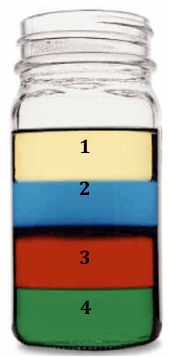
Put the liquids in order from most dense to least dense?
a)
4, 3, 2, 1
b)
1, 2, 3, 4
c)
3, 4, 2, 1, 
d)
4, 3, 1, 2
248.
If this substance takes up 6ml of space, what is its mass?
a)
 6 ml
b)
6 grams
c)
0 grams
d)
4 grams 
249.

Which of the answer choices has the highest density? 

a)
corn syrup
b)
lamp oil
c)
rubbing alcohol
d)
honey
250.
Why do ice cubes float in a  glass of water?
a)
the ice cubes are more dense than the water
b)
the water is more dense than the ice cubes
c)
the water is more dense than the glass
d)
the ice is more dense than the glass
251.

Water has a density of 1 g/mL. An object with which of the following densities will float on water?

a)

0.7 g/mL

b)

1.2 g/mL

c)

3.5 g/mL

d)

11.4 g/mL

252.
If you cut a wooden block in half, each half would have 
a)
Half the density of the original piece
b)
 Twice the density of the original piece 
c)
The same density as the original piece
d)
No density at all 
253.
A tiny piece of sand is very light but sinks in water. This is because 
a)
 Sand is a solid
b)
Sand is less dense than water 
c)
There is more water than sand
d)
Sand is denser than water 
254.
What is the density of this substance?
a)
5 grams
b)
5 ml
c)
5 g/ml
d)
 10 g/ml
255.
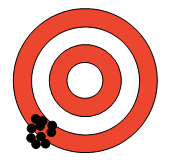
This bullseye demonstrates...
a)
High Accuracy & High Precision
b)
High Accuracy & Low Precision
c)
Low Accuracy & High Precision
d)
Low Accuracy & Low Precision
256.
?
a)
High Accuracy & High Precision
b)
High Accuracy & Low Precision
c)
Low Accuracy & High Precision
d)
Low Accuracy & Low Precision
257.
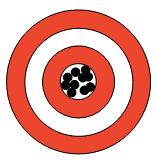
This image is an example of...
a)
precision ONLY
b)
accuracy ONLY
c)
BOTH precision and accuracy
d)
NEITHER precision and accuracy 
258.
Describe the accuracy and precision of the image
a)
Accurate and Precise
b)
Accurate and not precise
c)
Not Accurate and Precise
d)
not accurate and not precise
259.

How close a measurement is to the accepted value is called..

a)

Accuracy

b)

Precision

c)

Significant

d)

Estimate

260.
A set of data are all close to each other, but they are not close to the actual value.  This set of data can be described as...
a)
accurate
b)
precise
c)
both precise and accurate
261.
A set of data are all close to each other, and they are close to the actual value.  This set of data can be described as...
a)
accurate
b)
precise
c)
both precise and accurate
262.

Measurements: 24.9, 25.2, 25.1, 24.8

True Value: 25.0

These measurements are…

a)

Accurate, but not precise

b)

Precise, but not accurate

c)

Both precise and accurate

d)

Neither precise nor accurate

263.

Measurements: 2.5, 14.5, 10.1, 45.3

True Value: 25.0

These measurements are…

a)

Accurate, but not precise

b)

Precise, but not accurate

c)

Both precise and accurate

d)

Neither precise nor accurate

264.

What is the length?

a)

7

b)

7.7

c)

7.70

d)

7.700

265.

What is the volume?

a)

50

b)

45

c)

45.0

d)

40.5

266.

WHAT IS THE VOLUME?

a)

36

b)

36.5

c)

37.0

d)

36.0

267.

WHAT IS THE LENGTH?

a)

11.45

b)

11.4

c)

11

d)

11.450

268.

WHAT IS THE VOLUME?

a)

20.15

b)

20.1

c)

21.5

d)

21.50

269.

WHAT IS THE LENGTH?

a)

29

b)

29.2

c)

29.20

d)

30