wayground logo

Free Printable Worksheets

Font size

S
M
L
XL
Worksheets

Unit 1: Heat Transfer/ Earth Science

Total questions: 55

Worksheet time: 4hrs 21mins

Name
Class
Date
1.

Boiling Water

a)

Conduction

b)

Convection

c)

Radiation

2.

Curling Iron

a)

Conduction

b)

Convection

c)

Radiation

3.

Weather Patterns

a)

Conduction

b)

Convection

c)

Radiation

4.

Sun Bathing

a)

Conduction

b)

Convection

c)

Radiation

5.
What is the transfer of heat by direct contact?
a)
Convection
b)
Electromagnetic waves
c)
Radiation
d)
Conduction
6.
What is a transfer of heat energy by electromagnetic waves?
a)
Radiation
b)
Convection
c)
Conduction
d)
Heat
7.
What is the transfer of heat by movement of liquids or gases?
a)
Radiation
b)
Convection
c)
Conduction
d)
Heat
8.
Heat transfers from an area of ________temperature to an area of ______ temperature.
a)
high to low
b)
low to high
c)
high to high
9.

Radiation is how heat transfers through...

a)

Fluids

b)

Direct Contact

c)

Empty Space

10.

Convection is how heat transfers through...

a)

Fluids

b)

Direct Contact

c)

Empty Space

11.

Conduction is how heat passes through objects by...

a)

Fluids

b)

Direct Contact

c)

Empty Space

12.

Which shows an example of convection?

a)

Jose cooks an egg in a pot of boiling water.

b)

Clara burns her hand by touching a light bulb.

c)

Lucy wraps herself in an electric blanket to keep warm.

d)

Ben holds the end of a metal rod in a fire to cook hot dogs.

13.

Which is an example of radiated heat for cooking?

a)

cooking a pot of soup

b)

scrambling eggs on the stove

c)

grilling hot dogs over a campfire

d)

frying hamburgers in a frying pan

14.

Which is an example of radiation?

a)

boiling a pot of noodles for dinner

b)

getting hot from lying in the sun

c)

feeling warm while taking a shower

d)

burning yourself after touching a hot plate

15.

Which is the best example of conduction?

a)

boiling a pot of water

b)

feeling heat from a fireplace

c)

a hot air balloon rising and falling

d)

touching a hot handle and getting burned

16.

Which is an example of heat being transferred by conduction?

a)

a furnace heating the air in a school

b)

an ice cube melting in a person's hand

c)

a pot of water on a stove boiling

d)

the sun heating water in a swimming pool

17.

Cooking pizza in the microwave is an example of...

a)

conduction

b)

convection

c)

radiation

18.

Steam rising from hot soup is an example of...

a)

conduction

b)

convection

c)

radiation

19.

Cooking pancakes on a griddle is an example of...

a)

conduction

b)

convection

c)

radiation

20.
Warm air is __________ dense than cold air and rises creating convection currents.
a)
more
b)
less
21.

The unit for volume is. (there is more than one right answer)

a)

grams

b)

milliliters (mL)

c)

Newton

d)

Centimeters Cubed

22.


What two types of measurements make up DENSITY

a)

Volume and Weight

b)

Temperature and Mass

c)

Mass and Volume

23.

What is the unit for density ?

a)

g/ mL

b)

g

c)

gcm3\frac{g}{cm^3}  

d)

cm4cm^4  

24.
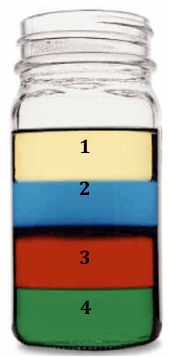
Put the liquids in order from most dense to least dense?
a)
4, 3, 2, 1
b)
1, 2, 3, 4
c)
3, 4, 2, 1, 
d)
4, 3, 1, 2
25.

Which box has a higher density?

a)

A

b)

B

c)

They are the same

26.
What is the formula for density?
a)
density = mass x volume
b)
density = mass / volume
c)
density = mass + volume
d)
density = mass - volume
27.
Frank has a paper clip. It has a mass of 9g and a volume of 3cm3. What is its density?
a)
3 g/cm3
b)
1/3 g/cm3
c)
27 g/cm3
d)
39 g/cm3
28.
A piece of copper has a mass of 89g and a volume of 10 cm3.  What would be the density of the copper?
a)
0.89 g/cm3
b)
89 g/cm3
c)
8.9 g/cm3
d)
890 g/cm3
29.

Calculate the density in the following question: A flower pot has a mass of 95 g and a volume of 92 mL.

a)

1.03 g/mL

b)

0.97 g/mL

c)

1.01 g/mL

d)

0.99 g/mL

30.

An object has a volume of 6 cm3 and a mass of 42 g. What's it's density?

a)

7 g/cm3

b)

48 g/cm3

c)

42 g/cm3

d)

6 g/cm3

31.
Jack has a rock. The rock has a mass of 14g and a volume of 2cm3. What is the density of the rock?
a)
7 mL
b)
7 g/cm3
c)
28 g/cm3
d)
1/7 g/cm3
32.
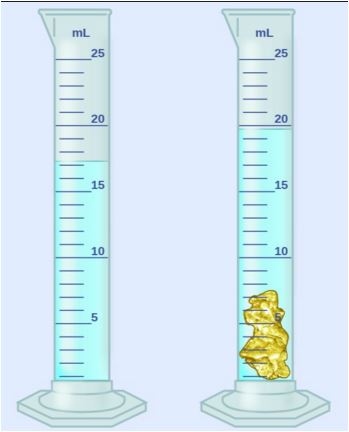
An irregularly shaped piece of gold was lowered into a graduated cylinder holding a volume of water equal to 17 ml. The height of the water rose to 20 ml. If the mass of the gold was 27 g, what was its density?
a)
9 g/mL
b)
10.5 g/mL
c)
6.5 g/mL
d)
8 g/mL
33.

An object is is placed into 45 mL of water. The water rises to 48 mL. What is the volume of the object?

a)

3 mL

b)

93mL

c)

8 mL

d)

83 mL

34.
What is the volume of 150 grams of lead if it has a density of 11.3 g/cm3?
a)
13.3 g
b)
13.3 cm3
c)
.075 g
d)
1695 cm3
35.

The density of a material is 2 g/cm3. The volume is 24 cm3 . What is the mass?

a)
12 grams
b)
48 grams
c)
12 g/cm3
d)
48 g/cm3
36.

There are 4 objects listed with their densities. Which of the following will float on water? ( Water has a density of 1g/ml) (SELECT 2)

a)

Object A:

0.7 g/cm3

b)

Object B:

1.2 g/cm3

c)

Object C:

0.25 g/cm3

d)

Object D:

11.4 g/cm3

37.

If an object has a density of 6 g/mL and you put it into water, will it sink or float?  

a)
sink
b)
float
38.
How does heat flow?
a)
Always from cold to warm
b)
Always from warm to cold
c)
Both warm to cold & cold to warm
d)
It depends on the temperature
39.
What is the equation to measure change in Thermal Energy?
a)
Q=mc∆t
b)
Q=mc
c)
Q= ∆mct
d)
m=QC
40.
What unit do you use to measure Thermal Energy?
a)
J/Kg ºC
b)
Kg
c)
ºC
d)
J
41.
When a  piece of aluminum foil is taken out of the oven and cools from 100° C to 50°C, What is the change in temperature?
a)
50°
b)
c)
100°
d)
150°
42.
The specific heat of aluminum is 0.21 cal/g°C.  How much heat(Q) is released when a 10 g piece of aluminum foil is taken out of the oven and cools from 100° to 50°?
a)
105 J
b)
10.5 J
c)
1.05 J
d)
50 J
43.
20 g of water. specific heat of water is 4.18 J/g°C.  temperature changes from 25° C to 20° Chow much heat energy (Q) moves from the water to the surroundings?
a)
418 Joules
b)
209 J
c)
83 J
d)
4.18 J
44.
The specific heat(c) of copper is 0.39 J/g °C. What is the temperature change(∆t) when 100 Joules of heat(Q) is added to 20 grams of copper?
a)
12.82 °C
b)
24.12°C
c)
351 °C
45.
The symbol for specific heat is .......
a)
c
b)
Q
c)
m
d)
t
46.
The temperature of an unknown piece of metal with a mass of 30.00 g changes from 25.0 °C to 35.0 °C when the metal absorbs 350.0 J of energy. What is the specific heat of the metal?
a)
1.17 J/g°C
b)
-1.17 J/g°C
c)
0.857 J/g°C
d)
-0.857 J/g°C
47.

A sample of iron receives 50 J of heat energy that raises the temperature of the iron 25.0°C. If iron has a specific heat of  0.10 J/g°C, what is the mass of the iron sample?

a)
25 g
b)
30 g
c)
20 g
d)
50 g
48.

What does m stand for and what is it's unit?

a)

temperature change, oC

b)

Heat, Joules

c)

mass, grams

d)

specific heat, J/goC

49.

The movement of the tectonic plates is caused by

a)

the rotation of the Earth.

b)

convection currents in the Asthenosphere

c)

the gravity of the iron-nickel core.

d)

the Moho discontinuity.

50.
There are three types of plate boundaries. Which choice is NOT a type of plate boundary?
a)
convergent
b)
thrust
c)
divergent
d)
transform
51.

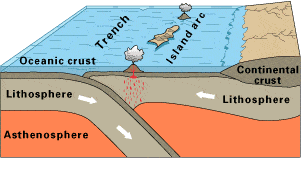
Observe this diagram of a plate boundary. One statement BEST describes what is happening. It is that

a)

the oceanic crust is melting.

b)

the denser ceanic crust is subducting under the less dense oceanic crust

c)

volcanic islands are forming.

d)

the tectonic plates are moving away from each other.
52.
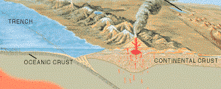
What geological forces might be responsible for this range of mountains?
a)
diverging tectonic plates
b)
erosion of the land by the ocean
c)
converging tectonic plates
d)
deposition of sediments by the ocean
53.
A plate boundary where two plates move away from each other is called
a)
Divergent Boundary
b)
Convergent Boundary
c)
Transform Boundary
d)
Subduction
54.
A Plate Boundary where two plates move toward each other is called
a)
Convergent Boundary
b)
Divergent Boundary
c)
Transform Boundary
d)
Subduction
55.
Which of the following is where one plate slides under another plate?
a)
submarine zone
b)
divergence zone
c)
subduction zone
d)
lower zone