
 Worksheets
1st Block Review 2022
Total questions: 58
Worksheet time: 46mins
True or False: The independent variable causes something to change.
True
False
True or False: The dependent variable changes in response to something else.
True
False
The amount of people at an event (p), and the number of chairs needed (c).
What's the dependent variable?
The amount of people (p)
The number of chairs needed (c)
The weight of a package (w), and the cost to mail it somewhere (c).
What's the independent variable?
The weight of the package (w)
The cost to mail it (c)
The number of blankets Rebecca can make (b), and the amount of fabric she has (f).
What is the dependent variable?
The number of blankets (b).
The amount of fabric (f).
The number of laptops needed (n), and the number of students in the class (s).
What is the independent variable?
The number of the laptops needed (n)
The number of students in the class (s)
How much water you use (w), and the price of your water bill (b).
What is the independent variable?
The price of your water bill (b)
How much water you use (w)
How fast Lacey runs (f), and how quickly she can run 4 laps (q).
What is the dependent variable?
How quickly she can run 4 laps (q)
How fast Lacey runs (f)
The number of students Mr. Gursaly has (s), and the amount of jolly ranchers he needs ( j ).
What is the independent variable>
The number of students Mr. Gursaly has (s)
the amount of jolly ranchers he needs ( j )
The weight of the bag (w), and the materials in the bag (m).
What is the independent variable?
The materials in the bag (m)
The weight of the bag (w)
The length of the lunch line (l), and how long you wait in line (w).
What is the dependent variable?
The length of the lunch line (l)
How long you wait in line (w)
The amount of hours Mr. Gursaly tutors (h), and the amount of money he makes (m).
What is the independent variable?
The amount of hours Mr. Gursaly tutors (h)
The amount of money he makes (m)
What is a Solid?
Matter that has a fixed shape and size.
Matter that has a fixed size and no fixed shape
Matter that has no fixed shape or size
Matter that has no fixed shape and size
The state of matter that expands to fill its container is called ______.
gas
liquid
solid
What is matter made up of?
particles that are too large to be seen
tiny butter particles
particles that are too small to be seen
tiny water particles
Define a liquid.
Matter that has fixed shape but no fixed volume
Matter that has fixed shape and fixed volume
Matter that has fixed volume, but no fixed shape
In which state of matter will there be the LARGEST space between molecules?
Solid
Liquid
Gas
What is a gas?
Matter that has fixed shape but no fixed volume
Matter that has no fixed shape and no fixed volume
Matter that has no fixed shape but fixed volume
compounds
What state of matter is an ice cube?
Solid
Liquid
Gas
Plasma
What state of matter is the air we breathe?
Solid
Liquid
Gas
Plasma


How do particles move if in a solid?
Not at all.
Quickly
Slow
They don't move they vibrate
The colder the temperature, the _______ the particle's motion.
Faster
Slower
Smaller
Larger
Fluids include...(select all that apply)
Liquids
Solids
Gases
Ice Cubes
Why does food coloring diffuse faster in hot water vs cold water?
Molecules are more dense allowing them to move faster
Molecules have more energy allowing them to move faster
The food coloring attaches to water molecules, slowing them down
Molecules have more weight with more food coloring

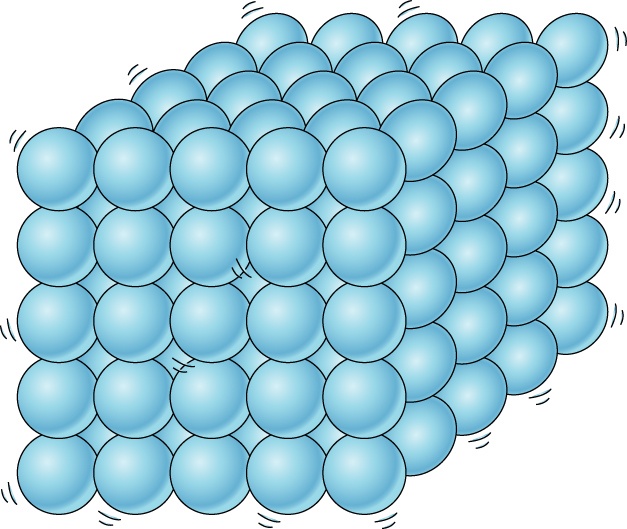
What state of matter?
Solid
Liquid
Gas
Plasma!!!
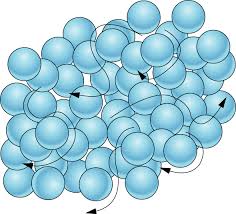
What state of matter?
Solid
Liquid
Gas
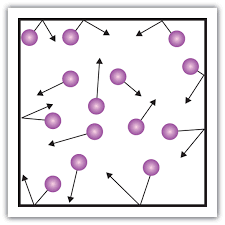
What state of matter?
Solid
Liquid
Gas
The slower the particles in a substance move,
the colder it is.
the warmer it is.
the more energy it has.
What is the phase change of a solid to a liquid?
freezing
melting
boiling
condensation
Change from Liquid to Solid is called ...
fusion
Freezing
sublimation
evaporation
Change from liquid to gas is called....
expansion
evaporation
condensation
sublimation
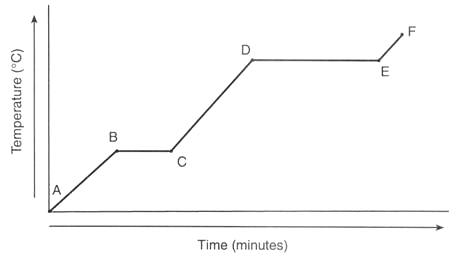
What state/phase is the object likely from points A to B?
Solid
Liquid
Gas
Plasma
What is happening to the particles in the substance between points D and E?
Melting
Freezing
Vaporizing
Sublimating

Gas pressure is caused by ______.


What will happen to the volume of a balloon if you warm it up into over hot water?
Volume will increase
Volume will decrease
Volume will not change
If the temperature of a gas decreases, the pressure of the gas will...
Decrease
Increase
Not change
Cannot be determined

particles in an object move slower and have less KE
particles in an object move faster and have more KE
Temperature does not effect particle movement.

Which container has higher pressure?
Container A
Container B
Container A and B have the same pressure.
air molecules hit the walls of the tire less frequently
When the temperature of a gas increases the particles...
speed up and move closer
speed up and move farther apart
slow down and move closer together
slow down and move farther apart
Pressure decreases when..
Temperature increases.
Temperature decreases.
Number of particles increase.
Volume decreases.
What will happen to the pressure inside a balloon if you squeeze it and the volume (size) of the balloon decreases?
Pressure will increase
Pressure will decrease
Pressure will not change
What will happen to the size of a balloon if you take it outside in the winter?
Volume will increase
Volume will decrease
Volume will not change

