wayground logo

Free Printable Worksheets

NEW

Font size

S
M
L
XL
Worksheets

Topic 7 (part 2)

Total questions: 35

Worksheet time: 26mins
Name
Class
Date
1.
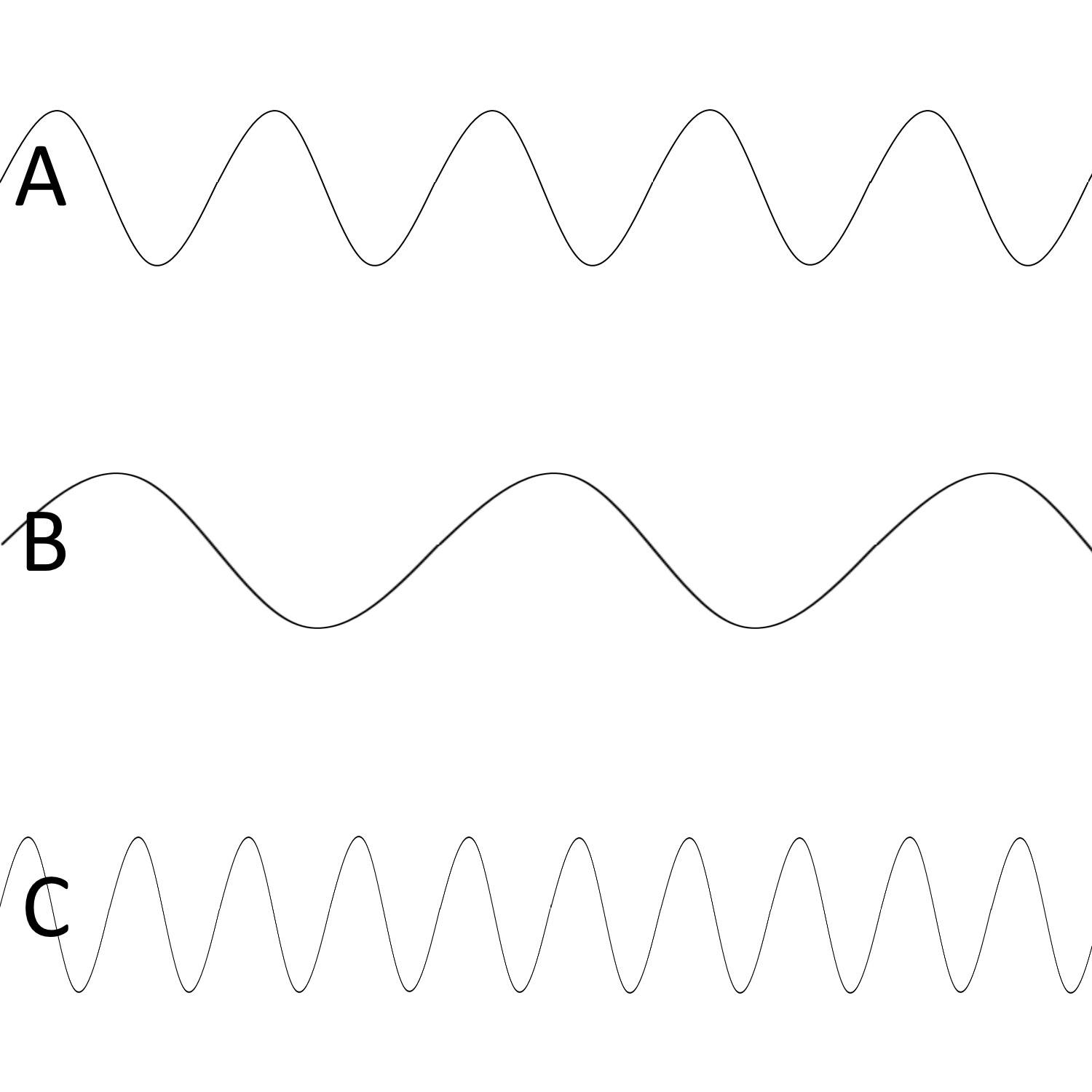
Which wave has the largest wavelength?
a)
A
b)
B
c)
C
d)
None (same wavelength)
2.
Which wave has the largest frequency?
a)
A
b)
B
c)
C
d)
None (same frequency)
3.
Two water waves combine in phase and build a larger wave. What phenomenon is happening?
a)
constructive interference
b)
refraction
c)
reflection
d)
diffraction
4.

What number harmonic is shown in A

a)

1

b)

2

c)

3

d)

4

5.

Even numbered harmonics do not form in a closed pipe because

a)

the pipe “fits” only an odd number of quarter wavelengths

b)

the pipe “fits” only an even number of quarter wavelengths

c)

the pipe cannot put an anti-node at the open end

d)

the pipe cannot get enough air to vibrate in the pipe at these lengths

6.

What is the fist harmonic also called?

a)

First harmonic

b)

First Overtone

c)

The fundamental

d)

The resonant frequency

7.

Of the sound sources shown, that which is vibrating with its first harmonic is the

a)

whistle.

b)

organ pipe.

c)

vibrating string.

d)

vibrating rod.

e)

vibrating spring.

8.

Of the sound sources shown, that which is vibrating with its first harmonic is

a)

the whistle.

b)

the organ pipe.

c)

the vibrating string.

d)

the vibrating rod.

e)

None of these.

9.

How many antinodes does this standing wave have?

a)

5

b)

6

c)

7

d)

8

10.
Which harmonic is shown?
a)
1st
b)
2nd
c)
3rd
d)
4th
11.

The third harmonic on a string fixed at both ends shows

a)

A wavelength and a half

b)

Half a wavelength

c)

Two wavelengths

d)

A wavelength

12.

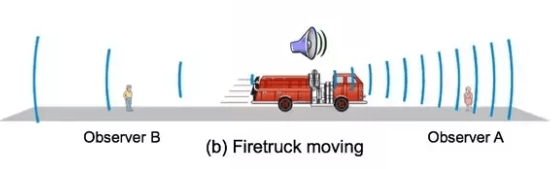
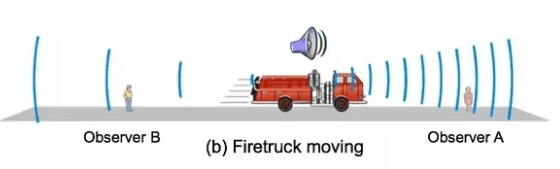
Look at the picture. Who is experiencing a lower pitched sound?

a)

Observer A

b)

Observer B

c)

There is no difference

13.

Look at the picture. Who is experiencing a higher pitched sound?

a)

Observer A

b)

Observer B

c)

There's no difference

14.
When an ambulance move TOWARD you it sounds ________ pitched. 
a)
high
b)
low
c)
medium
15.
When the car moves AWAY from you, its horn seems...
a)
Low pitched
b)
High pitched
c)
Normal
16.
What can you tell about this object's motion?
a)
Moving to the North (up).
b)
Moving to the South (down). 
c)
Moving to the West (left). 
d)
Moving to the East (right). 
17.
What can you tell about the motion of this object?
a)
Moving left.
b)
Moving right quickly.
c)
Standing still. 
d)
Moving up slowly. 
18.
The lowest point on a wave is the:
a)
Amplitude
b)
Crest
c)
Trough
d)
Wavelength
19.

In the diagram which letters represent the nodes

a)

A B C

b)

A C E

c)

B D

d)

B D E

e)

A C D

20.

Standing waves are created by

a)

Two identical waves reflecting off each other

b)

Two identical waves being diffracted together

c)

Two identical waves move through each other in opposite directions

d)

Two identical waves are diffracted from two identical sources

21.
The stationary dot is called:
a)
a node.
b)
an anti-node.
c)
the amplitude.
d)
the not moving bit.
22.
The moving black dot is called:
a)
a node
b)
an anti-node
c)
an anti-amplitude
d)
the wangy bit
23.

Which of the following equations represents a wave travelling along Y-axis?

a)

x = A sin (ky - ωt)

b)

y = A sin (kx - ωt)

c)

y = A sin (ky) cos (ωt)

d)

y = A cos (ky) sin (ωt)

24.
If two overlapping waves are in-phase, the resultant wave will have ______ compared to the two waves.
a)
Greater amplitude
b)
Greater frequency
c)
Greater wavelength
d)
Greater wave speed
25.
Standing waves are formed --
a)
by the superposition of two or more waves moving in opposite directions.
b)
by the superposition of two or more waves moving in the same direction.
c)
by the superposition of two or more waves moving in perpendicular directions.
d)
by the superposition of two or more waves moving in any arbitrary directions.
26.

The figure represents a string of length L, fixed at both ends, vibrating in several harmonics. Which string shows the 4th harmonic?

a)

A

b)

B

c)

C

d)

D

e)

E

27.
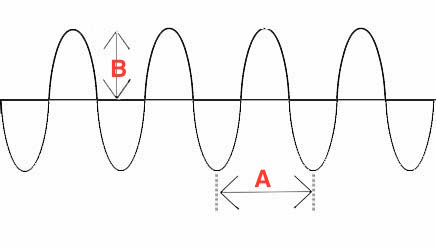
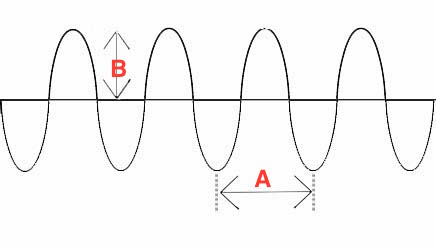
What property of this wave is represented by the letter "A"
a)
amplitude
b)
crest
c)
trough
d)
wavelength
28.

The equation of a progressive wave is given by y = 0.1 sin (3x + 10t) where y and x are in meters and t in second. The direction of the wave is

a)

leftwards

b)

rightwards

c)

upwards

d)

downwards

29.
What property of the wave is represented by the letter "B"?
a)
amplitude
b)
crest
c)
trough
d)
wavelength
30.

For waves on a water surface, the following graph shows how the displacement y of a water particle in the surface varies with the time t.


What are the quantities z and s?

a)

z: frequency

s: amplitude

b)

z: period

s: half-amplitude

c)

z: wavelength

s: half-amplitude

d)

z: period

s: amplitude

31.
Which is the correct equation for calculating the speed of a wave?
a)
T = 1/f
b)
Speed= Wavelength x Period
c)
Speed = Wavelength/Frequency
d)
Speed= Wavelength x Frequency
32.
When the frequency of a wave increases, what happens to the wavelength?
a)
The wavelength is not directly affected by the frequency of a wave.
b)
The wavelength increases.
c)
The wavelength decreases.
d)
More specific information is needed to form a conclusion about the wavelength.
33.
What kind of wave is pictured?
a)

transverse Wave

b)

longitudinal Wave

c)
compressional wave
d)
none of the above
34.
What kind of wave is pictured?
a)

transverse

b)

longitudinal

c)
surface
d)
none of the above
35.
Two water waves combine in phase and build a larger wave. What phenomenon is happening?
a)
constructive interference
b)
refraction
c)
reflection
d)
diffraction