

wayground logo

Free Printable Worksheets

Font size

S
M
L
XL
Worksheets

1.3 HBS

Total questions: 48

Worksheet time: 33mins

Name
Class
Date
1.
A nucleotide includes...?
a)
pentose sugar
b)
nitrogenous base
c)
phosphate group
d)
all of the above
2.
What does DNA stand for?
a)
Deoxyribonucleic acid
b)
Denitrogenous acid
c)
Deribonucleic acid
d)
Diribonucleic acid
3.
Fingerprint scan, vein recognition, and facial recognition are just a few examples of
a)
biometrics
b)
forensic anthroplogy
c)
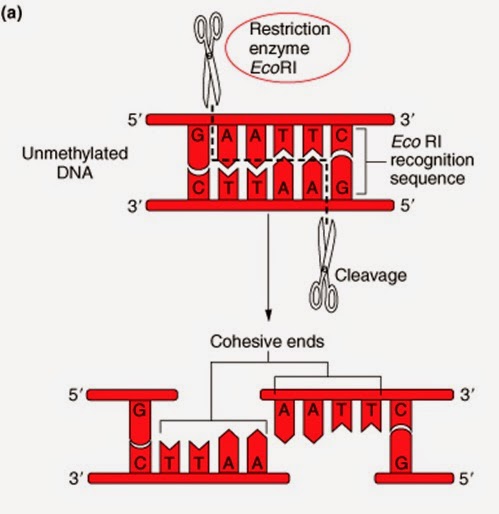
bioinformatics
d)
epigenetics
4.
How do restriction enzymes cut DNA?
a)
making random cuts
b)
following programmed instructions
c)
recognize sequences
d)
making cuts at every 12 base pairs
5.

This laboratory procedure is known as

a)

CLONING

b)

gel electrophoresis

c)

chromatography

d)

use of a dichotomous key

6.

In preparation for an electrophoresis procedure, enzymes are added to DNA in order to

a)

convert the DNA into gel

b)

cut the DNA into fragments

c)

change the color of the DNA

d)

produce longer sections of DNA

7.

A student performed a gel electrophoresis experiment. The results are represented in the diagram

below. Compared to the fragments at the top of the gel, the fragments at the lower end are

a)

larger, and move slower

b)

larger, and move faster

c)

smaller, and move faster

d)

smaller, and move slower

8.

This technique used to analyze DNA involves the

a)

synthesis of new DNA strands from subunits

b)

separation of DNA fragments based on size

c)

production of genetically engineered DNA molecules

d)

removal of defective genes from DNA

9.
Based on these results whose blood was found in the blood stain at the crime scene?
a)
Bob
b)
Sue
c)
John
d)
Lisa
10.
Which suspect is likely guilty?
a)
Suspect #1
b)
Suspect #2
c)
Suspect #3
11.
DNA fingerprinting works because
a)
Most genes are dominant
b)
All organisms contain RNA
c)
The most important genes are different among most people
d)
No two people, except identical twins, have exactly the same DNA 
12.
What is the purpose of gel electrophoresis?
a)
helps cut DNA
b)
count the genes in DNA
c)
separates DNA based on size
d)
allows for an exact replicated organism
13.
Why do the fragments of DNA in gel electrophoresis travel away from the negative electrode?
a)
DNA is negatively charged so attracted to the positive end of the unit
b)
DNA is positively charged to attracted to the negative end of the unit
c)
the agarose gel in negatively charged
d)
the agarose gel is positively charged
14.
In gel electrophoresis, the largest DNA fragment will appear
a)
closest to the starting wells
b)
farthest from the starting wells
c)
three quarters away from the starting wells
d)
it depends on how many fragments there are
15.
Which is the primary purpose of using restriction enzymes in gel electrophoresis?
a)
It allows the strands of DNA to be cut into various lengths for testing
b)
It restricts the number of base pairs that can be tested in a sample
c)
It makes the testing simpler by moving the strands into the gel faster
d)
It charges the DNA strands
16.
Which two bat species are most closely related?
a)
 Bat 1 and Bat 2
b)
Bat 1 and Bat 3
c)
Bat 2 and Bat 3
d)
There’s no way to tell
17.
a)

micropipette

b)

transfer pipette

c)

pipette pump

d)

serological pipette

18.
When using a micropipettor, if you push to the second stop to fill it you will get ____________
a)
the correct amount of solution
b)
too much solution
c)
too little solution
d)
either too much or too little solution
19.
The best tool to measure 146 uL (microliters) ______________.
a)
A PTP (plastic transfer pipette)
b)
A 5 - 50 uL micropipettor
c)
A 2 - 200 uL micropipettor
d)
A graduated cylinder
20.
In order to accurately fill a micropipettor you must ______________?
a)
Add a tip and push the button to the first stop.
b)
Add a tip and push the button to the second stop
c)
Turn the white wheel upward
d)
Push the eject button
21.
This equipment is used to 
a)
measure & transfer large volumes
b)
measure & transfer small volumes
c)
spin chemicals/tubes
d)
sterilize equipment
22.

Micropipettes are very accurate tools of measurement, but they are only as accurate as the person using it.

a)

true

b)

false

23.

Always change out the micropipette tip when changing reagents.

a)

true

b)

false

24.

This is a p20 micropipette.

How many microliters will this micropipette take up?

a)

500 uL

b)

50 uL

c)

5.0 uL

d)

0.5 uL

25.

This is a p200 micropipette.

How many microliters will this micropipette take up?

a)

500 uL

b)

50 uL

c)

5.0 uL

d)

0.5 uL

26.
What is the purpose of PCR?
a)
To produce millions of copies of DNA.
b)
To produce millions of copies of a specific region of DNA
c)
To add nucleotides to a DNA sequence
d)
To watch polymerase work.
27.
What is the function of a primer?
a)
To identify the particular region of DNA to be copied by PCR.
b)
To copy DNA.
c)
To create DNA nucleotides.
d)
To maintain the temperature of the PCR reaction.
28.
What are the base-pairing rules in DNA?
a)
A-C, G-T
b)
A-U, G-C
c)
A-T, G-C
d)
A-C, G-U
29.

What is the denaturation step?

a)

mutating RNA polymerase

b)

Cooling DNA to allow primers to form

c)

separating DNA helix in a cold environment

d)

separating DNA helix with using heat

30.

What happens after you have denatured your DNA?

a)

It denatures again.

b)

Primers attach to the gene of interest.

c)

The gene elongates

d)

PCR is over

31.
Why do the fragments of DNA in gel electrophoresis travel away from the negative electrode?
a)
DNA is negatively charged so attracted to the positive end of the unit
b)
DNA is positively charged to attracted to the negative end of the unit
c)
the agarose gel in negatively charged
d)
the agarose gel is positively charged
32.

Who commited the crime?

a)

Suspect 1

b)

Suspect 2

c)

Suspect 3

33.

Who is the father?

a)

Man 1

b)

Man 2

c)

Man 3

34.

Who is the father?

a)

Dad 1

b)

Dad 2

c)

Dad 3

35.
DNA is recovered from a suspected dead soldier.  Which Parents are the likely parents of the soldier?
a)
Parents C and D
b)
Parents E and F
c)
Parents A and B
d)
Parents G and H
36.
During gel electrophoresis, DNA moves from the ___ end to the ___ end.
a)
positive, negative
b)
negative, positive
37.

How are buffers used in Electrophoresis?

a)

Conduct electricity

b)

Remove salts

c)

Add extension energy

d)

Dissolve excess DNA

38.
What type of bonds hold the two strands of DNA together?
a)
Hydrogen bonds
b)
Covalent bonds
c)
Dipole-Dipole bonds
d)
Ionic bonds
39.

1. If the recognition sequence of the restriction enzyme HindIII is AAGCTT, then how many covalent bonds will be broken by the enzyme in the following DNA molecule?

a)

1

b)

2

c)

3

d)

4

40.

1. The DNA base sequences recognized by Endonuclease are called

a)

a).Restriction Site

b)

b). Recognition Site

c)

c).Fragmentation Site

d)

d).cutting Site

41.

How do we name restriction Enzymes ?

a)

a).First letter in Cap for Genus, next two letter in small for species, next one letter for strain and roman numeral for order of discovery

b)

b). First two letter in Cap for Genus, next one letter in small for species, next one letter for strain and English numeral for order of discovery

c)

c). First two letter in Cap for Genus, next one letter in capital for species, next one letter for strain and roman numeral for order of discovery

d)

d). First two letter in Cap for Genus, next one letter in small for species, next one letter for strain and roman numeral for order of discovery
42.

The recognition sites for restriction enzymes are :

a)

a).Tautomer

b)

b). Pallindrome

c)

c).Metamere

d)

d).Acronym

43.

Restriction Enzymes are isolated from :

a)

a).Protozoa

b)

b). Bacteria

c)

c).Virus

d)

d).Fungi

44.

Restriction Enzymes were primarily used as :

a)

a).Defence by Protozoa against antibiotics

b)

b).Tool by Virus to cleave Bacterial genome

c)

c)Defence by Bacteria against bacteriophages viruses

d)

d).All of the above

45.

How many RFLPs (fragements) would form if the following DNA was cut by HaeIII. The restriction site for HaeII GG^CC.

a)

1

b)

2

c)

3

d)

4

46.

How long is the shortest RFLP when DNA was cut by HaeIII. The restriction site for HaeII GG^CC.

a)

14

b)

18

c)

6

d)

4

47.

The enzyme EcoRI cuts at GAATTC. How many RFLPS will form?

a)

1

b)

2

c)

3

d)

4

48.

When the following bacterial plasmid DNA is cut with a restriction enzyme, how many bands will appear on the gel?

a)

1

b)

2

c)

3

d)

4

