
NEW
Font size
 Worksheets
Unit 3 Test Review
Total questions: 39
Worksheet time: 59mins
Newton's Law of Inertia (first law) describes the motion of-
Objects that accelerate

Law of Inertia
Law of Acceleration
Law of Action-Reaction
Law of Gravitation

Law of Inertia
Law of Acceleration
Law of Action - Reaction
Law of Gravitation
Law of Inertia
Law of Acceleration
Law of Action - Reaction

An automobile you are riding in suddenly stops, but you continue to go forward.
Law of Inertia
Law of Acceleration
Law of Action - reaction

You push against a wall and the wall is pushing back on you.
Law of Inertia
Law of Acceleration
Law of Action Reaction
Force=Mass x Acceleration
Newton's First Law
Newton's Second Law
Newton's Third Law
Isaac Newton stated for every action there is an
_________ and _________ reaction.
equal and same
equal and opposite
unequal and same
unequal and opposite
What determines an object’s mass?
amount of matter
amount of friction
amount of force
amount of gravity
What is inertia?
Only how things move
Only how things do not move
How things move and don't move
All of the above
What does friction do to a moving object?
Makes it rise
Slows it down
Speeds it up
All of the above
How is velocity different from speed?
Velocity is when an object goes in reverse.
Velocity is the direction an object moves in, and it has nothing to do with speed.
Velocity is speed and direction together.
Velocity is not at all different from speed.

Gravity is a _____ that _____
2 objects towards one another.
thing
reaches
energy
pushes
force
pulls
weight
takes
What two things determine the gravity of an object?
length & height
mass & distance
color & mass
volume & distance

Which model has greater gravitational attraction.
model A
model B
both models have equal gravity
When you drop a bowling ball and a feather, why does the feather fall slower?
air resistance causes the feather to fall slower
gravity pulls harder on the bowling ball than the feather
gravity pulls harder on the feather than the bowling ball
air resistance causes the bowling to fall slower

The first person to study gravity was an English scientist named __________.
Einstein
Fig Newton
Isaac Newton
Chris P. Bacon

When you push a desk that doesn't move,
Sliding friction occurs
static friction occurs
rolling friction occurs
fluid friction occurs

When you stand on a bathroom scale, it displays the _______________ that Earth is exerting on you.
gravitational force
mass
power

Friction acts in a a direction _________________ to the direction of the object's motion.
similar
opposite
that is nonexistent
The applied force required to push something across a surface _____________ as friction increases.
Increases
Decreases
Stays the same

When the irregularities of one surface come into contact with those of another surface, ___________ occurs
Gravity
Orbit
Friction
Electricity
A push or a pull.
work
force
motion
energy
Resistance to change.
power
force
inertia
energy
According to Newton's second law of motion, a/an ________ force will cause an object to move in the direction of the force.
balanced
unbalanced
equal
Yoda

This is an example of ... force
pull
push
gravity

This is an example of what force?
push
pull
magnetism
The momentum of an object depends upon the object's ___________&_____________.
size and shape
mass and speed
mass and veloctiy
mass and energy
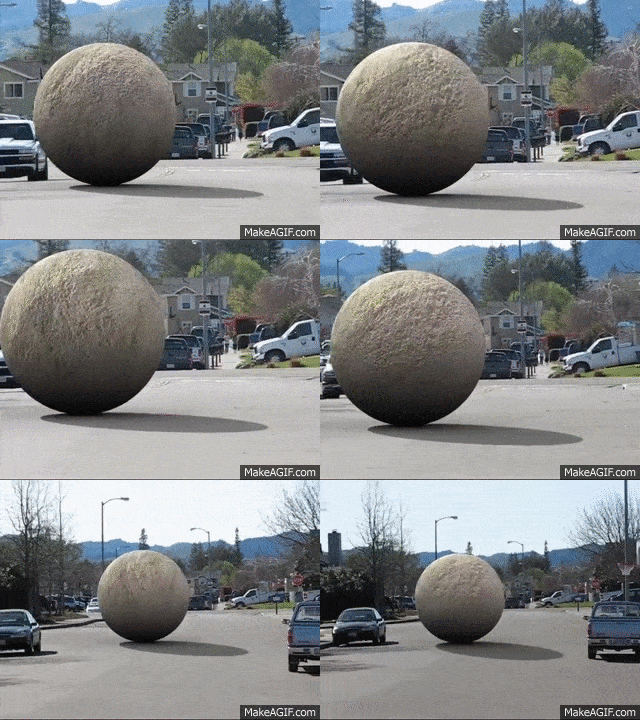

The more streamlined an object is, the...
More air resistance
Less air resistance
Slower air resistance
Faster air resistance
Air resistance pushes against falling
objects and __________________.
Speeds them up
Keeps them afloat
Slows them down
Spins them
What makes objects fall to the earth
Gravity
Wind
Force
Air Pressure
If we dropped a penny and a feather that had the exact same mass at the exact same time in OUR CLASSROOM. Which would hit the ground first?
Penny
Feather
They would hit at the same time
If we dropped a penny and a feather that had the exact same mass at the same time in a VACUUM (all air removed). Which would hit the ground first?
Penny
Feather
They would hit at the same time
Newtons

