
 Worksheets
Adaptations 2 Review
Total questions: 36
Worksheet time: 22mins

Which rock layer in the diagram seems to be the OLDEST?

Look at the diagram, what layer did animal E first show up in?
Layers #4
Layers #5
Layers #6
Layers #8

Which choice below is the animal which would be the youngest in site 1?
dinosaur

Based on the given rock and fossil evidence in the diagram to the right, which two letters most likely indicate layers that are the same age.
A & F
B & D
C & E
D & A
What pattern would you look for in the fossil record to determine if an organism went extinct?
There would a lot of that fossil in one layer
That fossil shows up in the youngest layer.
That fossil shows up in every layer.
That fossil shows up in older layers but not in younger layers.

The rock layer with the pottery is younger than the rock layer with the skull.
The rock layer with the skull is younger than the rock layer with the pottery.
The rock layer with the skull is approximately the same age as the rock layer with the pottery.
In rock layers, trilobite fossils are found lower than dinosaur fossils, and trilobite fossils are found lower than ammonite fossils. What can be determined from this information?
Trilobites are younger than dinosaurs and ammonites.
Dinosaurs are older than trilobites and ammonites.
Trilobites are older than ammonites and dinosaurs.
Dinosaurs, trilobites, and ammonites lived together.

Which of the following orders the rock layers accurately from oldest to youngest?
1, 2, 3, 4, 5
5, 4, 3, 2, 1
2, 3, 4, 5, 1
1, 2, 3, 5, 4

Which layer in Site #2 (right) is the same age as Layer F in Site #1 (left)?
z
y
w
there is no match
What are some patterns or trends that can be seen in the fossil record about the history of life? (Mark ALL that would be correct)
Life becomes more complex as time goes on.
Life becomes less complex as time goes on.
Life becomes more diverse as time goes on.
Life becomes less diverse as time goes on.
Life does not change in complexity or diversity over time.

During a walk on the beach, you find a jellyfish that has washed up next to several shells. You observe that jellyfish have soft bodies with no hard parts. What can you conclude?
The jellyfish and the shells will most likely become fossils
The jellyfish will more likely become a fossil but the shells won't
The shells will more likely become a fossil but the jellyfish won't
Neither the shells nor the jellyfish will become fossils

What is a mass extinction
When an organism dies off from Earth
When multiple species or organisms die off from Earth
A type of fossil

When moving up the fossil record, you notice from one layer to the next the amount of different species has doubled. What are you observing?
a mass extinction
an increase in biodiversity
a decrease in biodiversity
a species extinction

In which layer does an increase in biodiversity occur?
A
B
D
E
Do fossils in younger (newer) rock layers have more or less complex bodies than fossils in older rock layers?
More complex
Less complex
If the fossil record shows that there are no more fossils of a certain species (one species) in upper layers of sedimentary rock, what can scientists infer occurred?
The species became extinct.
There was a mass extinction.
The species evolved into a new species.
The species turned into transitional fossils.

When did fossil A become extinct? (Meaning: In which layer did fossil A last exist?)
Layer 1
Layer 2
Layer 3
Layer 4
Which diagram best depicts a mass extinction event?


Because manatees have a leg bone (pelvis in picture), it shows manatees are descended from an ancestor that was able to _____________________.
walk
fly
swim
climb
Cousins have similar traits because they inherit those traits from a common ancestor. How is this similar to some evidence for evolution?
Similarities can be seen between siblings in species today, which shows common ancestry.
Similarities can be seen among related organisms, which shows common ancestry.
There are many differences between siblings in species today, which shows common ancestry.
There are many differences between related organisms, which shows common ancestry.
What is the most likely reason that horses and mountain goats have hooves?
They have similar structures because they have a common ancestor.
They have different structures because they have a common ancestor.
These are un-used structures in both animals.
These are similar structures due genetic mutations.
An older organism which two or more different species evolved from is known as ________________________.
a common ancestor.
an embryo.
anatomy.
natural selection.

CHECK ALLof the traits a lizard and a pigeon have in common according to the diagram:
Jaws
Lungs
Claws
Feathers
Mammary glands

According to the diagram, which one of the following traits would the common ancestor of a crocodile and an amphibian have?
Hair
Bony skeleton
Amniotic eggs
Eggs with shells

Which number would be the most recent common ancestor of amphibians and crocodiles?
1
2
5
They do not share a common ancestor

Which species is most closely related to Taxidea taxus?
Lutra lutra
Panthera pardus
Canis latrans
Canis lupus
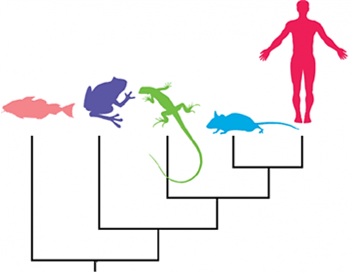
According to this evolutionary tree, which organism is most distantly related to humans?
Fish (pink)
Frog (purple)
Salamander (green)
Mouse (blue)
Humans, birds, whales, and lizards all have similar arm bones. What is a possible reason for this?
The function of these bones is the same in all animals
They live in similar environments
They have a common ancestor
All organisms resemble humans
The more similar the stages of embryonic development, the more likely that organisms share ____________
a common ancestor.
embryos.
traits when adults.
parents.

When scientists see similarities between a hippopotamus embryo and a rabbit embryo, this suggests:
Rabbits evolved from hippopotamus.
Hippopotamus share a common ancestor with rabbits.
Hippopotamus evolved from rabbits.
Hippopotamus and rabbits share the same traits.

According to the images shown, which species would be most closely related?
calf and rabbit
fish and human
pig and tortoise
salamander and chick

Human embryos have gill slits during early development. What is the best explanation for this?
Humans are technically considered fish in the earliest stages of development.
This is how all embryos breathe before lungs develop.
It is a common mutation found in most vertebrate species.
Humans and fish share a common ancestor which has gill slits.
TRUE or FALSE: If two organisms share similar traits, this means they are always closely related. For example: whales and sharks both have fins and live in water, but are they closely related?
True
False
TRUE or FALSE: Scientists only need to use one type of evidence to determine how closely or distantly related organisms might be to each other?
True
False

Which animal is most closely related to the cat based on the information in the table?
Chicken
Lizard
Eagle
Pig

