wayground logo

Free Printable Worksheets

Font size

S
M
L
XL
Worksheets

1st 9 weeks Biology Review

Total questions: 40

Worksheet time: 33mins

Name
Class
Date
1.

Why are there so few top predators present in any ecosystem?

a)

Because there is too much energy in the system

b)

Because there is not enough energy remaining in the ecosystem

c)

Because they do not need energy

d)

Because all predators are solitary animals

2.

List the trophic levels from lowest to highest

a)

Tertiary consumer, secondary consumer, primary consumer, primary producer

b)

Secondary consumer, tertiary consumer, primary consumer, primary producer

c)

Primary producer, primary consumer, secondary consumer, tertiary consumer

d)

Primary producer, tertiary consumer, secondary consumer, primary consumer

3.

Which is NOT a producer?

a)

Carrots

b)

Grains

c)

Grasshopper

d)

Grasses

4.

Based on the diagram who would be a primary consumer?

a)

Rabbit

b)

Owl

c)

Fox

d)

Grass

5.

Based on the diagram who is NOT a secondary consumer?

a)

Mice

b)

Bird

c)

Owl

d)

Fox

6.

The movement of new individuals into an existing population.

a)

moving

b)

immigration

c)

dynogration

d)

emigration

7.

Rabbits move from one forest to another in search of a better food supply. This is an example of _______________

a)

immigration

b)

emigration

c)

traveling

d)

population density

8.

Organisms introduced to a new area that out compete the species in the area.

a)

immigration

b)

competitive species

c)

invasive species

d)

emigration

9.

what term refers to the maximum number of individuals in a species that an environment can support long term?

a)

population growth rate

b)

exponential growth model

c)

logistic growth model

d)

carrying capacity

10.
If the number of births in a population is the same as the number of deaths in a population, what will happen to the growth of the population?
a)
It will increase.
b)
It will decrease.
c)
It will stay the same.
d)
It will fluctuate.
11.
If the number of births is greater than the number of deaths in a population, what will happen to the growth of the population?
a)
It will increase.
b)
It will decrease.
c)
It will stay the same.
d)
It will fluctuate.
12.

The maximum number of organisms an ecosystem can hold

a)

limiting factor

b)

carrying capacity

c)

biodiversity

d)

limit

13.

A species that, if removed from an ecosystem, would cause a major change in that ecosystem.

a)

Endangered species

b)

unlimited species

c)

important species

d)

keystone species

14.

The largest number of individuals that an environment can support long term is...

a)

carrying capacity

b)

emigration

c)

immigration

d)

population density

15.

What happens if a population grows past its carrying capacity?

a)

The population keeps growing

b)

The population starts to die off

c)

The entire species will go extinct

d)

The carrying capacity just increases

16.

Which ocean zone allows plants to grow??

a)

midnight zone

b)

photic zone

c)

twilight zone

d)

intertidal zone

17.

MOST sealife lives in the:

a)

Photic zone

b)

Twilight zone

c)

Midnight zone

d)

Deep zone

18.
The aphotic zone is
a)
the ocean's dark lower layer where photosynthesis cannot occur
b)
the sunlit upper layer of the ocean where photosynthesis occurs
c)
on the bottom of lakes, streams, and oceans.
d)
where benthos are found
19.

What is the best definition of desalination?

a)

Removing harmful chemicals from water

b)

Filtering dirty water

c)

Cleaning natural spring water

d)

Removing salt and minerals from sea water

20.

The demand for water around the world is_________.

a)

decreasing

b)

increasing

c)

declining

d)

constant

21.

Desalination is good for marine life because it removes salt from the ocean water.

a)

True

b)

False

22.

Carbon emissions is not a problem caused by desalination.

a)

True

b)

False

23.

What is "overfishing"?

a)

Fishing out of season

b)

Catching fish faster than they can replenish

c)

Catching fish from the top of the food chain

d)

Catching more fish than what people eat

24.

What strategies can be implemented to reduce/prevent overfishing? (Select more than one.)

a)

Fishing quotas

b)

Establishing laws

c)

Marine protected areas

d)

International standards for mesh size of nets

e)

banning certain kinds of nets

25.
A technique sometimes used in forest management, farming, or prairie restoration to improve habitat and reduce wildfire risk.
a)
Selective Cutting
b)
Controlled Burn 
c)
Thinning
d)
Clear Cutting
26.
Removal of all marketable trees from an area.
a)
Selective Cutting
b)
Controlled Burn 
c)
Thinning
d)
Clear Cutting
27.
Environmental causes of land degradation include...
a)
poverty, urban sprawl, deforestation
b)
deforestation, bio-industries, poverty
c)
overgrazing, deforestation, agriculture
d)
agriculture, urban sprawl, poverty
28.

The process by which water, ice, wind or gravity moves weathered rock and soil from one place to another.

a)
weathering
b)
erosion
c)
deposition
d)
dumptruck
29.
What word describes when water is attracted to other substances?
a)
cohesion
b)
adhesion
c)
capillary action
d)
surface tension
30.
Large bodies of water, such as lakes and oceans, do not quickly fluctuate in temperature. What is the reason for this phenomenon?
a)
Water is an acid.
b)
Water is a versatile solvent.
c)
Water has a high heat capacity.
d)
 Water acts as a buffer.
31.
Water is a universal solvent because it...
a)
It can be found anywhere
b)
It freezes when it gets cold
c)
floats when frozen
d)
Dissolves most substances
32.
Which of the following is LEAST likely to dissolve in water?
a)
nonpolar fats and oils
b)
polar sugar molecules
c)
salt made of a positive sodium ion and a negative chloride ion
d)
all of the substances will dissolve easily in water
33.
When a molecule has an opposite electrical charge on each end, it is known as what?
a)
cohesion
b)
polar molecule
c)
hydrogen bond
d)
solution
34.
When water molecules stick easily to other water molecules, this is called what?
a)
cohesion
b)
adhesion
c)
solution
d)
polar molecule
35.

Storing energy is the primary function of two macromolecules. What macromolecule is represented by the structure below?

a)

Carbohydrates

b)

Proteins

c)

Lipids

d)

Nucleic Acids

36.
What type of macromolecule is being represented in this image? 
a)
carbohydrate
b)
lipid
c)
protein
d)
nucleic acid
37.
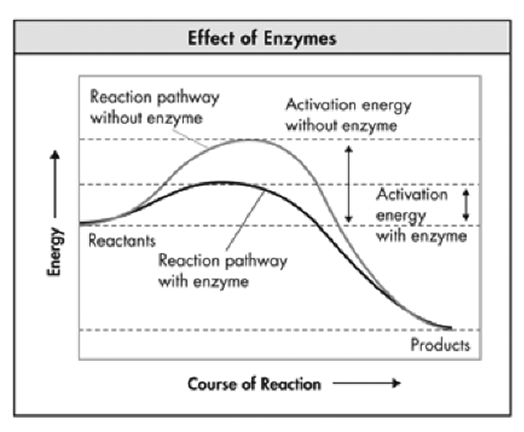
The graph shows how enzymes affect reactions in cells. Which statement best summarizes the information shown in the graph?
a)
Enzymes increase the energy of the reactants.
b)
Enzymes decrease the energy level of the products.
c)
Enzyme decrease the activation energy of the reaction.
d)
Enzymes reverse the direction of the reaction.
38.

Changes in pH and temperature can ___________________ an enzyme which causes it to lose its shape and affects its function.

a)

puncture

b)

denature

c)

double

d)

delete

39.
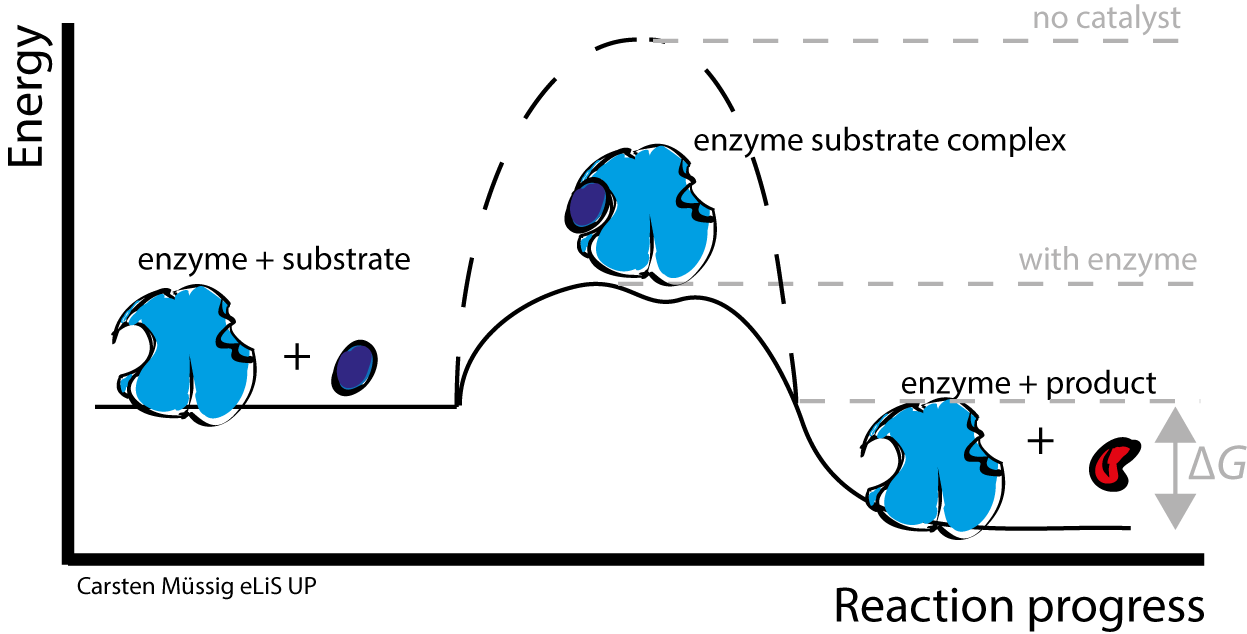
An enzyme speeds up a reaction by
a)
lowering the activation energy.
b)
raising the activation energy.
c)
releasing energy.
d)
absorbing energy.
40.
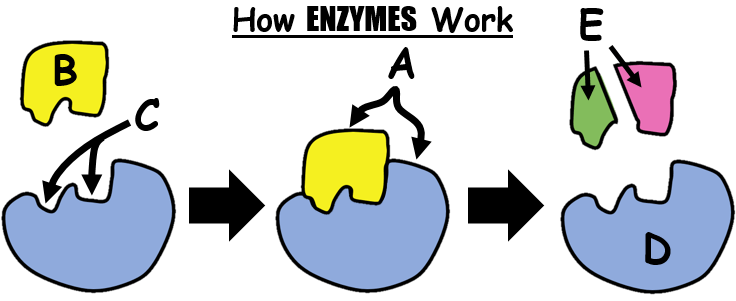
Letter B...
a)
active site
b)
enzyme
c)
substrate
d)
products