
 Worksheets
Rigid Body Dynamics
Total questions: 8
Worksheet time: 11mins
The net moment of the body is zero that means the distance between the force and the rotational axis is zero.
The first part of the statement is false and other part is true
The first part of the statement is false and other part is false too
The first part of the statement is true and other part is false
The first part of the statement is true and other part is true too
Suppose a gymnast is sitting on a rotating chair and his arms are outstretched. If he suddenly shortens his arms, what will happen?
angular velocity will decrease
moment of inertia will decrease
angular velocity will stay constant
angular momentum will increase.
For the conditions of the equilibrium of the body, i.e. the rigid body only the external forces defines the equilibrium. Because the internal forces cancels out so not to be considered.
The first part of the statement is false and other part is true
The first part of the statement is false and other part is false too
The first part of the statement is true and other part is false
The first part of the statement is true and other part is true too
A particle is in UCM (uniform circular motion). Its angular momentum remains intact about:
middle point of the circle
at any point within the circle
circumference point of the circle
at any point exterior to the circle.
A closed vessel of cylindrical shape is partly filled with water. If the vessel rotates along a horizontal plane around the perpendicular bisector, the moment of inertia (a)
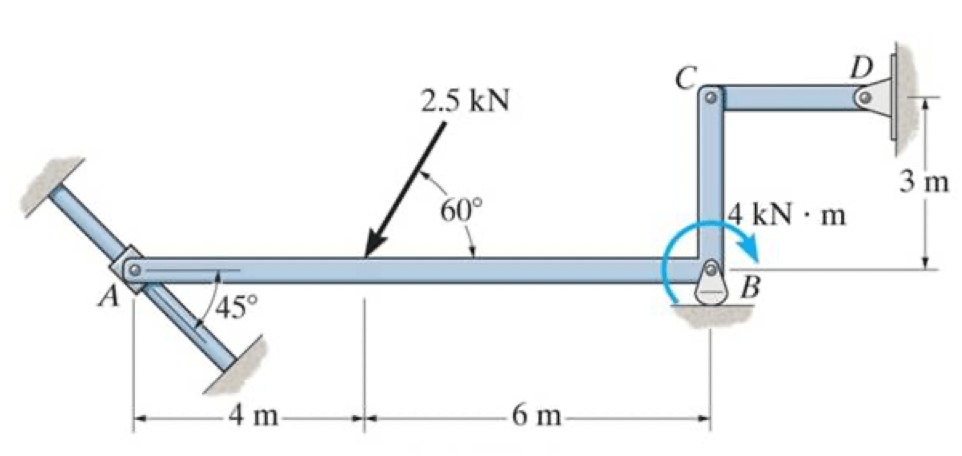
Draw a FBD of member ABC, which is supported by a smooth collar at A, roller at B, and link CD.
If an object's angular velocity is increased by 10 percent, then K.E must be increased by what percentage?
Maintaining constant velocity, a particle is traveling down a line that is parallel to X-axis (positive). What will be the angular momentum magnitude with regards to origin?
zero
increasing along with x
decreasing along with x
remains constant

