wayground logo

Free Printable Worksheets

Font size

S
M
L
XL
Worksheets

Macromolecules

Total questions: 63

Worksheet time: 1hrs 21mins

Name
Class
Date
1.

A ______________ is a large molecule.

a)

Micromolecule

b)

Polymer

c)

Amino Acid

d)

Macromolecule

2.

Which of the following elements are found in all macromolecules? (Select all that apply).

a)
b)
c)
d)
3.

Which of the following is not one of the four major classes of macromolecules?

a)

Lipids

b)

Carbon

c)

Protein

d)

Carbohydrates

e)

Nucleic Acid

4.

Which macromolecule is used as our main source of energy?

a)

Lipids/Fats

b)

Nucleic Acids

c)

Proteins

d)

Carbohydrates

5.

Which of the following are examples of carbohydrates? (Select all that apply).

a)

Bread

b)

Pasta

c)

Olive Oil

d)

Cheese

6.

Which macromolecule stores energy?

a)

Carbohydrates

b)

Proteins

c)

Lipids/Fats

d)

Nucleic Acids

7.

Nucleic acids make up which of the two molecules listed below?

a)

FDA

b)

RNA

c)

DNA

d)

FDR

8.

This is one job proteins do not have in the body.

a)

structure for tissues and organs

b)

transport things through cell membranes

c)

speed up chemical reactions

d)

insulation

9.

An avocado is an example of a which macromolecule?

a)

Carbohydrate

b)

Lipid/Fat

c)

Protein

d)

Nucleic Acid

10.
Proteins are made of monomers called ___________
a)
Nucleotides
b)
Monosaccharides
c)
Amino Acids
d)
Glycerol and fatty acids
11.
Nucleotides are monomers of
a)
Carbohydrates
b)
Lipids
c)
Proteins
d)
Nucleic Acids
12.
Monosaccharides are monomers of
a)
Carbohydrates
b)
Lipids
c)
Proteins
d)
Nucleic Acids
13.
Waxes, oils and fats are examples of
a)
Carbohydrates
b)
Lipids
c)
Proteins
d)
Nucleic Acids
14.
What is the function of nucleic acids?
a)
store genetic information
b)
store energy (long-term)
c)
store energy (short-term)
d)
build skin, hair, nails, muscles
15.
Which macromolecule stores energy, insulates us, and makes up the cell membrane?
a)
lipids
b)
proteins
c)
carbohydrates
d)
nucleic acids
16.
All polymers are made up of...
a)
monosaccharides
b)
monomers
c)
proteins
d)
None of these
17.

The most important element that is the backbone of all biological molecules

a)
carbon
b)
nitrogen
c)
phosphorus
d)
sulfur
18.
Building blocks of the body, hair , muscles etc.
a)
protein
b)
nucleic acid
c)
lipids
d)
carbohydrates
19.
Enzymes are..
a)
nucleic acids 
b)
carbohydrates 
c)
lipids 
d)
proteins 
20.
Which is an example of a lipid?
a)
Candy
b)
Olive Oil
c)
DNA
d)
Meat
21.
Glycerol and fatty acids are the monomers of
a)
Carbohydrates
b)
Lipids
c)
Proteins
d)
Nucleic Acids
22.
The organic compounds that have many structural purposes and are used in many processes within the
cell are called ____________________.
a)
Carbohydrates
b)
Lipids
c)
Proteins
d)
Nucleic Acids
23.
What are the four macromolecules?
a)
proteins, nucleic acids, carbohydrates, and lipids
b)
monosaccharides, lipids, polysaccaharides, and proteins
c)
RNA, DNA, proteins, and carbohydrates
d)
proteins, DNA, RNA, and steroids
24.
What is the primary function of carbohydrates in your body?
a)
Speed up chemical reactions.
b)
Give immediate energy.
c)
Help to store energy.
d)
Build cell walls in plants.
25.
Carbohydrates are made of... 
a)
C H O
b)
C H O N
c)
C H O N P
d)
C H O N S
26.
Lipids are made of... 
a)
C H O
b)
C H O N
c)
C H O N P
d)
C H O N S
27.
Proteins are made of... 
a)
C H O
b)
C H O N
c)
C H O N P
d)
C H O N S
28.

Starch is...

a)

a protein

b)

a lipid

c)

a carbohydrate

29.
The element _______is found in all of the organic compounds.
a)
Iron
b)
Nitrogen
c)
Carbon
d)
Oxygen
30.
Nucleotides are monomers of
a)
Carbohydrates
b)
Lipids
c)
Proteins
d)
Nucleic Acids
31.

Which macromolecule is shown?

a)

lipid

b)

protein

c)

nucleic acid

d)

carbohydrate

32.

Which macromolecule is shown?

a)

lipid

b)

protein

c)

nucleic acid

d)

carbohydrate

33.

This macromolecule make up cell membranes, store energy, and provide insulation

a)

carbohydrate

b)

lipids

c)

protein

d)

nucleic acid

34.

This macromolecule carries hereditary information and instructions for building molecules

a)

carbohydrate

b)

lipids

c)

protein

d)

nucleic acid

35.

Which statement is true?

a)

Simple sugars are made of polysaccharides.

b)

Glycerol is made of fatty acids.

c)

RNA molecules are made of nucleotides.

d)

Amino acids are made of proteins.

36.

Plants build cellulose (a polysaccharide) to makeup their parts like leaves, roots, stems, etc. What monomer do plants use to build cellulose?

a)

monosaccharides

b)

disaccharides

c)

amino acids

d)

nucleotides

37.

This group includes steroids like estrogen and testosterone

a)

carbohydrate

b)

lipid

c)

protein

d)

nucleic acid

38.

One of the characteristics of life is that organisms must have genetic material. This genetic material is a ________.

a)

carbohydrate

b)

lipid

c)

protein

d)

nucleic acid

39.

Identify the macromolecule in the picture.

a)

carbohydrate

b)

lipid

c)

protein

d)

nucleic acid

40.

What is the term used to describe the energy needed to get a reaction started?

a)

activation energy

b)

adhesion energy

c)

cohesion energy

d)

chemical energy

41.

Which of the following statements is true about catalysts (enzymes)?

a)

Catalysts slow down the rate of chemical reactions.

b)

Enzymes help regulate pH.

c)

Catalysts are used up during a chemical reaction.

d)

Catalysts lower the activation energy of a chemical reaction.

42.

An enzyme and substrate can be compared to

a)

lock and key

b)

a faucet

c)

a door hinge

d)

light switch

43.

The picture below shows an enzyme acting on a substrate to form products during a chemical reaction. Using the figure, what letters represents the enzyme?

a)

A and B

b)

B and D

c)

A and E

d)

D and E

44.

Storing energy is the primary function of two macromolecules. What macromolecule is represented by the structure below?

a)

Carbohydrates

b)

Proteins

c)

Lipids

d)

Nucleic Acids

45.

Chitin is found in the exoskeleton of arthropod. What group does this monomer belong to?

a)

Carbohydrates

b)

Lipids

c)

Proteins

d)

Nucleic Acids

46.

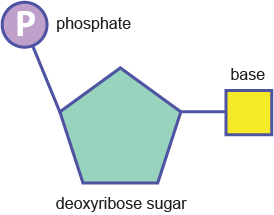
Identify the monomer shown

a)

monosaccharide

b)

amino acid

c)

neucleotide

d)

glucose molecule

47.
What are the 4 most abundant elements in living things?
a)
hydrogen, oxygen, nitrogen, carbon
b)
hydrogen, helium, oxygen, carbon
c)
carbon, manganese, iron, hydrogen
48.
___________ are many monomers bonded together that form a larger molecule.
a)
Polymers
b)
Monomers
c)
Trinominers
d)
DNA
49.
Sugars, starches and chitin are examples of
a)
Carbohydrates
b)
Lipids
c)
Proteins
d)
Nucleic Acids
50.
The basic unit of life is a ____________.
a)
atom
b)
molecule
c)
organelle
d)
cell
51.

Which of the following compounds is organic?

a)

CH2O

b)

NaOH

c)

Fe2O3

d)

H2O

52.

What is an example of a saturated fat?

a)
b)
53.
What do carbohydrates and fats have in common?
a)
They're both sources of glucose
b)
They're both sources of protein
c)
They're both sources of fatty acids
d)
They're both sources of glycerol
54.
What is the key difference between saturated and unsaturated fats?
a)
Saturated fats are usually liquid at room temperature; unsaturated fats are usually solid
b)
Saturated fats stay solid at room temperature; unsaturated fats are usually liquid
c)
Saturated fats can be found in vegetable oils, unsaturated fats can be found in animal products
d)
Saturated fats are healthier than unsaturated fats
55.

Which of the following is NOT a monosaccharide?

a)

starch

b)

fructose

c)

glucose

d)

galactose

56.

Lactose is composed of

a)

glucose + fructose

b)

glucose + glucose

c)

glucose + sucrose

d)

glucose + galactose

57.

Which polysaccharide is used by plants to make their cell wall?

a)

starch

b)

glycogen

c)

cellulose

d)

chitin

58.

What makes up the disaccharide sucrose?

a)

glucose + glucose

b)

glucose + fructose

c)

glucose + galactose

d)

glucose + maltose

59.
Sugars all end with what three letter ending?
a)
-ote
b)
-ate
c)
-ase
d)
-ose
60.
What type of carbohydrate is this?
a)
polysaccharide
b)
disaccharide
c)
monosaccharide
d)
it isn't a carbohydrate
61.
The simple sugar from fruit is called_____.
a)
sucrose
b)
lactose
c)
fructose
d)
maltose
62.
______________ carbohydrates supply longer lasting energy.
a)
simple
b)
complex
c)
generic
63.
How many sugar units make up monosaccharides?
a)
one
b)
two
c)
three
d)
zero