
Font size
 Worksheets
Star Corpses
Total questions: 31
Worksheet time: 54mins
Once Fusion slows down and stops what will happen?
Gravity wins and brings the matter closer together
Supernova Explosion
A black hole forms instantly
Nobody knows
Protons and Electrons fuse into Neutrons
Why does a star die?
Imbalance in radiation pressure v. gravity
Runs out of fuel to fuse
A black hole sucks it up
Planets crash into it
A supernova explosion blasts it away
As a star begins to die, why does it get bigger?
There is less gravity holding the star together so it is able to spread out.
"Higher element" fusion releases More energy as gravity compresses the star making it hotter.
Protons and Electrons combining into neutrons releases a lot of energy causing the star to slowly get bigger before it pops like a balloon
More hydrogen is being fused which releases even more energy making the star bigger
Which of the following is NOT a star corpse
White Dwarf Star
Neutron Star
Black Hole
Red Dwarf Star
What determines what type of corpse a star will become
Brightness
Mass
Random Chance
Volume
Elements that are fused
What type of star corpse will our sun become?
White Dwarf
Brown Dwarf
Black Hole
Neutron Star
Red Dwarf
Approximately how much mass is left over from the sun when it becomes its corpse?
~10%
Less than 1%
~50%
~99%
~33.33%
The sun right now is about 1,000,000 times larger than the Earth Approximately how big would the star corpse be?
Half the size of the sun
It won't change size
About the size of the Earth
Twice the size of the sun
There is no "size" when talking about star corpses
What prevents a white dwarf from collapsing?
Electrons can't be in the same 'state' so they occupy higher energy states creating a pressure pushing outwards
A white dwarf is made up of neutrons which are held together by the strong force
We have no idea what prevents the white dwarf from collapsing.
'Reverse beta decay' occurs and all electrons and protons collapse into Neutrons
A white dwarf can be through of as...
A single atom with a giant nucleus and huge electron cloud
A single atomic nucleus with protons and neutrons hanging out.
A normal every day star
Hydrogen and Helium fusing together to form heavier elements
Electron Degeneracy Pressure keeps a white dwarf from collapsing. Why does electron degeneracy pressure occur?
Electrons follow the Pauli Exclusion Principle which states that electrons CAN be in the same spot at the same time with the same energy
Electrons follow the Pauli Exclusion Principle which states that electrons CANNOT be in the same spot at the same time with the same energy
Electrons don't follow the Pauli Exclusion Principle and can be on top of each other
Gravity forces electrons to collapse into protons making lots and lots of neutrons.
Neutron Stars are held together by...
Electrons can't be in the same 'state' so they occupy higher energy states creating a pressure pushing outwards
The strong force holds neutrons together
We don't know what holds neutron stars together
Reverse Beta Decay happens releasing energy which prevents the neutron star from collapsing
A neutron star can be thought of
As a giant atom with a single nucleus and orbit electron cloud
A giant atomic nucleus containing protons and neutrons
A bunch of Neutrons sandwiched together
As nothing important or exotic at all
Neutron stars are smaller than white dwarfs because
They have more mass
There is nothing preventing neutrons from getting closer together
Protons have positive charges and repel each other
This is a trick question White dwarfs are always smaller than neutron stars
Neutron stars are typically about the size of...
Planets like Earth
Stars
Cities
They have no defined size
Atoms
Neutron stars are spinning because...
There supernova explosion isn't symmetrical and twists the neutron star as it forms.
They are being pulled from a nearby black hole
Neutrons have positive charges which repel them causing them to spin
They have giant magnetic fields causing them to spin
The faster a Neutron Star spins that means
The Neutron star is younger
The Neutron star is older
There is no correlation between age of neutron star and how fast it spins
It is more massive
It is less massive
The most massive stars will become
White Dwarfs
Neutron Stars
Black Holes
Red Giants
Brown Dwarfs
The defining characteristic of a black hole is...
That is spins
That is dark
That it is so much gravity that not even light can escape its pull
They allow you to travel back in time.
What holds a Black Hole together
As far as we know, nothing
Electron Degeneracy Pressure
The Strong Force
The Electromagnetic Force
If the Sun became a black hole (with the same mass) what would happen to Earth's orbit
The Earth would be sucked up into the black hole
The Earth's orbit would continue undistrubed
Earth would be flung out of the solar system
The Earth would crash into Mars
The point at which light can no longer escape a black hole's gravity is called the...
Event Horizon
Schwarzschild Radius
Quark-Gluon Plasma
Final Destination
Light Limit
The event horizon is determined only by the...
Mass of the black hole
Random
Quark-Gluon Plasma
Charge of the black hole
When Black Holes collide they release energy and
Gravitational Waves
White Holes
Worm Holes
Degenerate Quark Matter
LIGO detects gravitational waves from black hole (or neutron star) mergers by
Measuring the changes in length of an interferometer's arms
A really big telescope
By measuring the repeated x-rays that flash by the Earth every few seconds
Screaming "SCIENCE" as loud as possible
What are blackholes made of?
Quarks and stuff
Neutrons crammed together
Degenerate Electrons
We aren't actually sure
Black Holes will form from stars that are how many times more massive than the sun?
3x times
> 18 times
About the same size
1,000,000, times
When we look at the picture of a black hole what are the bright colors that we are seeing?
Superheated gas moving close to the speed of light orbiting the black hole in an accretion disc.
Superheated gas going into the blackhole and coming back out
The black hole releasing energy in the form of light and radio waves
The black hole itself.
Why can't we see what has already fallen into a black hole?
If it has fallen into a black hole no matter how fast it goes it can't escape gravity's pull
It has escaped the black hole it just hasn't reached Earth's telescopes yet
There is too much dust in the accretion disc that blocks us from seeing it
The light has shifted into non visible part of the spectrum of light and therefore we can't see it.
Instead of building a telescope the size of the Earth, the scientists at the Event Horizon Telescope did what in order to image the black hole at the center of our galaxy.
They used an array of telescope all around the Earth to act as an Earth sized telescope in the aggregate.
They used an interferometer to measure the different gravity at different locations in order to correctly recreate the image
They used one telescope and used computer simulations to rebuild the rest of the data in massive hard drives
They used an array of telescopes that each took a tiny picture and then put them together like a collage.
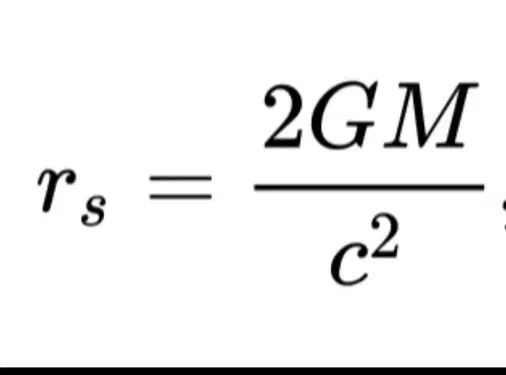
What is the Schwarzschild radius of the supermassive black hole (Sagittarius A*) at the center of our (Milky way) Galaxy if it has a mass of 8.56 x 10^36 kg.
Remember 2G/c^2 = 1.48 x 10^(-27)
(Your answer should be in scientific notation (i.e 1.00 x 10^5) rounded to the nearest hundredth for the number in front of the 10^)
(a)

