
 Worksheets
periodic table
Total questions: 40
Worksheet time: 10hrs 0mins
what is used to make computer chips
alkali metals
semi-metals
metalloids
metals
What is the atomic symbol for gold,Iron and potassium
(a)
A horizontal row is a
period
family
atomic line
shrek
a vertical line is
family
periods
my lost father
iron

using the periodic table what is the atomic number of mercury
(a)

What does the C represent?
atomic mass
atomic number
element name
chemical symbol

What does the 6 represent?
atomic mass
atomic number
element name
chemical symbol
Who invented the Periodic Table?
Mendeleev
Bohr
Lewis
Democritus
What charge do protons have?
Positive
Negative
Neutral
What family is copper in?
alkali metals
alkaline earth metals
noble gases
transition metals
What element is the chemical symbol Au?
gold
silver
Augium
Auxiom
What family is on the far right of the periodic table?
alkali metals
transition metals
actinoids
noble gases
What is mercury's chemical symbol?
Me
M
Hg
Mc
What is nickel's chemical symbol?
An
N
Nc
Ni
What is sodium's chemical symbol?
N
Na
S
So
Which pair of properties describes the elements in Group 1?
They are chemically stable
They have 8 valence electrons
They are the most reactive metals
They are the most reactive non metals

What property does element X have based on its location in the periodic table?
Highly reactive gas
Manmade radioactive substance
Nonreactive nonmetal
Metallic solid
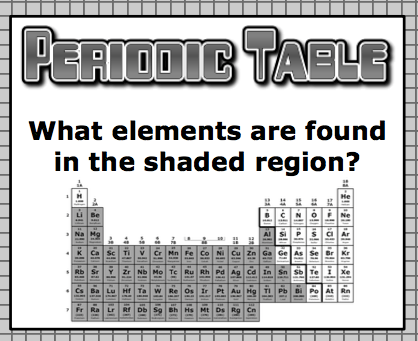
Who created the periodic table?
John Dalton
Marie Curie
Dmitri Mendeleev
The periodic table is arranged in order of...
increasing atomic number
increasing atomic mass
decreasing atomic mass
decreasing atomic number
The atomic number tells you the number of (a) in the nucleus?
The atomic mass of an element is equal to the number of...
protons and neutrons
protons and electrons
protons neutrons and electrons
Groups on the periodic table are arranged...
vertically
horizontally
diagonally
Periods on the periodic table are arranged...
vertically
horizontally
diagonally
At room temperature, most elements are classified as...
non-metal
metal
mettalloids
halogens
Which of the following are located along a dividing line that looks like a staircase?
metals
metalloids
non-metals
alkali metals
Which of the following is a property of non-metals?
malleable (easily reshaped w/o breaking)
brittle (easily broken)
ductile (capable of being drown out into a wire or thread)
Which of the following is not a property of metalloids?
poor conductors of electricity
have properties of metals & non-metals
solids at room temperature
Which of the following is not a property of metals?
conduct electricity
brittle
shiny
Which of the following statements is TRUE?
elements within a period have similar properties
there are 7 periods on the periodic table
different elements can have the same atomic number
Which of the following statements is FALSE?
Au is the element symbol for gold
H2O is the element symbol for water
Hydrogen does not belong to any family
What family does Hydrogen belong?
Non-metal
Noble Gas
Halogen
Metalloid
Which elements are in the nucleus?
Proton and Electron
Neutron and Electron
Proton and Neutron
The atomic number tells you the number of (a) in the nucleus?
Groups on the periodic table are arranged...
vertically
horizontally
diagonally
Metals are found on the ______________ side of the periodic table.
nonmetals
left
right
metals

