
 Worksheets
3.3-4 | Nuclear Practice
Total questions: 40
Worksheet time: 2hrs 19mins
If 10 mg of iodine 131 is given to a patient, how much is left after 24 days? The half-life of iodine-131 is 8 days. Round to two decimal points.
(a)
The half-life of strontium-90 is 25 years. How much strontium-90 will remain after 100 years if the initial amount is 4.0 g? Round to two decimal points.
(a)
The half-life of Zn-71 is 2.4 minutes. If 6.25 g of Zn-71 are needed for an experiment, how much should be prepared if it will take 9.6 minutes before the experiment can begin? (FIND Mi)
100.0g
50.0g
12.5g
8.5g
Barium-122 has a half-life of 2 minutes. If after 10 minutes a sample of 15.0 g is left, what mass must have been initially present?
30 g
480 g
240 g
120 g
If 10 mg of iodine 131 is left after 40 days how much must we have started with? The half-life of iodine-131 is 8 days.
(a)
The half life of isotope X is 2.0 years. How many years would it take for a 4.0 mg sample of X to decay and have only 0.50 mg of it remain?
6.0 years
3.0 years
8.0 years
2.0 years
The half-life of Po-218 is three minutes. If it is allowed to decay from 150.0 grams to 2.34 grams, how many half lifes have occured?
6 half lifes
3 half lifes
8 half lifes
5 half lifes
The half-life of strontium-90 is 25 years. How much strontium-90 must we have started with if after 75 years 15 grams remains?
(a)
What type of radioactive decay has the most mass?
Alpha
Beta
Gamma
20985At = ___ + 42He
146C = ___ + 0-1e
6027Co = ___ + 0-1e
24395Am → 23993Np + 42He
94Be + 11H → _____ + 42He

Arrange the particles of radioactive decay in order from greatest to least penetrating ability.
Beta, gamma, alpha
Alpha, gamma, beta
Gamma, beta, alpha
Alpha, beta, gamma
If element 5024 Cr undergoes an alpha decay, the resulting element looks like _______.
5025 Mn
4622 Ti
4820 Ca
5426 Fe


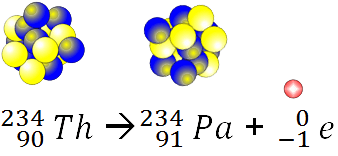


Why does alpha decay occur?
The nucleus is too large to be stable
The proton to neutron ratio is unstable
The nucleus is in an excited state. This usually follows other types of decay.
None of the above
If Plonium-210 undergoes 2 consecutive rounds of alpha decay followed by a beta decay, what would be the resulting daughter nuclide?
21084Po --> 42He + _______
_______ --> 42He + _______
_______ --> 0-1e + ________
20682Pb
20280Hg
20281Tl
21486Rn
What process describes two small nuclei combining into a larger nucleus?
fission
fusion
alpha decay
beta decay
What process is described by the splitting of a nucleus into smaller nuclei?
fusion
fission
half-life
gamma radiation
How do nuclear power-plants work?
Fusion
Half-life
Fission
Fusion or fission

What nuclear process is shown in the picture?
alpha decay
gamma emission
fusion
fission

Which nuclear process if shown in the picture?
alpha decay
beta decay
fusion
fission
One disadvantage of nuclear energy produced through fission is ___.
it is a fossil fuel
it leaves behind radioactive waste
it emits large amounts of pollution into the atmosphere
there are no disadvantages
Which of the following is NOT an example of nuclear fission?
nuclear power plants
the sun
atomic bombs
Fill in the blanks: In nuclear _____, two ____ nuclei are ______ together to form one larger nucleus.
fission; large; split
fission; smaller; combined
fusion; smaller; combined
fusion; larger; split
Fill in the blanks: In a nuclear ____ reaction, a _____ nucleus is bombarded y a small neutron causing it to become unstable.
fission; large
fission; small
fusion; large
fusion; small
Why is fusion hard to achieve?
it produces a lot of radioactive waste
the nuclei containing protons are positive and will repel
the temperature must 0 K
the average kinetic energy of hydrogen atoms is too low
Which of the following is NOT a true statement about nuclear fission?
big atoms split apart
it occurs naturally
it produces radioactive waste
it releases less energy than fusion

