wayground logo

Free Printable Worksheets

Font size

S
M
L
XL
Worksheets

Module 5 Test Review

Total questions: 102

Worksheet time: 4hrs 39mins

Name
Class
Date
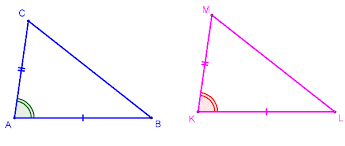
1.

What type of an angle is this?

a)

SAS

b)

SSS

c)

HL

d)

ASA

2.

Is this SSS?

a)

Yes

b)

No

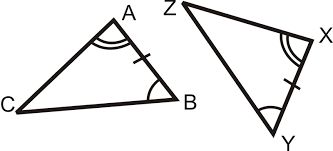
3.

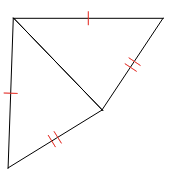
Which one is this?

a)

HL

b)

SSS

c)

SAS

d)

ASA

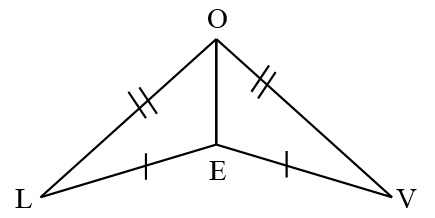
4.

Which one is this?

a)

SSS

b)

ASA

c)

SAS

d)

HL

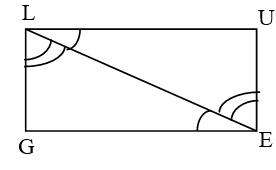
5.

Which one is this

a)

SSS

b)

SAS

c)

ASA

d)

HL

6.

Which one is this

a)

SSS

b)

SAS

c)

ASA

d)

AAS

7.

a)

HL

b)

SAS

c)

SSS

d)

ASA

8.

Is this SSS?

a)

Yes

b)

No

9.

Is this AAS

a)

Yes

b)

No

10.

Which of the following is not a test used to prove triangles congruent

a)

SSA

b)

SAS

c)

ASA

d)

AAS

e)

HL

11.

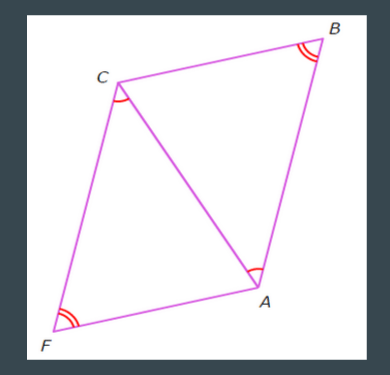
What additional information is needed to prove the two triangles congruent?

a)

PNQS\overline{PN}\cong\overline{QS}  

b)

OS\angle O\cong\angle S  

c)

NO\angle N\cong\angle O  

d)

POQR\overline{PO}\cong\overline{QR}  

12.

Which pair of trianlges can be proved congruent using SAS?

a)
b)
c)
d)
13.

Which pair of triangles can be proved congruent by SSS?

a)
b)
c)
d)
14.

For the ASA Postulate to apply, which side is part of the congruence for two triangles?

a)

the longest side

b)

the shortest side

c)

the non-included side

d)

the included side

15.

For the AAS Theorem to apply, which side of twon triangles is part of the congruence?

a)

the longest side

b)

the shortest side

c)

the non-included side

d)

the included side

16.
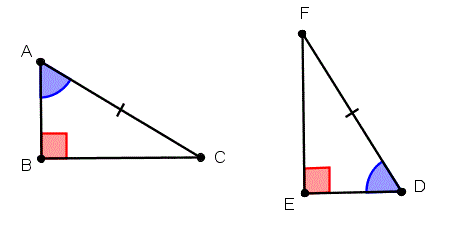
Name the postulate, if possible, that makes the triangles congruent.
a)
SSS
b)
SAS
c)
ASA
d)
Not Possible
17.
Name the postulate, if possible, that makes the triangles congruent.
a)
SSS
b)
SAS
c)
ASA
d)
AAS
18.
Name the postulate, if possible, that makes the triangles congruent.
a)
SSS
b)
SAS
c)
ASA
d)
AAS
19.
How are these two triangles congruent?
a)
AAS
b)
ASA
c)
Not enough information
d)
SAS
20.
Name the postulate, if possible, that makes the triangles congruent.
a)
SSS
b)
SAS
c)
HL
d)
Not Possible
21.
∆ABC≅∆XYZ
which is true?
a)
AB≅XY
b)
AB≅YX
c)
AB≅XZ
d)
BC≅CB
22.
∆EHG≅∆KFC
Which is a true statement?
a)
EH≅FK
b)
HG≅KF
c)
EG≅KC
d)
∠E≅∠C
23.
Which of these is a valid congruency statement for these 2 triangles?
a)
 ∠A ≅ ∠N
b)
∠B ≅ ∠M
c)
 ∠E ≅ ∠P
d)
∠T ≅ ∠G
24.
Which of these is a valid congruency statement for these 2 triangles?
a)
 ∠R ≅ ∠S
b)
∠J ≅ ∠Y
c)
 ∠Q ≅ ∠J
d)
∠T ≅ ∠G
25.
Which of these is a valid congruency statement for these 2 triangles?
a)
 LK ≅ TS
b)
KS ≅ MU
c)
∠T ≅ ∠K
d)
∠M ≅ ∠L 
26.
∆ABC≅∆XYZ
which is true?
a)
AB≅XY
b)
AB≅YX
c)
AB≅XZ
d)
BC≅CB
27.
∠A ≅∠?
a)
∠B
b)
∠E
c)
∠D
d)
∠F
28.

Which side of the triangle will complete the SSS postulate ?

a)

CNCN\overline{CN}\cong\overline{CN}  

b)

CNNP\overline{CN}\cong\overline{NP}  

c)

MNPC\overline{MN}\cong\overline{PC}  

29.

Using the fact that Vertical Angles are congruent, state whether the triangles are congruent and why.

a)

yes, ASA

b)

yes, AAS

c)

yes, SAS

d)

Not congruent, not enough information.

30.
Can the triangles be proven congruent?  If so, how?
a)
ASA
b)
AAS
c)
SAS
d)
Cannot be proven congruent
31.

What information would you need to prove ΔHATΔMAP\Delta HAT\cong\Delta MAP  by ASA?

a)

HTMPHT\cong MP  

b)

TAAMTA\cong AM  

c)

TAMATA\cong MA  

d)

Not Possible HAAPHA\cong AP  

32.
What missing piece of information is needed to prove the triangles congruent using SAS?
a)
∠F≅∠Q
b)
∠G≅∠R
c)
∠H≅∠S
d)
FH = QS
33.

Which of the following is not a triangle congruence theorem?

a)

SAS

b)

ASA

c)

AAS

d)

SSA

34.

Looking at the given information in the figure, what additional reasoning would you most likely use before you prove the triangles congruent?

a)

Reflexive Property

b)

Vertical Angles

c)

Definition of Midpoint

d)

Def. Bisector

e)

Def. Perpendicular

35.
Can the triangles be proven congruent?  If so, how?
a)
ASA
b)
AAS
c)
SAS
d)
Cannot be proven congruent
36.
Can the triangles be proven congruent?  If so, how?
a)
ASA
b)
AAS
c)
SAS
d)
Cannot be proven congruent
37.
Can the triangles be proven congruent?  If so, how?
a)
ASA
b)
AAS
c)
SAS
d)
Cannot be proven congruent
38.
Can the triangles be proven congruent?  If so, how?
a)
ASA
b)
Cannot be proven congruent
c)
SAS
d)
SSS
39.
What is the reason these triangles are congruent?
a)
SSS
b)
SAS
c)
ASA
d)
AAS
40.
What congruency postulate proves the triangles congruency?
a)
SAS
b)
ASA
c)
SSS
d)
HL
41.
Name the postulate, if possible, that makes the triangles congruent.
a)
SAS
b)
ASA
c)
AAS
d)
Not Possible
42.
Name the postulate, if possible, that makes the triangles congruent.
a)
SSS
b)
SAS
c)
AAS
d)
Not enough information
43.

Including the Reflexive Property, state whether the triangles are congruent and why.

a)

no, not enough information

b)

yes, SAS

c)

yes, ASA

d)

yes, HL

44.

Including the Reflexive Property, state whether the triangles are congruent and why.

a)

yes, SSS

b)

yes, ASA

c)

yes, AAS

d)

yes, HL

45.
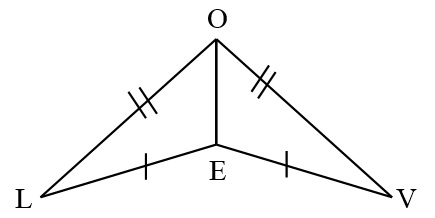
State if the triangles are congruent and why.
a)
Not congruent
b)
AAS
c)
SSS
d)
ASA
46.
State if the triangles are congruent and why.
a)
AAS
b)
ASA
c)
Not congruent
d)
SSS
47.

Using the Reflexive Property, which theorem proves that the triangles are congruent.

a)

SAS

b)

AAS

c)

ASA

d)

HL

48.

Using the fact that vertical angles are congruent, which theorem proves the triangles are congruent.

a)

SAS

b)

ASA

c)

AAS

d)

HL

49.
What is statement #1?
a)
BC≅DC
b)
AC≅EC
c)
BC≅DC, AC≅EC
d)
∆BCA≅∆DCE
50.
What is statement #2?
a)
∠ABC≅∠EDC
b)
∠BCA≅∠DCE
c)
BC≅CD
d)
∠E≅∠A
51.
What is reason #3?
a)
SAS
b)
ASA
c)
SSS
d)
AAS
52.

What is the "statement" for step 3 of the proof?

a)

HA=HA

b)

HA=AH

c)

MA=AM

d)

MA=MA

53.
What is always the 1st statement in reason column of a proof?
a)
Prove
b)
Given
c)
Reason
d)
Statement
54.
What is the "statement" for step 3 of the proof? 
a)
∡EDA≅∡DCB
b)
∡AED≅∡BEC
c)
DE=CE
d)
∡AED≅∡CED
55.
Determine if the triangles are congruent, if "yes" state the theorem.
a)
yes, SAS
b)
not congruent
c)
yes, ASA
d)
yes, AAS
56.
Which is NOT a test to prove triangles congruent?
a)
SAA
b)
SSS
c)
SSA
d)
SAS
57.
Use the congruence statement to find the missing part of the statement
a)
WV
b)
WU
c)
VU
d)
WB
58.

What is #4 Statement?

a)

∠MNL ≌ ∠ONP

b)

MN ≌ ON

c)

N ≌ N

d)

MO ≌ OM

59.

What is #3 Reason?

a)

Same Line

b)

Perpendicular Lines

c)

Segment Bisector

d)

Reflexive Property

60.

What is #3 Reason?

a)

Alternate Exterior Angles

b)

Alternate Interior Angles

c)

Vertical Angles

d)

Angle Bisector

61.

Which of the following is a correct statement and reason for the proof shown?

a)

GEQNEW\angle GEQ\cong\angle NEW Vertical

b)

WNGQ\overline{WN}\cong\overline{GQ} ; Prove

c)

GN\angle G\cong\angle N ; Alternate Interior

d)

WQ\angle W\cong\angle Q ; Alternate Interior

62.
State if the two triangles are congruent.  If they are, state how you know.
a)
A
b)
B
c)
C
d)
D
63.
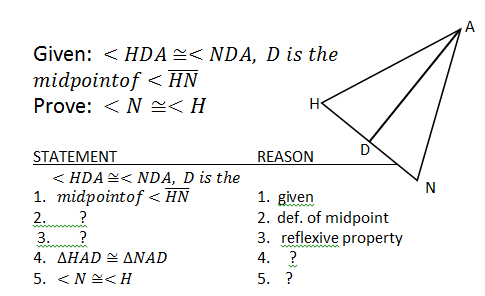
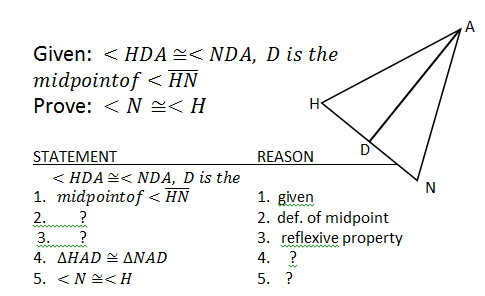
What is the "statement" for step 2 of the proof?
a)
AD=AD
b)
AD=DA
c)
HD=DN
d)
HA = AN
64.
What is the "statement" for step 3 of the proof?
a)
AD=DA
b)
AN = AH
c)
HD=ND
d)
HD=DN
65.
When using hypotenuse leg (HL) in a proof, you must first state ...
a)
CPCTC.
b)
there are right triangles.
c)
that vertical angles are congruent.
d)
the reflexive property.
66.
What is the justification (reason)?
a)
reflexive property
b)
definition of segment bisect
c)
definition of a midpoint
d)
substitution property
67.
What triangle congruence criteria is shown in the given diagram?
a)
ASA
b)
AAS
c)
SSA
d)
HL
68.
Fill in the missing proofs.
a)
Transitive Property, SAS(Side-Angle-Side)
b)
Reflexive Property, SAS(Side-Angle-Side)
c)
Reflexive Property, Vertical Angles Thm.
d)
Transitive Property, SSS(Side-Side-Side)
69.
What is reason #3?
a)
SAS
b)
ASA
c)
SSS
d)
AAS
70.
What is statement #4?
a)
∆HFG≅∆IHF
b)
∆FHG≅∆IHF
c)
∆GFH≅∆IFH
d)
∆HFG≅∆IFH
71.
What is reason #2?
a)
Vertical angles are congruent.
b)
Consecutive angles are congruent.
c)
Alternate interior angles are congruent.
d)
Definition of Bisect
72.
What is reason #4?
a)
Reflexive Property
b)
Definition of Midpoint
c)
Vertical angles are congruent.
d)
Given
73.
What is reason #5?
a)
SSS
b)
SAS
c)
ASA
d)
AAS
74.
What is statement #6?
a)
BC≅BC
b)
BC≅DA
c)
∠BCD≅BAC
d)
AB≅CD
75.
What is the "reason" for step 5 of the proof?
a)
Angle Bisector Theorem
b)
Reflexive property
c)
CPCTC Theorem
d)
Proof
76.
What are the 2 missing pieces of information?
a)
Transitive Property, SAS(Side-Angle-Side)
b)
Reflexive Property, SAS(Side-Angle-Side)
c)
Transitive Property, SSS(Side-Side-Side)
d)
Reflexive Property, SSS(Side-Side-Side)
77.
What is the "reason" for step 4 of the proof?
a)
proof
b)
AAS
≅ Thrm
c)
ASA
≅ Thrm
d)
SAS
≅ Thrm
78.

Which option does not work to prove triangles congruent?

a)

SSS

b)

SAS

c)

ASA

d)

HL

e)

SSA

79.
What is the "reason" for step 5 of the proof?
a)
Angle Bisector Theorem
b)
Reflexive property
c)
CPCTC Theorem
d)
Proof
80.
What is the "statement" for step 3 of the proof?
a)
HA=HA
b)
HA=AH
c)
MA=AM
d)
MA=MA
81.

Why is ∠KMJ ≌∠LJM?

a)

Alternate Exterior angles are congruent

b)

Alternate Interior Angles are congruent

c)

Corresponding Angles are Congruent

d)

Consecutive Interior angles are supplementary

82.
What congruency postulate proves the triangles congruency?
a)
SAS
b)
ASA
c)
SSS
d)
HL
83.
What additional information is required for the 2 triangles to be congruent by SSS?
a)
A
b)
B
c)
C
d)
D
84.
What additional information is required for the 2 triangles to be congruent by SAS?
a)
A
b)
B
c)
C
d)
D
85.
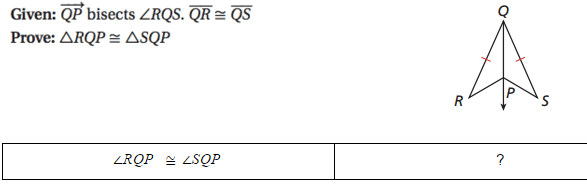
Identify the  missing statement or reason
a)
Given
b)
Vertical Angles Theorem
c)
Definition of Angle Bisector
d)
Alternate Interior Angles Theorem
86.
What is the "reason" for step 4 of the proof?
a)
proof
b)
AAS
≅ Thrm
c)
ASA
≅ Thrm
d)
SAS
≅ Thrm
87.
What is the "statement" for step 3 of the proof?
a)
AD=DA
b)
AD=AD
c)
HD=ND
d)
HD=DN
88.
What would be the correct "given" statements for this diagram?
a)
T is the midpoint of segment BG and
∡B≅∡G
b)
∡B≅∡G and ∡A≅∡W
c)
T is the midpoint of segment BG and ∡A≅∡W
d)
T is the midpoint of segment AW and ∡A≅∡W
89.
Rigid Motions preserve ...
a)
angle measure and side lengths
b)
angle measure
c)
side lengths
d)
they do not preserve anything
90.
Which of the following is NOT a triangle congruence criteria?
a)
SAS
b)
AAS
c)
SSA
d)
ASA
91.
What triangle congruence criteria is shown in the given diagram?
a)
AAS
b)
ASA
c)
SSA
d)
SAS
92.
Determine if the triangles are congruent, if "yes" state the theorem.
a)
not congruent
b)
yes, SSS
c)
yes, SAS
d)
yes, ASA
93.
Are the triangles congruent, if yes, why?
a)
SSS
b)
SAS
c)
ASA
d)
Not Congruent
94.
State if the two triangles are congruent.  If they are, state how you know.
a)
A
b)
B
c)
C
d)
D
95.
Can the triangles be proven congruent?  If so, how?
a)
ASA
b)
AAS
c)
SAS
d)
Cannot be proven congruent
96.
Can the triangles be proven congruent?  If so, how?
a)
ASA
b)
Cannot be proven congruent
c)
SAS
d)
SSS
97.
What missing piece of information is needed to prove the triangles congruent using ASA?
a)
GC = CD
b)
CE = CD
c)
∠GCE≅∠BCE
d)
BD = GE
98.
What missing piece of information is needed to prove the triangles congruent using SAS?
a)
NM = AM
b)
NL = CA
c)
∠M≅∠B
d)
∠N≅∠C
99.
What postulate proves these triangles congruent?
a)
SAS
b)
CPCTC
c)
AAS
d)
ASA
100.
What postulate proves these triangles congruent?
a)
SAS
b)
ASA
c)
AAS
d)
Not enough information
101.

Given: 1 and 3 are vertical angles. What should you conclude by the vertical angles theorem?

a)

1\angle1  and 3\angle3  are a linear pair

b)

undefined andundefined are right angles.

c)

23\angle2\cong\angle3  

d)

13\angle1\cong\angle3  

102.

Why are these 2 triangles congruent according to your proof?

a)

ASA

b)

SAS

c)

SSS

d)

Cannot be determined