
 Worksheets
Chemistry Packet 1 Test Review
Total questions: 50
Worksheet time: 30mins

Matter is made of tiny particles called atoms and molecules.
True
False

State of matter that takes the shape of it's container and has a definite volume.
Solid state
Liquid state
Gas state
Plasma state

State of matter that can fill containers with no fixed shape or volume.
Solid state
Liquid state
Gas state
Plasma state
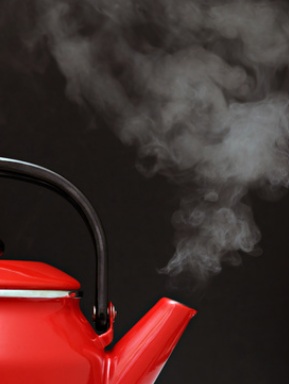
What change of state is taking place in this photograph?
Condensation
Freezing
Vaporization
Melting

What change of state is taking place in this photograph?
Condensation
Freezing
Vaporization
Melting

The diagram shows the changes in state of water (H2O). What is the process Z called?
Condensation
Freezing
Vaporization
Melting

Which of the following is a property of gases?
They have a definite volume.
They are not compressible.
They have no definite shape.
They have no ability to flow.

When a beaker of water is heated its volume increases a little. What is happening to the particles in the liquid?
They are getting bigger.
They are moving slower.
They are moving faster.
They are getting smaller.

When you place a bottle of water in the freezer its volume increases. What is happening to the particles in the liquid?
They are getting bigger.
They are moving slower.
They are moving faster.
They are getting smaller.

Which state of matter is represented in the following diagram?
Liquid
Liquid and gas
Gas
Solid

Which change of state occurs when particles in a solid begin to move slowly past each other?
Melting
Freezing
Condensing
Vaporizing

What is freezing?
Solid to gas
Gas to solid
Liquid to solid
Liquid to gas
The amount of space something takes up is its...
Volume
Mass
Temperature
Energy

What is it called when a solid turns directly into a gas?
Sublimation
Condensation
Melting
Freezing

What is it called when Gas change to Solid.
Sublimation
Condensation
Deposition
Freezing
All phase changes (changing states) requires energy to be added or taken away.
True
False
A substance has a melting point of 25 oC and a boiling point of 235 oC. What state is it at 5oC?
Solid
Liquid
Gas

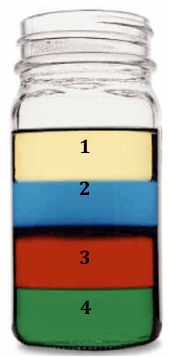

What is the center of an atom containing protons and neutrons?
nucleus
neutron
proton
electron cloud
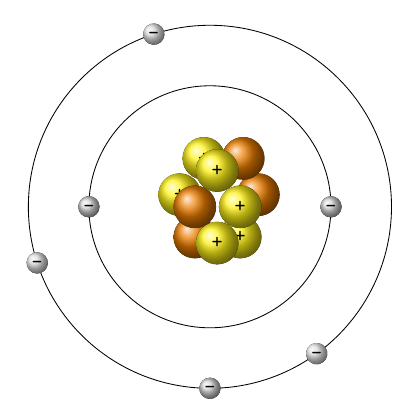
How many electrons does this atom have?
2
4
6
10

Knowledge Check:
Why does Sodium become a +1 charge?
Sodium gives away 1 e-, so it now has 1 less negative (-) charge.
Sodium accepts 1 e-, so it now has 1 more negative (-) charge.


Which of the following cannot be broken down into something simpler?
a compound
an element
a chemical formula
a mixture
Which of the following is not a compound?
HCl
Cl2
NaCl
CO2

Elements
are made of two or more types of atoms chemically bonded together
are made of one type of atom
are made of two or more types of molecules combined in the same space
are always individual atoms
Compounds
are made of two or more types of atoms chemically bonded together
are made of one type of atom
are found on the periodic table
can be separated into their individual parts through physical means
Mixtures
are made of two different types of atoms chemically bonded together
Are only liquids
Cannot be separated
Can be separated using physical properties
Pure Substances
Are only made of one type of atom
Have the same properties throughout
Can never be broken down into something simpler
Are only made of molecules
Which of the following are examples of Mixtures?
The atmosphere
Carbon Dioxide (CO2)
O2
Lemonade
Anything on the Periodic Table

What type of atom is element C?
Normal atom
Ion
Isotope

What is an ion?
An atom that has gained or lost an electron.
An atom that has gained or lost a neutron.
An atom that has gained or lost a proton.
An atom that is electrically neutral.

Chocolate Chip Ice Cream
HOMOGENEOUS
HETEROGENEOUS

Sugar
HOMOGENEOUS
HETEROGENEOUS

Black Coffee
HOMOGENEOUS
HETEROGENEOUS

Salad Dressing
HOMOGENEOUS
HETEROGENEOUS

Paint
HOMOGENEOUS
HETEROGENEOUS

