
 Worksheets
Gas Laws Review
Total questions: 55
Worksheet time: 48mins
Which of the following is the variable used for pressure?
n
P
V
T
Which of the following is the variable used for temperature?
n
P
V
T
Which of the following is the variable used for volume?
n
P
V
T
Which of the following is the variable used for atm?
n
P
V
T
Which of the following is the variable used for K?
n
P
V
T
What is the temperature in Kelvin for 25 C?
25 K
273 K
298 K
248 K
What is the standard temperature in K?
25 K
273 K
298 K
248 K
Which two variables have an indirect relationship? (Choose any two)
n
P
V
T
Hydrogen gas occupies 7.0 liters of volume at a pressure of 1.5 atmospheres. What is its volume when under a pressure of 3.10 atmospheres?
34
0.66
6.7
3.4
A gas having an initial temperature of 275 K, is under a pressure of 3.1 atm. What temperature will the gas read at 1.2 atm?
1023
710
106
0.014
A gas having an initial volume of 2.4 L is under standard conditions (STP). The volume expands to 6.2 L and the pressure doubles. What is the resulting temperature?
326
53
274
1410
An ideal gas is composed of____________
Gas molecules that are tightly bonded to one another with strong IMF's
Gas molecules that are far apart from each other
Gas molecules with a high mass
Gas molecules with a large molecular volume (not volume of container)
Gas molecules are most ideal at the following conditions:
High pressure and high temperature
Low pressure and low temperature
Low pressure and high temperature
High pressure and low temperature
Gas molecules are less ideal (more real) at the following conditions:
High pressure and high temperature
Low pressure and low temperature
Low pressure and high temperature
High pressure and low temperature
Under which conditions is He the most ideal?
200 K and 1 atm
400 K and 0.5 atm
400 K and 1 atm
200 K and 0.5 atm
Under which conditions does Ar deviate the most from the ideal gas law?
(when is it least ideal/more real)
100 K and 3.0 atm
500 K and 1.0 atm
200 K and 1.0 atm
200 K and 3.0 atm
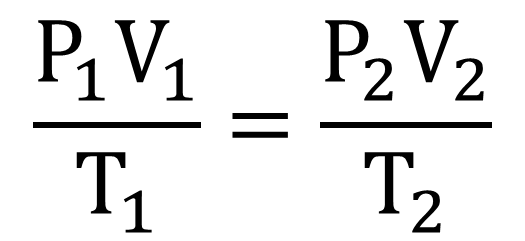
A sample of gas was collected in a 2.5 L bulb at 295K and 99kPa. What volume would the gas occupy at 273 K and 101 kPa?
2.3 L
2.6 L
2.75 L
0.44 L
If I initially have 4.0 L of a gas at a pressure of 1.1 atm, what will the volume be if I increase the pressure to 3.4 atm?
1.29 L
12.36 L
1.29 atm
12.36 atm
If I have 5.6 liters of gas in a piston at a pressure of 1.5 atm and compress the gas until its volume is 4.8 L, what will the new pressure inside the piston be?
1.8 atm
3.27 atm
1.8 L
3.27 atm
I’ve got a car with an internal volume of 12,000 L. If I drive my car into the river and it implodes, what will be the volume of the gas when the pressure goes from 1.0 atm to 1.4 atm?
8571.43 L
3210.26 L
8669.0 atm
3905.33 atm

A sample of sulfur dioxide occupies a volume of 652 mL at 313 K and 150 kPa. What volume will the sulfur dioxide occupy at STP?
STP = 273 K, 101.3 kPa
1682.6 mL
20.7 mL
492.3 mL
842.1 mL
As pressure increases, volume decreases. Describe the relationship:
Direct Relationship
Inverse Relationship
No Relationship
As temperature increases, volume increases. Describe the relationship:
Direct Relationship
Inverse Relationship
No Relationship
As pressure increases, temperature increases. Describe the relationship:
Direct Relationship
Inverse Relationship
No Relationship

A quantity of gas has a volume of 250 L, at 290 K and 303.98 kPa of pressure. What volume must the gas be for the gas to be at 273 K and 101.33 kPa?
78.4 L
88.5 L
706 L
771 L

What volume of methane gas at 273 K and 101.33 kPa do you have when the volume is decreased to 0.50 L, with a temperature of 300 K and a pressure of 151.99 kPa.
0.68 L
0.82 L
0.50 L
0.37 L

If 3.0 L of helium at 293 K with a pressure of 200 kPa is allowed to expand to 4.4 L with the pressure staying constant. What is the new temperature?
702 K
430 K
157 K
0 K
If a hairspray can is heated, what can be expected of the pressure of the gas inside the can?
The pressure will increase
The pressure will decrease
The pressure will remain constant
The pressure will equalize

A gas is heated from 263K to 298K. The volume is increased from 24.0L to 35.0L. If the original pressure was 101.33 kPa, what is the new pressure?
78.7 kPa
167.2 kPa
129.7 kPa
61.8 kPa

A weather balloon has a volume of 105 L at 98.3 kPa when the temperature is 318 K. What is the volume at 293 K and 106.4 kPa?
89.4 L
0.32 L
93.8 L
3.13 L
If I have 5.6 liters of gas in a piston at a pressure of 1.5 atm and compress the gas until its volume is 4.8 L, what will the new pressure inside the piston be?
1.8 atm
3.27 atm
1.8 L
3.27 atm
If I initially have 4.0 L of a gas at a pressure of 1.1 atm, what will the volume be if I increase the pressure to 3.4 atm?
1.29 L
12.36 L
1.29 atm
12.36 atm
How do you convert Kelvin to Celsius?
Add 273
Subtract 273
You can't convert those
They are the same thing
What happens to pressure when temperature decreases
increase in pressure
decrease in pressure
no change
What is the relationship between volume and pressure?
flipped
direct
inverse
none

what relationship does this graph show?
temperature and pressure- direct
temperature and pressure- inverse
pressure and volume- direct
pressure and volume- inverse
As pressure increases, temperature increases. Describe the relationship:
Direct Relationship
Inverse Relationship
No Relationship
Which rigid cylinder contains the same number of gas molecules as a 2.0 Liter rigid cylinder containing hydrogen gas?
1.0 L of Oxygen gas
2.0 L of methane gas
1.5 L of ammonia gas
4.0 L of Helium gas
Absolute zero is
0 K
0 degrees C
0 degrees F
-273 K
What quantity is not in the combined gas law?
pressure
temperature
volume
moles
What is the volume of one mole of gas at STP?
22.7
22.4
8.314
0.0821
What is the temperature at STP? Pick all that are correct
1 atm
770 torr
0 degrees C
273 K
What is the pressure at STP?
1 atm
770 torr
0 degrees C
273 K
P1= 1 atm
P2 = 4 atm
V1= 2 L
V2 = ?
0.5 L
1.0 L
2.0 L
4.0L
V1 = 500 mL
V2 = 250 mL
T1 = 200 K
T2 = ?
100 K
200 K
400 K
50 K
Pressure is
defined as the mass that an object exerts when at rest.
not a measurable in gases.
defined as the number of moles of substance divided by the mass of the substance.
created by the force of the gas particles impacting the walls of the container.

