
 Worksheets
H Marine Communities
Total questions: 69
Worksheet time: 1hrs 7mins

A tendency to maintain a balanced or constant internal state; the regulation of any aspect of body chemistry, such as blood glucose, around a particular level
hormones
homeostasis
disease

Loops that cause a response to build up and build up until something big happens are called ____________ loops
positive
negative
Labor during pregnancy is an example of a ____________ feedback loop
positive
negative
Blood clotting is an example of a ____________ feedback loop
positive
negative
The heater kicks on and the house warms up, so it kicks off. Then the house cools a bit and the heater kicks back on. This continues all day. It's a _____________ loop.
positive
negative
Most of the body's feedback loops are ____________ loops.
positive
negative
Blood sugar regulation is an example of a ______________ loop
positive
negative
Body temperature regulation is an example of a ______________ loop
positive
negative
In a positive feedback loop, each action creates a consequence that _____________________ the other action.
decreases
has no effect on
amplifies
When the population of deer in an area begin to grow, they start overgrazing the vegetation that feeds them. When there is not enough vegetation to sustain the rapidly growing deer population, they will begin to die off until the vegetation grows back to normal levels and the deer will have enough food to repopulate again.
Positive
Negative
A organization posts an advertisement with a very "click-baity" title and image on a social media platform. The title and image draw in people to click on the ad. As the ad receives more views, the algorithm shows the ad to more people.
Positive Feedback Loop
Negative Feedback Loop
In some developing countries poverty causes illness and contributes to poor standards of education. In the absence of knowledge of family planning methods and hygiene, this contributes to population growth and illness, adding further to the causes of poverty; “a vicious circle of poverty.”
Positive Feedback Loop
Negative Feedback Loop
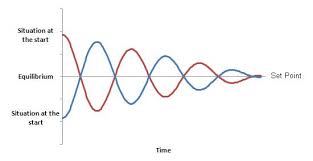
Does the graph show positive or negative feedback?
Positive, because when the red line shifts, the blue one does also
Negative, because the blue line starts below equilibrium
Negative, because the two actions are keeping each other near equilibrium
Both positive and negative because the graph moves up and down
The things that are changing in an experiment
Variables
Questions
Hypothesis
Data
The one thing that a scientist changes in their investigation
Variable
Independent variable
data
Hypothesis
What the scientist is measuring in their investigation.
Dependent variable
variable
hypothesis
data
What is a constant in an experiment?
Things that do not change in a experiment. It's the variable that stays the same. You can have many variables stay the same.
It's the variables that the scientist changes in the experiment
It's the variables that are being measured in an experiment
What would the independent variable be in an experiment testing which type of paper airplane goes the furthest?
the type of paper used.
the distance each plane flies.
how hard the plane is thrown.
the type of paper airplane.
This part of the experiment serves as a basis of comparison:
control group
Independent variable
dependent variable
data

A species that plays a critical role in the health, maintenance, growth, or definition of an ecosystem.
keystone
invasive
engineer
predator

Which of the following would be the most likely effect, if there were a sudden increase in the cricket population?
There would be a decrease in the small bird population.
There would be a decrease in the grass/flowers population.
There would be a decrease in the mice population.
There would be an increase in the grass/flowers population.

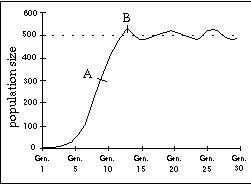
What type of growth is this graph representing
Logistical Growth
Exponential Growth

What type of growth is this graph representing?
Logistical Growth
Exponential Growth
Biotic or Abiotic factor that restricts the growth of the population
carrying capacity
limiting factor
abiotic factor
biotic factor

In the graph to the right, what is the population of deer at the carrying capacity of the environment?
3
7
70
40

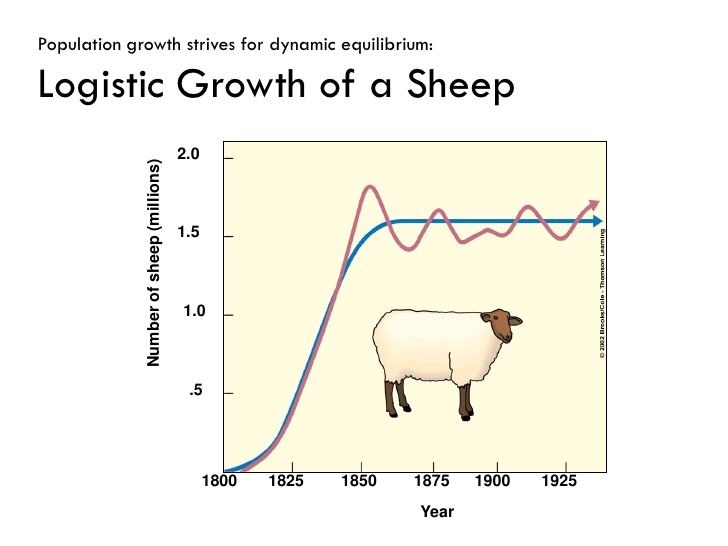

What happens if a population grows past its carrying capacity?
The population keeps growing
The population starts to die off
The entire species will go extinct
The carrying capacity just increases
Long life span
K-selected
r-selected
many years to reach reproductive maturity
K-selected
r-selected
many reproductive events
K-selected
r-selected
many offspring
K-selected
r-selected
size of offspring is small
K-selected
r-selected
substantial parental care is given
K-selected
r-selected
population growth rate is fast
K-selected
r-selected
population growth rate is slow
K-selected
r-selected
population dynamic; stable, near carrying capacity
K-selected
r-selected
elephant
K-selected
r-selected
mosquitos
K-selected
r-selected
Organisms with the “best” traits (adaptations) will live longer and reproduce more than others, causing changes in the population over time by acting on traits that are heritable.
Fitness
Adaptation
Variation
Natural Selection
A measure of how well you can survive in your environment
Adaptation
Variation
Fitness
Overproduction of offspring
Lots of offspring and limited resources causes competition for those resources.
Overproduction of offspring
Natural selection
variation
adaptation
differences in the physical traits of organisms
overproduction of offspring
Variation
adaptation
Descent with modification
a feature that allows an organism to better survive in its environment.
Variation
Descent with modification
overproduction of offspring
adaptation
A change in gene frequency over time.
Variation
Descent with modification
overproduction of offspring
adaptation
any change in a DNA sequence
Mutations
Natural Selection
Genetic Drift
Gene Flow
Having a large beak in an environment that needs the large beak to survive is an example of ______________.
adaptation
fitness
natural selection
variation

individuals with alleles for an extreme type are more likely to survive and reproduce
stabilizing selection
directional selection
disruptive selection
genetic drift

the selection pressure favors the extreme phenotypes, dividing the population into 2 distinct groups
directional selection
stabilizing selection
geographic selection
disruptive selection

Individuals with intermediate traits are more likely to survive and reproduce
stabilizing selection
directional selection
adaptive radiation
disruptive selection
Tall kelp have a distinct advantage over shorter kelp in receiving needed sunlight in their ocean environment
directional selection
disruptive selection
stabilizing selection
sexual selection
artificial selection
Aspen trees that are over 25 m tend to blow over in high winds; aspen that are under 15 m don't get enough sun
directional selection
stabilizing selection
disruptive selection
artificial selection
sexual selection

snails with a forward spiral and snails with a backward spiral have an advantage in their environment
directional selection
stabilizing selection
disruptive selection
artificial selection
sexual selection
Light-colored oysters would blend into the rocks in the shallows, and the darkest would blend better into the shadows. The ones in the intermediate range make them easier prey.
directional selection
stabilizing selection
disruptive selection
artificial selection
sexual selection

Label the natural selection graphs correctly...
1 Stabilizing, 2 Directional, 3 Disruptive
1 Disruptive, 2 Stabilizing, 3 Directional
1 Directional, 2 Stabilizing, 3 Disruptive

Starlings produce an average of five eggs. If there are more than five the parents cannot adequately feed the young. Fewer than five and predators may destroy them. As a result, five eggs becomes the most common number.
Stabilizing
Directional
Disruptive

A population of Madagascar hissing cockroaches lives in a woodpile. The cockroaches are eaten by lizards. Because the lizards have small heads, the lizards are unable to eat the very largest adult cockroaches, and instead prey upon small and medium sized adults. Over time, only the large headed lizards survive.
Stabilizing
Directional
Disruptive

Female birds that lay close to the optimum number of eggs have the most surviving offspring. Those that lay fewer or more eggs have lower relative fitness.
Stabilizing
Directional
Disruptive

