Wayground logo

Free Printable Worksheets

Font size

S
M
L
XL
Worksheets

Astro.U3.Q1

Total questions: 20

Worksheet time: 20mins

Name
Class
Date
1.
What celestial body eventually evolved into our modern solar system?
a)
a nebula
b)
a supernova
c)
a quasar
d)
a galaxy
2.
Smaller particles collecting together into larger and larger objects is called . . .
a)
accretion
b)
contraction
c)
explosion
d)
rotation
3.
The Nebular Theory is:
a)
A theory on how the Milky Way galaxy was formed
b)
A theory on how the universe was formed
c)
A theory on how the solar system will be destroyed
d)
A theory on how the solar system was formed
4.
A nebula starts to collapse because of:
a)
A nearby star shining it's light
b)
A passing spaceship
c)
A passing comet
d)
Gravity
5.
As a nebula collapses it also begins:
a)
Expand
b)
Rotate
c)
Shake
d)
Turn to ice
6.
The group of inner planets are known as:
a)
The Terrestrial Planets
b)
The Gas Giants
c)
The Outer Planets
d)
The Hallow Planets
7.
What caused the lighter elements to leave the terrestrial planets?
a)
Gravity from the Gas Giants
b)
Nothing, the lighter elements stayed
c)
Gravity from the Sun
d)
Heat from the Sun
8.
The group of outer planets are known as:
a)
The Terrestrial Planets
b)
The Gas Giants
c)
The Inner Planets
d)
The Rocky Planets
9.
The shape of the planets and dwarf planets after accumulating all their material is:
a)
Irregular
b)
A Sphere
c)
An Oval
d)
A disk
10.

Where in our solar system would you expect to find a planet that is mostly made of gas?

a)

very close to the sun

b)

outside of the sun's gravitational pull

c)

very far from the sun

d)

very close to other planets

11.

Where would you expect to find a planet that is small, dense, and rocky?

a)

close to the sun

b)

outside of the sun's gravitational pull

c)

far away from the sun

d)

close to the gas planets

12.

The streak of light that is seen when a space rock enters the planet's atmosphere.

a)
meteor
b)
meteorite
c)
asteroid
d)
comet
13.
Objects made of ice, gas and dust and orbit our sun are called:
a)
Asteroids
b)
Comets
c)
Meteroids
d)
Meteors
14.
When a meteoroid STRIKES the surface of the earth scientists refer to them as:
a)
Asteroids
b)
Comets
c)
Meteors
d)
Meteorites 
15.

The moon was formed when a _____ smashed into Earth, spreading debris into orbit that then _____ to form the moon.

a)

asteroid, froze

b)

planetesimal, accreted

c)

comet, accreted

d)

planetesimal, froze

16.
Planets orbit the Sun in a shape called a(n)
a)
circle
b)
ellipse
c)
focus
d)
perihelion
17.
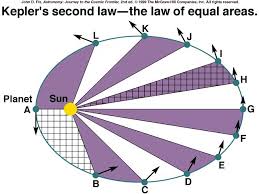
Where is the planet moving faster
a)
Position A to B
b)
Position B to C
c)
Position H to I
d)
Position I to J
18.

Kepler's 2nd Law deals with

a)

the shape of the planets' orbits

b)

the area the planet travels

c)

the length of time/period it takes the planet to orbit the sun

19.
A planet moves __________ when it is farthest from the sun.
a)
faster
b)
slower
20.
The farther away a planet is from the sun, the _______ it takes it to orbit the sun once. 
a)
longer
b)
shorter