Worksheets
Waves Into & Properties
Total questions: 33
Worksheet time: 11mins
Which of the options is the scientific explanation for a WAVE?
Any disturbance that transfers energy from place to place
Something you can surf on.
A transfer of thermal energy from one medium to another.
When molecules disperse as a result of Charles' Law
What is a medium?
Someone that talks to ghosts.
A material/matter in which a wave travels through.
The length of a transverse wave.
An absence of all matter
Which type of wave must have a material to transfer through?
Electromagnetic radiation
Mechanical waves

What wave feature is B indicating on the diagram?
crest
trough
amplitude
wavelength
What wave feature is D indicating on the diagram?
crest
trough
amplitude
wavelength
What wave feature is C and E indicating on the diagram?
crest
resting position
amplitude
wavelength
What term does the following sentence describe?
The distance between the highest point of a wave crest and the resting position of the wave is the _________.
frequency
amplitude
trough
resting position
True or false?
A transverse wave travels perpendicular (at 90 degree/right angles) to the direction of the wave source's energy?
True
False
Which wave travels in the SAME DIRECTION as the vibrations that are produced my the source?
Longitudinal
Transverse

What type of wave does this image display?
Transverse wave
Longitudinal wave
You place a ping pong ball in a wave machine that is producing transverse waves. Which of these statements is true about the ball?
The ball will travel in the direction of the wave
The ball will travel against the direction of the wave.
The ball will bob up and down and remain in the same position.
The ball will sink below the surface of the water.
Fill in the blank:
The distance a wave travels from crest to crest in know as the _________.
Frequency
Wave length
trough
refraction

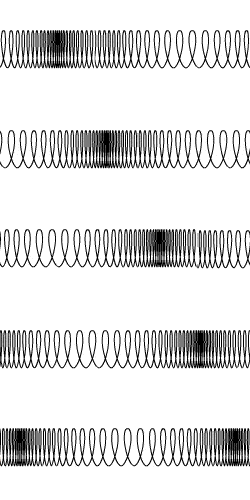
What is letter A indicating?
Wave compression
Wave rarefaction
What is letter B indicating?
Wave compression
Wave rarefaction
Which of the following is not a type of mechanical wave?
Transverse
Standing
Longitudinal
Surface
If the frequency of a wave increases and the wave is traveling at a constant speed, what happens to its wavelength?
It increases
It decreases
It does not change
The distance between 2 high points (or low points) in a wave.
frequency
wavelength
crest
trough
Mechanical waves that travel through a medium moving back and forth in the same direction the wave travels
Longitudinal wave
Transverse wave
Surface wave
A substance (like solid, liquid or gas) that the energy of a wave can travel through
amplitude
compression
medium
frequency
The measurement of highest point (or lowest point) in a wave when compared to resting position.
medium
transverse wave
crest
amplitude
The rate at which something repeats over time.
wavelength
amplitude
frequency
mechanical wave
These waves can travel through a solid, liquid or gas.
wavelength
mechanical
amplitude
frequency
The area of a longitudinal wave where the particles are crowded together.
compression
crest
transverse
medium
Which type of wave requires TWO mediums?
Transverse Wave
Surface Wave
Mechanical Wave
Longitudinal Wave

Determine the wavelength of this wave.
1m
2m
3m
4m

A wave has a frequency of 8 Hz and a speed of 32m/s meters. By using formula above, what is the wavelength of the wave?
2 meter
3 meter
4 meter
5 meter
The number of waves that pass a fixed point in a given amount of time is...
frequency
wave speed
amplitude
wavelength
The length of one complete wave cycle is...
frequency
wave speed
amplitude
wavelength
The bigger the amplitude, the ________ energy carried by the wave.
more
less