wayground logo

Free Printable Worksheets

Font size

S
M
L
XL
Worksheets

Midterm Review P1

Total questions: 32

Worksheet time: 23mins

Name
Class
Date
1.

What macromolecule is shown?

a)

Protein

b)

Nucleic Acid

c)

Carbohydrate

d)

Lipid

2.

What is the monomer of a lipid?

a)

Amino Acid

b)

Fatty Acid

c)

Monosaccharides

d)

Glucose

3.

What is the function of carbohydrates?

a)

Short term energy

b)

Long term energy

c)

Storing genetic information

d)

Speeding up chemical reactions

4.

What is one of the functions of lipids?

a)

Storing genetic information

b)

Long Term Energy

c)

Short Term Energy

d)

Acting as chemical signals

5.

What is the function of nucleic acids?

a)

Short Term Energy

b)

Storing Genetic Information

c)

Long Term Energy

d)

Speeding Up Chemical Reactions

6.

What macromolecule is shown?

a)

Nucleic Acids

b)

Lipids

c)

Proteins

d)

Carbohydrates

7.

What macromolecule is shown?

a)

Carbohydrate

b)

Nucleic Acid

c)

Protein

d)

Lipid

8.

What macromolecule is shown?

a)

Lipids

b)

Proteins

c)

Carbohydrates

d)

Nucleic Acids

9.

What element if the building block of life?

a)

Carbon

b)

Hydrogen

c)

Oxygen

d)

Nitrogen

10.

Which of the following is NOT a macromolecule?

a)

Fiber

b)

Carbohydrates

c)

Amino Acid

d)

Monosaccharides

11.

A ______________ is a large molecule.

a)

Micromolecule

b)

Polymer

c)

Amino Acid

d)

Macromolecule

12.

Which of the following are examples of carbohydrates? (Select all that apply).

a)

Bread

b)

Pasta

c)

Olive Oil

d)

Cheese

13.

An avocado is an example of a which macromolecule?

a)

Carbohydrate

b)

Lipid/Fat

c)

Protein

d)

Nucleic Acid

14.
Proteins are made of monomers called ___________
a)
Nucleotides
b)
Monosaccharides
c)
Amino Acids
d)
Glycerol and fatty acids
15.
Nucleotides are monomers of
a)
Carbohydrates
b)
Lipids
c)
Proteins
d)
Nucleic Acids
16.
Monosaccharides are monomers of
a)
Carbohydrates
b)
Lipids
c)
Proteins
d)
Nucleic Acids
17.
Waxes, oils and fats are examples of
a)
Carbohydrates
b)
Lipids
c)
Proteins
d)
Nucleic Acids
18.
Glycerol and fatty acids are the monomers of
a)
Carbohydrates
b)
Lipids
c)
Proteins
d)
Nucleic Acids
19.

An example of simple sugar (monosaccharide).

a)

glucose

b)

sucrose

c)

starch

d)

glycogen

20.

Two examples of much larger sugar molecules (polysaccharides).

a)

starch

b)

sucrose

c)

glucose

d)

glycogen

21.

What is the polysaccharide used by animals to store glucose?

a)

glycogen

b)

fructose

c)

starch

d)

cellulose

22.

Which polysaccharide is used by plants to make their cell wall?

a)

starch

b)

glycogen

c)

cellulose

d)

chitin

23.

Enzymes are an example of

a)

Lipids

b)

Carbohydrate

c)

Protein

d)

Nucleic Acid

24.
What is the purpose  of an enzyme?
a)
give permission for the reaction
b)
raise activation energy
c)
speed up reactions
d)
control how many reactions occur
25.
What 3 letters do enzymes typically end in?
a)
-ose
b)
-ase
c)
-ese
d)
-tic
26.
Any substance that is acted upon by an enzyme is called a(n)?
a)
Coenzyme
b)
Substrate
c)
Vitamin
d)
Polypeptide
27.
After the enzyme and substrate bind together and perform the reaction, what does the substrate become?
a)
a substrate
b)
an enzyme
c)
a product
d)
an active site
28.
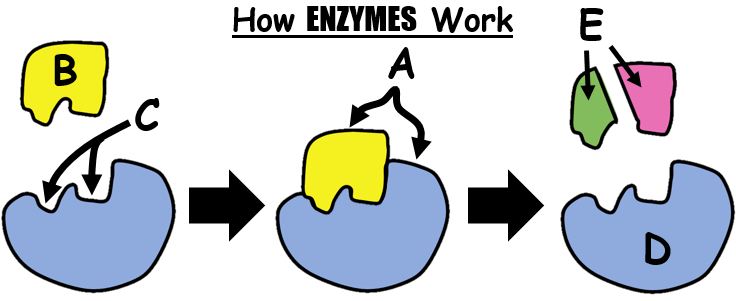
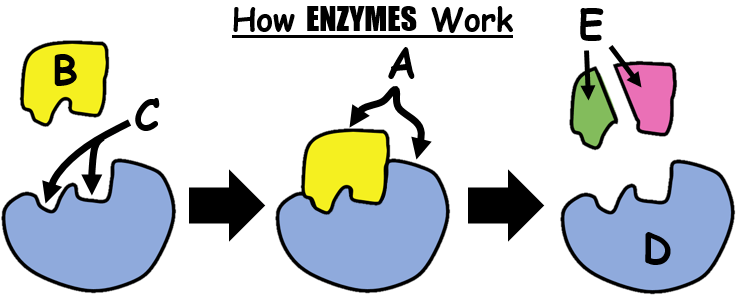
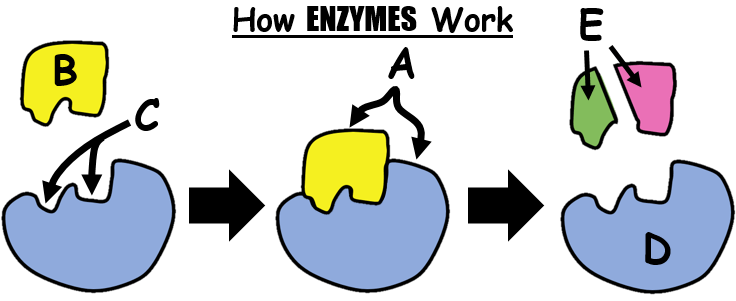
In the diagram, what is letter A? 
a)
product
b)
substrate
c)
enzyme-substrate complex
d)
active site
29.
Letter D...
a)
active site
b)
enzyme
c)
substrate
d)
products
30.
Letter B...
a)
active site
b)
enzyme
c)
substrate
d)
products
31.
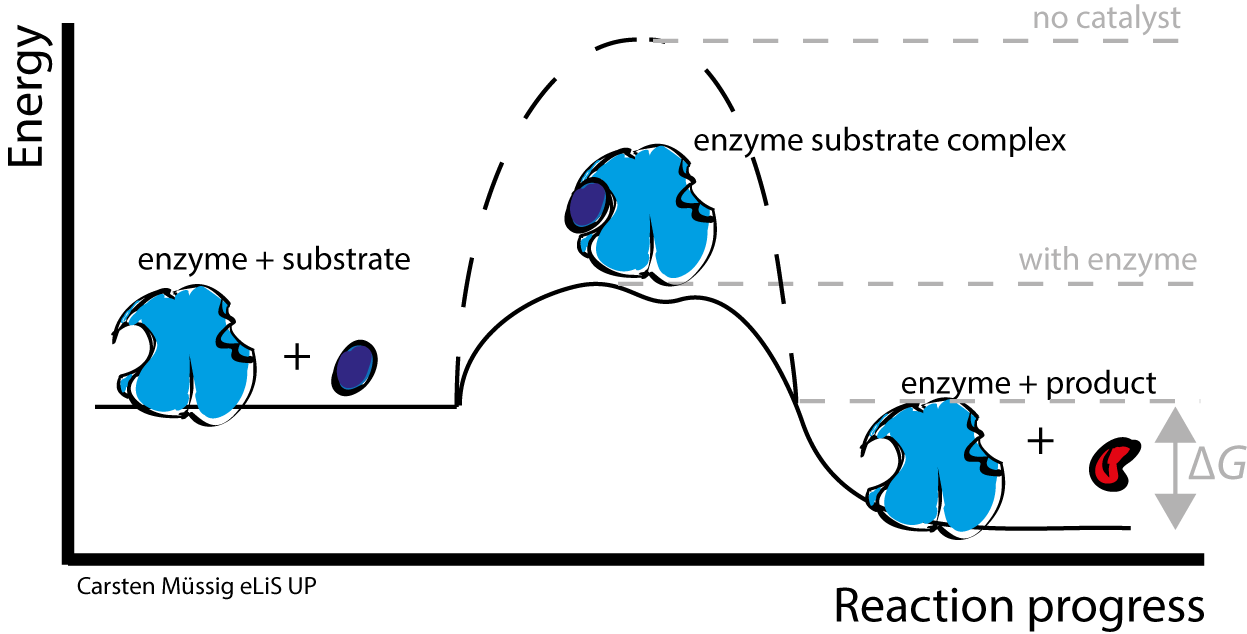
An enzyme speeds up a reaction by
a)
lowering the activation energy.
b)
raising the activation energy.
c)
releasing energy.
d)
absorbing energy.
32.

Changes in pH and temperature can ___________________ an enzyme which causes it to lose its shape and affects its function.

a)

puncture

b)

denature

c)

double

d)

delete