wayground logo

Free Printable Worksheets

NEW

Font size

S
M
L
XL
Worksheets

Plate Tectonics Review

Total questions: 45

Worksheet time: 15mins

Name
Class
Date
1.

The process of hot stuff becoming less dense and rising, then cooling and becoming more dense and sinking is called

a)

conduction

b)

convection

c)

radiation

d)

subduction

2.

The idea that the continents were once joined together in one large landmass that then broke apart and slowly drifted to where they are today is called the

a)

seafloor spreading theory.

b)

plate tectonics theory.

c)

continental drift theory.

3.

Wegener's supercontinent was known as

a)

Glossopteris

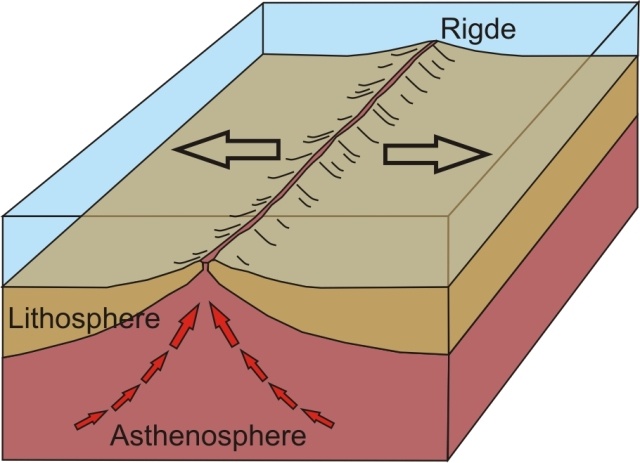
b)

Eurasia

c)

Pangea

d)

Gondwandaland

4.

The lithosphere (crust) is broken into sections called

a)

plates

b)

faults

c)

ridges

d)

trenches

5.

The movement of tectonic plates are generally thought to be caused by

a)

volcanoes.

b)

convection currents.

c)

earthquakes.

d)

wind.

6.

The process of magma rising from the mantle and spreading out at the mid-ocean ridge is called

a)

trenching

b)

seafloor spreading

c)

continental drift

d)

tectonicking

7.

Really big mountains form at which boundary?

a)

divergent

b)

convergent

c)

transform

8.

Seafloor spreading occurs at which type of boundary?

a)

divergent

b)

convergent

c)

transform

9.

The San Andreas Fault is located on a ____ boundary.

a)

divergent

b)

convergent

c)

transform

10.

Plates collide at a ___ boundary.

a)

divergent

b)

convergent

c)

transform

11.

Plates move apart at a ___ boundary.

a)

divergent

b)

convergent

c)

transform

12.

Plates slide past each other at a ____ boundary.

a)

divergent

b)

convergent

c)

transform

13.

Convection currents in the outer core create Earth's

a)

magnetism

b)

gravitational pull.

c)

earthquakes.

d)

weather.

14.

Convection currents occur in the....

a)

Lithosphere.

b)

Asthenosphere.

c)

lower mantle.

d)

Inner Core.

15.

What are the two different types of crust?

a)

Continental and Oceanic

b)

Lithosphere and Mesosphere

c)

Nazca and Eurasian

d)

Laurasia and Gondwana

16.

A subduction zone is where two plates do what?

a)

Collide and one is pushed under and destroyed

b)

Spread apart to form new crust

c)

Collide and form mountains

d)

Separate and form new continents

17.

Does temperature increase or decrease the closer you get to the core?

a)

Decrease

b)

Increase

18.

Does pressure increase or decrease the closer you get to the core?

a)

Decrease

b)

Increase

19.

Which layer of the core is made of solid metal?

a)

Inner Core

b)

Outer Core

20.
The outermost solid layer of the Earth is called the
a)
mantle
b)
outer core
c)
inner core
d)
crust
21.
This is the outermost, rigid layer of the Earth, made up of two parts, is divided into pieces call tectonic plates.
a)
Inner Core
b)
Asthensophere
c)
Lithosphere
d)
Outer Core
22.
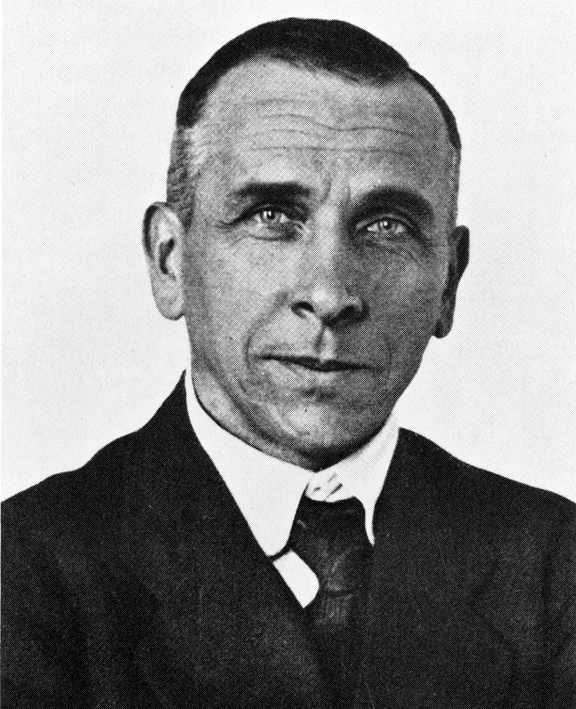
Who is the person credited with developing the theory of continental drift?
a)
Harry Hess
b)
Galileo
c)
Alfred Wegener
d)
Newton
23.
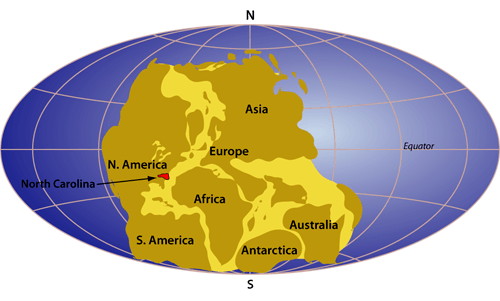
What is this a picture of?
a)
plate tectonics
b)
continental drift
c)
pangea
d)
glacier scaring
24.
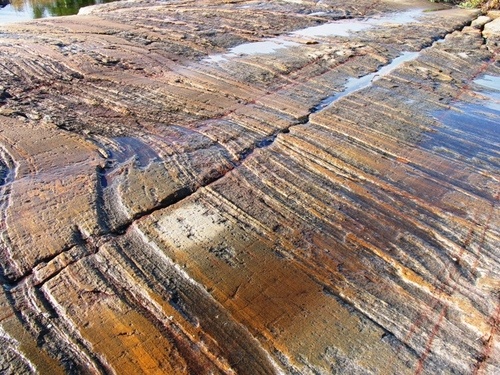
This is a picture of glacier scars found in Africa.  What are these evidence for?
a)
Africa has always been near the equator
b)
Africa was once in an area of the Earth that had a very cold climate
c)
The continents have not moved
d)
sea floor spreading
25.
What does the theory of continental drift state?
a)
The continents were once joined in a super-continent and have moved over time
b)
Continents are stationary and do not move
c)
The Earth is broken into lithospheric plates that move due to convection currents
d)
none of the above
26.
What evidence did Wegener use in his theory?
a)
Continents and fossils fitting together/matching-up like puzzle pieces 
b)
glacier scars and evidence from temperature
c)
mountain ranges and coal deposits line up across continents
d)
all of the above
27.
Why did no one believe Wegener's thoery?
a)
He could not explain HOW the continents moved
b)
He didn't have evidence
c)
His data was wrong
d)
He didn't use the right technology to gather data
28.
Which layer of the earth is under the highest pressure?
a)
Crust
b)
Mantle
c)
Outer Core
d)
Inner Core
29.
Contains molten (hot liquid) iron and nickel.
a)
outer core
b)
inner core
c)
mantle
d)
crust
30.

The oldest seafloor is located?

a)

Closest to the mid-ocean ridge

b)

Farthest from the mid-ocean ridge

31.
True or False : Sea-floor Spreading adds new material to the ocean floor?
a)
True
b)
False
32.
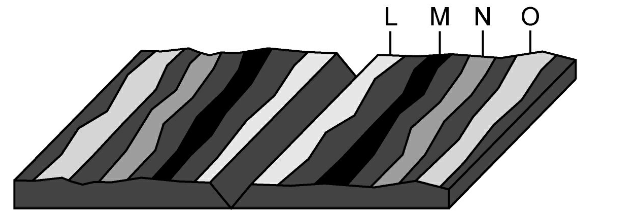
Where would the oldest rock be found?
a)
L
b)
M
c)
N
d)
O
33.

The process in which a denser plate is pushed beneath a less dense plate.

a)

Trenches

b)

Divergent Boundary

c)

Lithosphere

d)

Subduction

e)

Tectonic Plates

34.

The deepest parts of the ocean; long, narrow ditches

a)

Trenches

b)

Divergent Boundary

c)

Lithosphere

d)

Subduction

e)

Tectonic Plates

35.

Part of the cycle of recycling seafloor material includes it getting destroyed. This occurs...

a)

through weathering and erosion of exposed rock layers.

b)

as a result of violent and constant volcanic activity.

c)

at trenches where rock material is subducted.

d)

when elements in rock are rearranged chemically.

36.

Seafloor spreading occurs because ____.

a)

new material is being added to the asthenosphere

b)

earthquakes break apart the ocean floor

c)

sediments accumulate at the area of spreading

d)

molten material beneath Earth's crust rises to the surface

37.

What particular event is shown on the picture?

a)

mid-ocean ridge

b)

subduction zone

c)

transform boundary

d)

divergent boundary

38.
What kind of plate boundary is shown here?
a)
divergent
b)
convergent
c)
transform
d)
submergent
39.
What kind of plate boundary is shown here?
a)
divergent
b)
convergent
c)
transform
d)
subducting
40.
What kind of plate boundary is shown here?
a)
divergent
b)
convergent
c)
transform
d)
strike slip
41.
What geologic feature/event you be most likely to find at a transform boundary?
a)
Earthquakes
b)
Volcanoes
c)
Mountains
d)
Rift Valleys
42.
What geologic feature/event would you most likely to find at a divergent boundary between two pieces of oceanic crust?
a)
Rift Valley
b)
Mid-Ocean Ridge
c)
Island Arc
d)
Flat land
43.
What geologic feature/event would you most likely to find at a divergent boundary between two pieces of continental crust?
a)
Mid-Ocean Ridge
b)
Mountain
c)
Rift Valley
d)
Island Arc
44.
What geologic feature/event would you most likely to find at a convergent boundary between two pieces of continental crust?
a)
Volcano
b)
Mountain
c)
Rift
d)
Island Arc
45.
The area where two or more plates meet is called a __________________.
a)
fault
b)
plate boundary
c)
plate edge
d)
ring of fire