
 Worksheets
Ecology
Total questions: 62
Worksheet time: 1hrs 15mins
What would be a good example of a primary consumer?
carnivore
detrivore
decomposer
herbivore

The monkey would be a
decomposer
producer
primary consumer
secondary consumer

What type of relationship is this?
parasitism
mutualism
commensalism
competition

symbiotic relationship in which both organisms benefit
competition
mutualism
predation
commensalism


What is a niche?
The habitat that an organism lives in
An organism’s “role” in an ecosystem
A type of consumer
The relationship between a producer and consumer

Rabbits introduced into Australia over 100 years ago have become a serious pest to farmers. Rabbit populations increases so much that they displaced many native species of plant eaters. What is the most logical explanation for their increased numbers?
Rabbits have a high death rate.
There are few effective predators.
Additional rabbit species have been introduced.
There is an increase in rabbit competitors.

All organisms, that are not plants, get their energy from the sun ______________________.
directly
immediately
indirectly
slowly

90% of the energy that gets lost as you move up a food pyramid or chain gets lost as
pollution to the environment
heat to the environment
energy for decomposers
gets recycled
In some environments, wolves prey on deer for their source of food. If all of the wolves were taken from the environment, what would most likely happen to the deer population?
A The deer population would increase and begin to compete for food.
B The deer population would become larger and healthier animals.
C The deer population would decrease, because there would be an increase in disease.
D The deer population would change color, because they would not have to hide from wolves.
High biodiversity is a sign of a healthy ecosystem.
True
False
An organism that gets energy from eating other organisms is a ______________.
producer
consumer
decomposer
prey

The arrows most likely represent. . . ..
Energy released from metabolism into the environment as heat
Oxygen released from metabolism produced by cellular respiration
The absorption of energy from the environment that has been created
The transport of glucose away from the organism through photosynthesis

Predation

Symbiosis

Commensalism

Parasitism
A condition that occurs when two or more organisms compete for the same resources
competition
predation
parasitism
mutualism

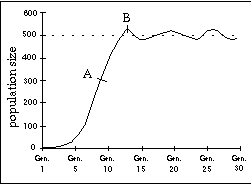
In the graph to the right, what is the population of deer at the carrying capacity of the environment?
3
7
70
40
What will happen if all of the frogs in a population die?
The frogs' predators will decrease and the frogs' prey will increase
The frogs' predators will increase and the frogs' prey will decrease
We better all pray because there isn't anymore frogs.

What happens if a population grows past its carrying capacity?
The population keeps growing
The population starts to die off
The entire species will go extinct
The carrying capacity just increases

What is a population?
One individual member of a species
a group of individuals that belong to the same species and live in the same area
all the different populations of species that live together in an area
a community of species and the physical environment

What is a community?
One individual of a species
a group of individuals living together in an area
all the different populations living together in an area
different communities and their physical environment

What is an ecosystem?
One individual of a species
a group of individuals of a species that live in the same area
all the different species in an area
all the communities in an area and the physical environment

What is a biosphere?
A group of individuals that belong to the same species and live in the same area
A biological community of interacting organisms and their physical environment
part of Earth in which life exists including land, water, and air or atmosphere
A group of ecosystems that share similar climates and animals

What is a biome?
one individual of a species
all the different populations of species that live together in an area
all the biological communities and their physical environment
a group of similar ecosystems that share similar climates and animales

An organism that can make its own food
autobot
heterotroph
autotroph
heterobot

An organism that cannot make its own food.
autobot
heterotroph
autotroph
heterobot

A process plants use to turn sunlight into food: Conversion of light energy from the sun into chemical energy (stored in glucose).
toxoplasmosis
photosynthesis
aqua-synthesis
homeosynthesis

What are the primary consumers in this image?
Owl
Grasshopper
Mouse
Bird
Rabbit
What is biomass?
amount of living tissue
amount of energy
number of individual organisms
dead plants
A decomposer is
heterotroph
an organism that breaks down organic materials
autotroph
recycles nutrients


Use this energy pyramid to answer the question -
Assume there are 1000 units of energy in the producer level of the energy pyramid.
How many units of energy are available at the secondary consumer level?
1000 units
100 units
10 units
1 unit


Why do the populations of invasive species grow so quickly?
Invasive species are native to an area
Invasive species are prey to many animals
Invasive species have no predators
Invasive species keep the ecosystem in equilibrium
Which of these words does NOT describe an invasive species?
Alien
Intruder
Non-native
Natural

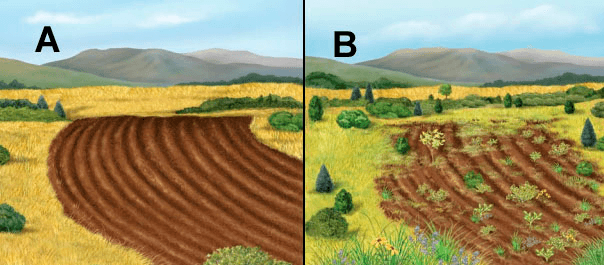
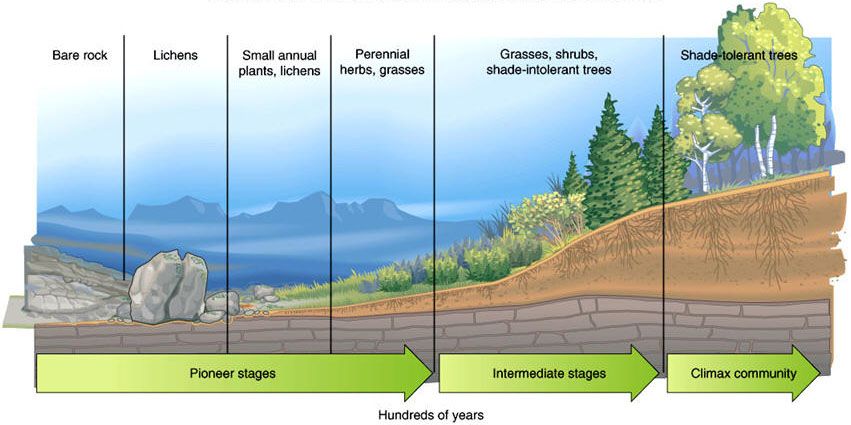
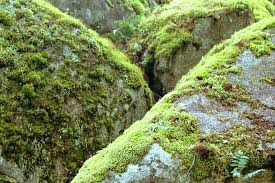

Which of the following best describes primary succession?
Volcano wipes out ecosystem that gradually grows back from ash covered soil
Volcano creates a new island of rock that must break down to form an ecosystem
Forest fire burns down forest that must bounce back over time
Tornado destroys a crop that must slowly grow back over time.
Which process removes carbon dioxide from the atmosphere?
deforestation
tree farms
burning fossil fuels
cellular respiration

What are two (2) ways to reduce the carbon emissions from passenger cars?
Use less expensive gas
Carpooling
Public Transportation
Driving only passenger cars
When humans EXHALE, we release __________________.
Oxygen
Carbon Dioxide
Nitrogen
Water

