
 Worksheets
Chemistry: Sates of matter
Total questions: 19
Worksheet time: 10mins
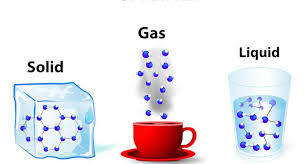

As matter changes state from liquid to solid, the atoms have ____ kinetic energy.
more
less
the same
Which of the following is an assumption of the kinetic-molecular theory of gases?
Collisions between gas particles are inelastic.
Gases consist of closely spaced particles.
Gas particles move around in an orderly manner.
The temperature of a gas depends on the average kinetic energy of the gas particles.
The kinetic theory states
Particles won't move if you don't apply energy to it.
Particles only move in liquids and gases.
Particles are always in motion.
At the same temperature the object that has the most mass heats quicker.

What state of matter exists at A, B, and C?
Solid, Liquid, Gas
Gas, Liquid, Solid
Solid, Gas, Liquid
Liquid, Solid, Gas
Gas condenses to a liquid
Evaporation
Melting
Freezing
Condensation
Transition from a liquid to a gas
Condensation
Freezing
Evaporation
Melting
When you boil water in a pot, some of the water escapes as steam. Which of the following choices explains what is happening with the water molecules in this scenario?
The molecules slow down as the kinetic energy increases and move farther apart from one another.
The molecules slow down as the kinetic energy decreases and move closer together.
The molecules speed up as the kinetic energy increases and the molecules move farther apart from one another.
The molecules speed up as the kinetic energy decreases and the molecules move closer together.

What letter on the diagram represents the substance only in the gas phase?
A
B
C
D
What is the melting point of this substance at 1 ATM of pressure?
40
60
100
110

What happens along the BC line?
Melting/Freezing
Boiling/Condensing
Boiling/melting
freezing/condensing

In which region(s) does temperature increase?
Region C only
Regions B and D
Regions A, C, and E
Regions A and B
In a heating curve, diagonal lines indicate temperature is __________, while flat lines indicate temperature is __________.
Constant, changing
Changing, constant

Which letter indicates where water is in both the solid and liquid phase at the same time?
A
B
C
D
E

