
 Worksheets
DNA, DNA Replication, RNA and Protein Synthesis
Total questions: 54
Worksheet time: 45mins


ATG TGA CAG


What part of the nucleotide is labled "A"
Phosphate
Nitrogenous Base
Protein
Sugar (Deoxyribose or Ribose)
What part of the nucleotide is labled "B"
Phosphate
Nitrogenous Base
Protein
Sugar (Deoxyribose or Ribose)
What part of the nucleotide is labled "C"
Phosphate
Nitrogenous Base
Protein
Sugar (Deoxyribose or Ribose)
Your sequence of nitrogen bases is different than your sibling.
During transcription, this type of ribonucleic acid is responsible for copying the DNA and brining it out of the nucleus.
tRNA
mRNA
rRNA
dRNA
Which of the following is the complementary mRNA sequence to this DNA strand: AACTGAA
UUGACUU
TTGACTT
AACTGAA
AACUGAA


What brings the amino acids to the ribosome to assemble a protein?
DNA
How many nucleotides code for 1 amino acid?
1
2
3
4
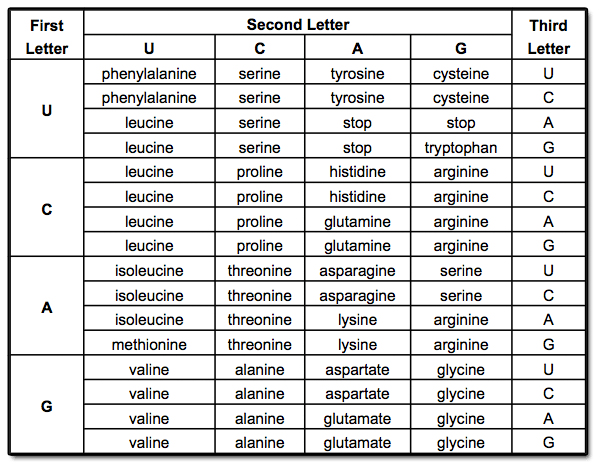
Which of the following units are repeatedly joined together to form a strand of DNA? (This is the MONOMER of DNA.)
amino acids
nucleotides
fatty acids
polysaccharides
TRANSLATE this RNA sequence: AUGCAAUGA
Met-Glu-Stop
Met-His-Stop
Thr-Glu-Stop
Thr-Pro-Stop

A polypeptide is a sequence of ____________________ held together by a ______________ bond.
amino acids; peptide
fatty acids; ionic
proteins; hydrogen
fatty acids; covalent
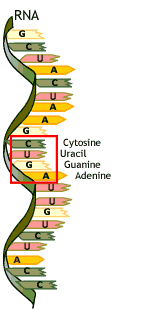

The following codon is translated into which amino acid?
UAA
STOP
Phenylalanine
Valine
Aspartic acid

The following codon is translated into which amino acid?
CAU
Methionine
Isoleucine
Histidine
Arginine

The following codon is translated into which amino acid?
AGG
Methionine
Isoleucine
Histidine
Arginine
DNA is the code for (a) life.
Which bases are only found in DNA?
Thymine
Cytosine
Adenine
Uracil
Guanine
What is the complimentary DNA sequence of the following sequence:
GATCAG
TGACAT
GACATG
CTAGTC
CGACTA

What do the dotted lines between the nitrogenous bases (A,T,C,G) represent in the image provided?
Covalent bonds
Ionic bonds
Peptide bonds
Hydrogen bonds

What is bonded to Adenine in the image to form a section of the DNA molecule?
Guanine and Phosphate group
Cytosine and Deoxyribose sugar
Thymine and Deoxyribose sugar
Deoxyribose sugar and Phosphate group
What determines the specific traits in an organism?
The number of carbons in the DNA molecule.
The number of hydrogen bonds that hold the strands of DNA together.
The sequence of nucleotide bases in the DNA molecule.
The sequence of phosphates along each DNA strand.

What is the first step in the process of DNA replication?
enzymes "unzip" the DNA molecule by breaking the hydrogen bonds
free nucleotides are added to the 2 original strands of DNA
2 identical DNA molecules are produced
1 cell divides into 2 cells
Enzyme that connects the DNA to the backbone (glues)
Ligase
Polymerase
Helicase
Primase
The mutated DNA segment is TTCGCAAG. This is an example of ___ mutation.
GAG-CTC-GAC-AGA
Mutant
GAG CTC-CAC-AGA
A normal strand of DNA is shown. It is followed by the same strand of DNA after mutations have occurred.
Normal strand: G T C C A T C T G A T T A C G G C A
Mutated strand: G T C C A T C G A T T A C G G C A
Which mutations have taken place?
Substitution and inversion mutations
Addition and frameshift mutations
Inversion and deletion mutations
Deletion and frameshift mutations

A codon chart is shown below.
Which of these changes to the DNA triplet 3’GCT 5’ will affect the protein(amino acid) produced?
GTT
TCT
TCC
GCA
The original strand of DNA is shown below. Match each mutated piece of DNA to its correct type of mutation.
Original strand: AAACCCGGGTTT
Mutated Strand: AAACCCGGTTT
Insertion
Deletion
Substitution
The original strand of DNA is shown below. Match each mutated piece of DNA to its correct type of mutation.
Original strand: AAACCCGGGTTT
Mutated Strand: AAACCCGGGGTTT
Insertion
Deletion
Substitution
The original strand of DNA is shown below. Match each mutated piece of DNA to its correct type of mutation.
Original strand: AAACCCGGGTTT
Mutated Strand: AAACTCGGGTTT
Insertion
Deletion
Substitution

