
 Worksheets
Summation
Total questions: 32
Worksheet time: 54mins
Name
Class
Date
1.
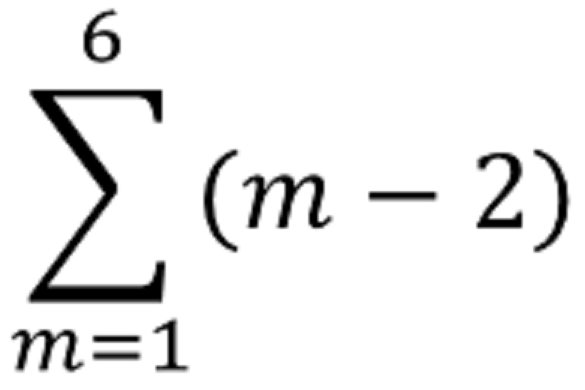
This summation is the same as which series?
a)
1 + 2 + 3 + 4 + 5 + 6
b)
(1 - 2) + (2 - 2) + (3 - 2) + (4 - 2) + (5 - 2) + (6 - 2)
c)
(1 - 2) + (6 - 2)
d)
(1 - 2) + (2 - 2) + (3 - 2) + (4 - 2)
2.

Evaluate.
a)
290
b)
278
c)
250
d)
295
3.

Evaluate.
a)
2445
b)
3360
c)
2500
d)
3500
4.

Evaluate.
a)
539
b)
364
c)
346
d)
361
5.

Evaluate.
a)
20
b)
28
c)
18
d)
21
6.

Evaluate.
a)
112
b)
99
c)
140
d)
-8
7.

Evaluate.
a)
1260
b)
1109
c)
1400
d)
1339
8.

Evaluate.
a)
1260
b)
1200
c)
945
d)
1145
9.

Evaluate.
a)
1445
b)
2009
c)
1745
d)
1709
10.
Evaluate the series below.
k=0∑∞32((8)1)k
a)
83
b)
38
c)
2116
d)
1621
11.
Is this summation finite or infinite?
a)
Finite, because there are only 6 terms to add up.
b)
Infinite, because there are an infinite number of terms to add up.
12.
Evaluate.
a)
290
b)
278
c)
250
d)
295
13.

Calculate the sum.
a)
66
b)
14
c)
704
d)
114
14.

Evaluate.
a)
225
b)
140
c)
784
d)
153
15.
This summation is the same as which series?
a)
1 + 2 + 3 + 4 + 5 + 6
b)
(1 - 2) + (2 - 2) + (3 - 2) + (4 - 2) + (5 - 2) + (6 - 2)
c)
(1 - 2) + (6 - 2)
d)
(1 - 2) + (2 - 2) + (3 - 2) + (4 - 2)
16.
Calculate the final sum/total of the series.
a)
6
b)
21
c)
9
d)
2
17.
Is this summation finite or infinite?
a)
Finite, because there are only 6 terms to add up.
b)
Infinite, because there are an infinite number of terms to add up.
18.
The summation is the same as which series?
a)
(4+10) + (4+20) + (4+30) + (4+40) + (4+50) + (4+60) + (4+70) + (4+80) + (4+90) + (4+100) + (4+110)
b)
1+2+3+4+5+6+7+8+9+10+11
c)
4 + 110
d)
4 + 10
19.
Is this sum finite or infinite?
a)
Finite, because there are only 11 terms to add up.
b)
Infinite, because there are an infinite number of terms to add up.
20.
Calculate the sum.
a)
66
b)
14
c)
704
d)
114
21.

Is this sum finite or infinite?
a)
Finite, because there are 4 terms to add up.
b)
Infinite, because there are an infinite amount of terms to add up (m goes from 1 to infinity).
22.
This summation is the same as which series?
a)
(1/4) + (1/5) + (1/6) + (1/7) + ...
b)
4+5+6+7+8+...
c)
(1/4) + (2/4) + (3/4) + (4/4) + (5/4) + (6/4) + ...
23.
The total sum, once you add all the terms, is equal to...?
a)
1/4
b)
4
c)
infinity
d)
0
24.
Is this sum divergent or convergent?
a)
Divergent, because the sum adds up to infinity.
b)
Convergent, because the sum adds up to about 1/4
25.

Is this sum finite or infinite?
a)
Finite, because there are only a few terms to add up.
b)
Infinite, because there are an infinite amount of terms to add up. ("m goes from 1 to infinity")
26.
This summation is the same as which series?
a)
(1/3) + (1/3) + (1/3) + (1/3) + (1/3) + (1/3) +...
b)
(1/3) + (1/4) + (1/5) + (1/6) + (1/7) + (1/8) + (1/9) +...
c)
(1/3) + (1/9) + (1/27) + (1/81) + (1/243) + (1/729) + (1/2187) +...
d)
3+4+5+6+7+8+...
27.
Estimate the total sum.
a)
0.3333
b)
0.5
c)
infinity
28.
Is this sum divergent or convergent?
a)
Convergent, because the sum adds up to a single value (0.5)
b)
Divergent, because the sum adds up to infinity.
29.
Evaluate the series below.
k=0∑∞32((8)1)k
a)
83
b)
38
c)
2116
d)
1621
30.
What is the sum of the series below?
k=1∑∞6(−2)(k−1)
a)
2
b)
-12
c)
105,400
d)
No sum exists
31.

Evaluate the series.
a)
36
b)
85
c)
35
d)
86
32.
What is the proper expansion for the following series?
k=0∑33(−2)k
a)
3 + (-6) + 18
b)
3 + (-6) +12
c)
3 + (-6) + 12 + (-24)
d)
-6 + 12 + (-24) + 48
100 %

